
.png)





Welcome to your definitive Voice of the Customer Guide.
Here you can find everything you need to know about the voice of the customer, its importance and how your business can grow by using voice of the customer tools.
[ca-form id="194451" align="left" var1="http://www.customer-alliance.com/wp-content/uploads/2020/09/customer-alliance-voc-guide-download.pdf"]
Voice of the customer is an integral part of customer experience management, which now outranks price and quality as the key differentiator among brands (1).
How can your company know how best to improve its products and services without listening to what your customers are saying about their interactions with your brand?
Here’s the basic idea behind the voice of the customer methodology—to gather indirect and direct feedback which enables you to understand what your customers’ needs and expectations are in detail and then innovate to match and exceed them.
(And yes, you’ll need some voice of the customer tools to help you out.)
Consider your customers.
Do you know what their priorities are, what their likes and dislikes are and whether or not your product and services match their preferences?

In this digital age, customers can easily compare you to your competitors because they’ll want to know why they should invest their time and money in your business.
By utilising a successful voice of the customer strategy, you’ll learn exactly what your customers needs and wants are and how to communicate to them in the manner that best engages them.
These statistics about companies using a VoC program have us convinced:
Not bad right?
The 3 components that a VoC program should support you in are:
[ca-form id="44600" align="right"]
Next, consider the following areas you need the voice of the customer to guide you in:
Assess how intuitive your product is and see if customers desire any other features that your competitors may have.
As a result, you'll be able to not only further evolve your product, but also to test out new products or feature ideas in order to launch them with confidence.
You’ll find using voice of the customer tools to grab your customers own words to implement them in your marketing copy is a stroke of brilliance!
From email copy to product explanation to call-to-action buttons, attract customers by speaking their everyday language. Additionally, including customer quotes here and there on your website copy builds trust.
Proudly display your voice of the customer!
How is your brand perceived?
Monitor what customers are saying about you and compare it to that of your competitors as well as dive into analytics covering customer behaviours and trends to know what they’ll want next from you.
Identify gaps in your customer journey.
See how customers feel about their interaction with your brand by listening to the voice of the customer. This covers customer service, onboarding, engagement and more.
Customers will come back to you depending on how you treat them. Therefore, utilise VoC tools to make them happier than ever and reduce your churn rate.
Check out our article on How to Improve the Customer Experience.
To implement an effective voice of the customer program, your organisation has to be able to easily collaborate across departments, locations and management levels.
By having one, centralised VoC program by which everyone can access the insights, alerts and reports needed based on their role, your company can unite and progress forward towards clear, shared customer experience goals.
In listening to the voice of the customer, you are letting your own customers clue you in how to evolve as a company. It’s no longer a radical suggestion, it’s imperative to your business’ growth.

In previous years, the above questions were often utilised as is. Pretty general.
But we recommend taking these four questions and applying them to different areas of your business.
For example, let’s say you own a hotel. You can dive into different areas of the customer journey by utilizing a questionnaire to truly gather the voice of the customer.
Pre-arrival:
Get pre-check-in information by emailing or texting guests a questionnaire asking preferences, allergies or any other information to personalise their stay.
During Stay:
Upsell services. Why? You can increase your revenue. Resolve any issues right on the spot, and as a result, deter negative reviews and increase guest satisfaction.
Post-stay
Lastly, show guests you care how they experienced your hotel (plus get some helpful voice of the customer data wink, wink). You can analyse each aspect of their stay from service to cleanliness to the breakfast you provide.
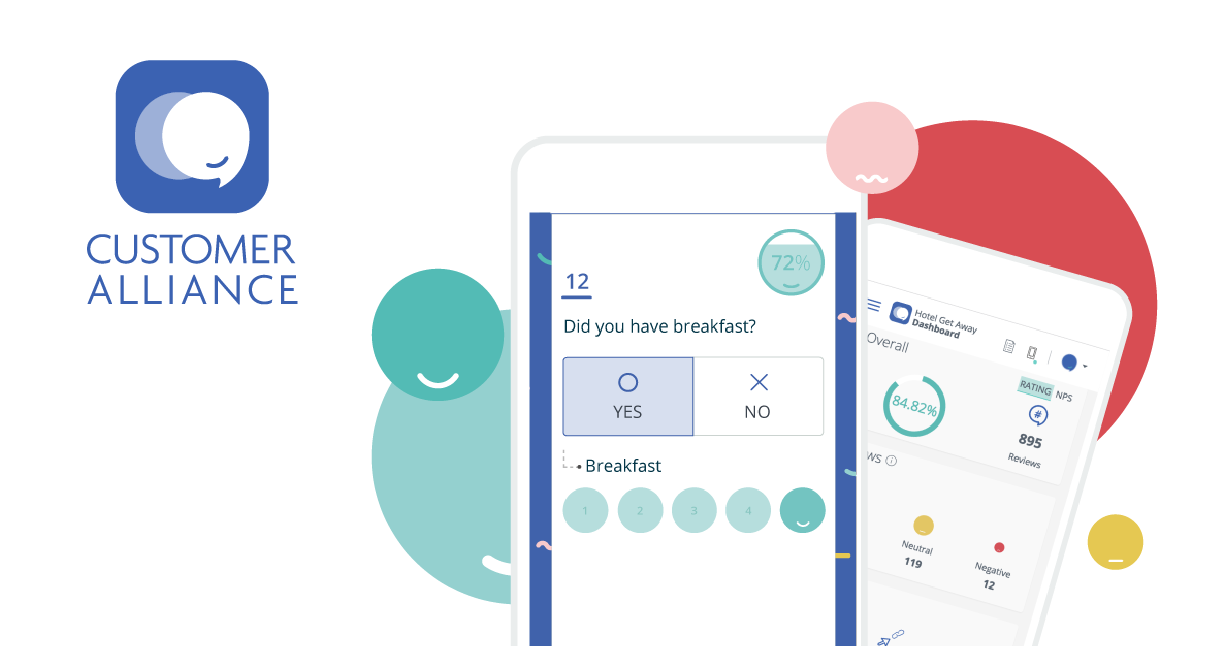
Happier customers can mean more positive reviews, and subsequently, higher online rankings and an improved online reputation for even more bookings.
The seemingly small things matter. Therefore, learn what they are and how to improve them by taking the 4 main VoC questions and specifying them to each aspect of the customer journey.
There are many customer experience softwares out there that offer questionnaires which automate the sending out of voice of the customer survey questions.
For instance, use cases for automating surveys can include after a customer purchases a product or visits a restaurant, before they arrive at a hotel, after a customer support call, etc.
Consequently, there’s no shortage of use cases to gather the voice of the customer. Simply focus on which information gaps you’d like your customers to fill you in on with the proper VoC tools.
We’ve provided you with an example of all the different insights you could obtain from a questionnaire:
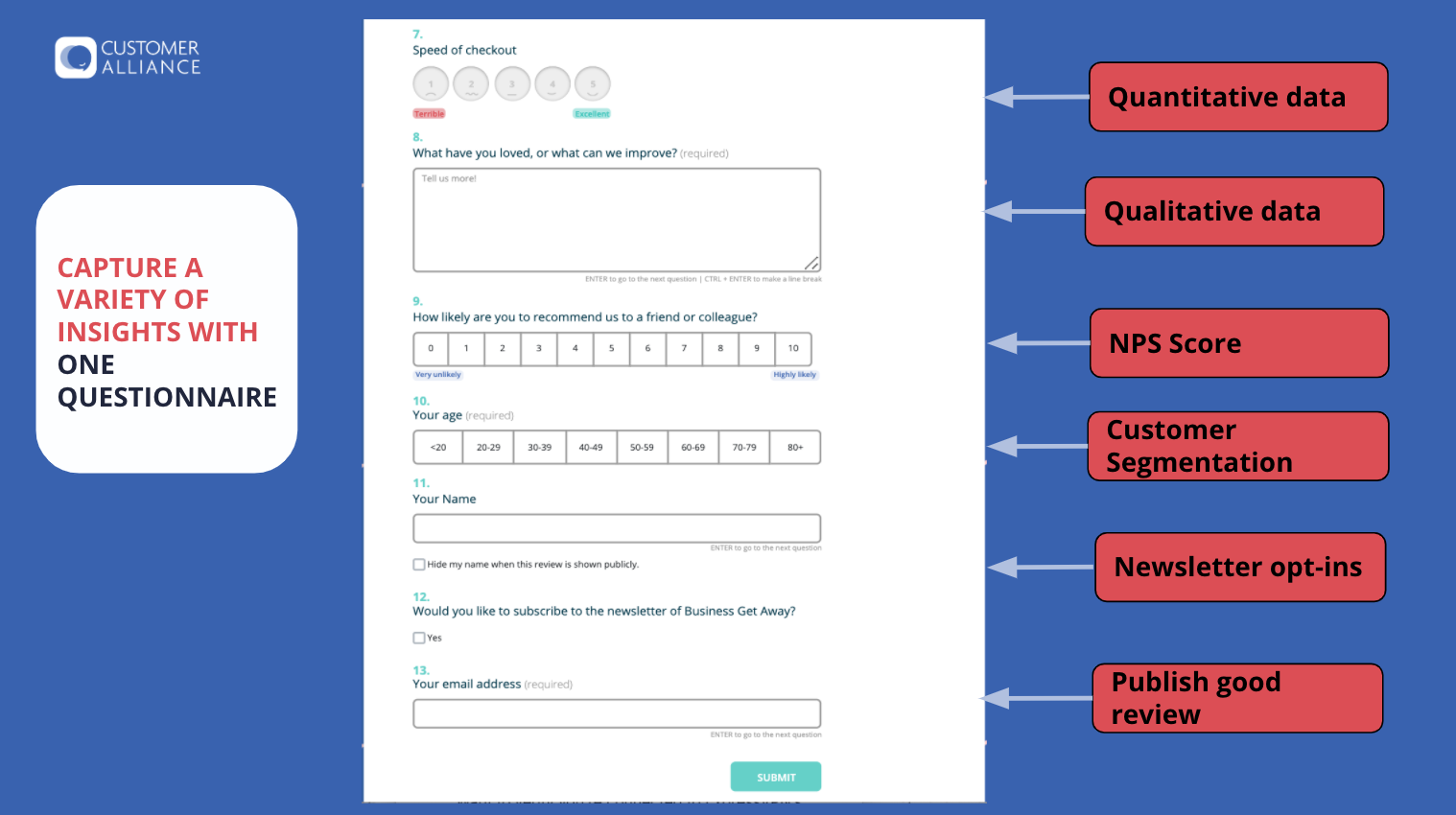
To clarify, a questionnaire form can provide a variety insights from a Net Promoter Score to customer segmentation. But first, you need to have a strategy in place to determine which insights you should focus on.
In this article, we discuss how to strengthen loyalty by optimising customer experience.
Think: what information do we need to enhance our products and services?
Gather voice of the customer data according to your specific needs.

Once you obtain customer feedback using voice of the customer tools, you’ll want to dive in to get the insights you need.
When thinking about the voice of the customer, focus on what you want to learn in your VoC program.
Trends
Look at topics discussed in reviews and feedback to discover trends and themes related to your customers’ interactions with your brand.
Customer Sentiment
Examine customer sentiment, in other words, the meaning behind their words. How are they talking–positively or negatively–about certain themes related to your business?
Customer Segmentation
Put your customers into groups based on their behaviour, preferences, demographics, and much more to better target a niche set of customers, maintaining your competitiveness in your market.
Competitor Analysis
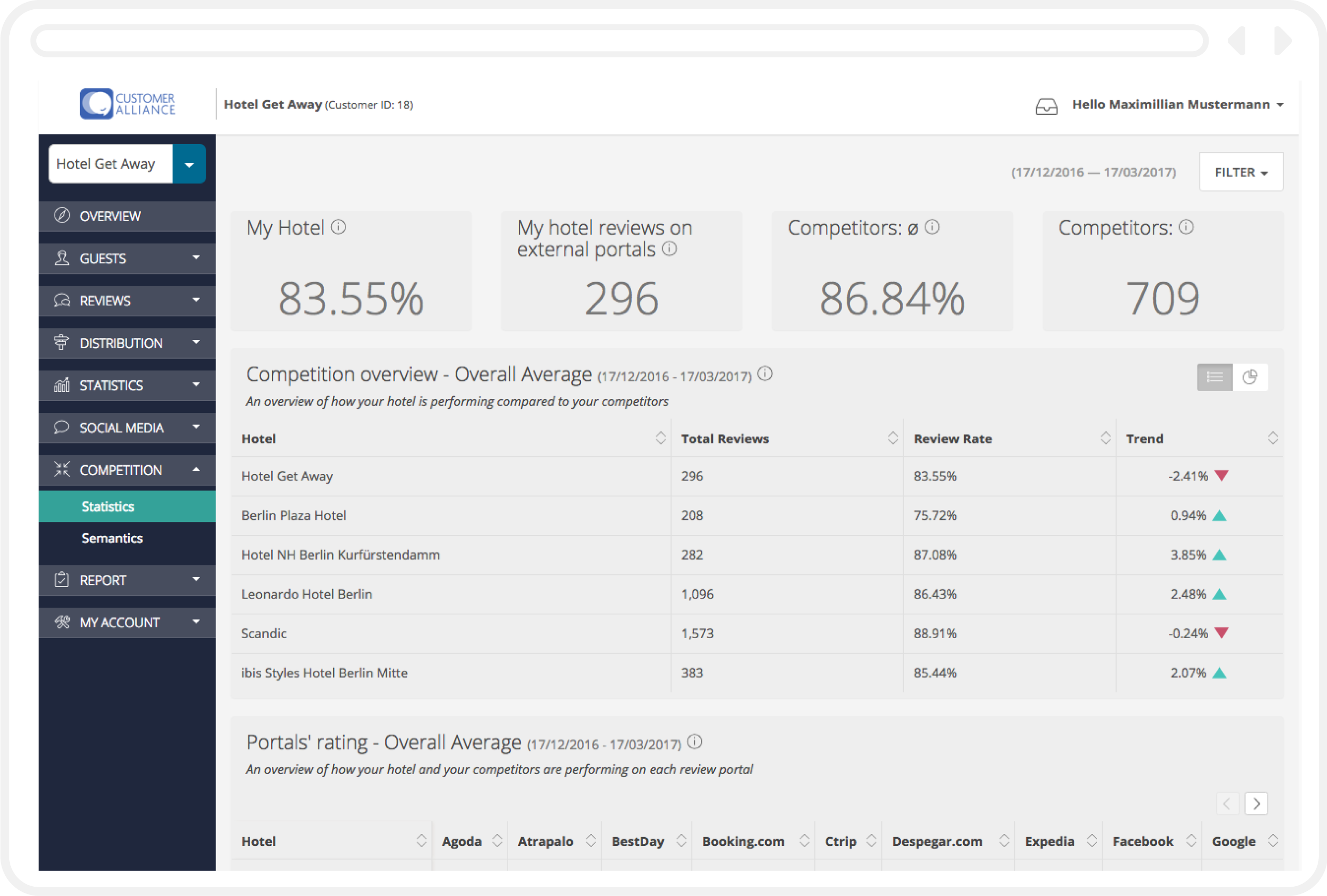
How do you compare to your competitors in the area of voice of the customer? Don’t be siloed in your goals. Ensure you’re setting appropriate benchmarks by also looking at how your competitors are ranking.
A voice of the customer tool can be a methodology, a program or an application that allows your company to gather customer perspective and feedback.
These VoC tools can collect voice of the customer data directly or indirectly to help inform your buyer personas.
The Net Promoter Score (NPS) is a metric used to measure customer satisfaction with questions ranked on a scale from 1 to 10.
NPS or Customer satisfaction survey software is likely the most familiar of the VoC tools utilised by companies today because it provides an easy scale by which to measure customer loyalty.
NPS surveys are great! However, you’ll likely want to ask your customers questions that go beyond a numerical answer by also acquiring qualitative data from your voice of the customer.
We highly recommend utilising a VoC program that offers flexible questionnaires that adapt to your company’s needs. The VoC program should allow for tailoring depending on the target audience.
Select different points of your customer journey for customer interviews. After that, ask the four voice of the customer questions mentioned earlier.
By taking the time to ask individual customers about their experiences, you’ll get unfiltered feedback. This could be useful for product/service evolution, future marketing copy, and top management decisions.
Dig into the context of what customers are saying about your business. Online reviews can provide a wealth of insights as it is one of the truest forms of voice of the customer.
How your customers express themselves regarding their experience with your business is absolutely customer data you’ll want to mine.
Moreover, if you’re taking the time to listen, interact with and learn from customer feedback, let the world know that you value the voice of your customer.
Ensure the positive feedback is on the major review portals that are relevant to your business. In the same vein, Customer Alliance's VoC program offers a distribution feature allowing you to automate review distribution among selected platforms.
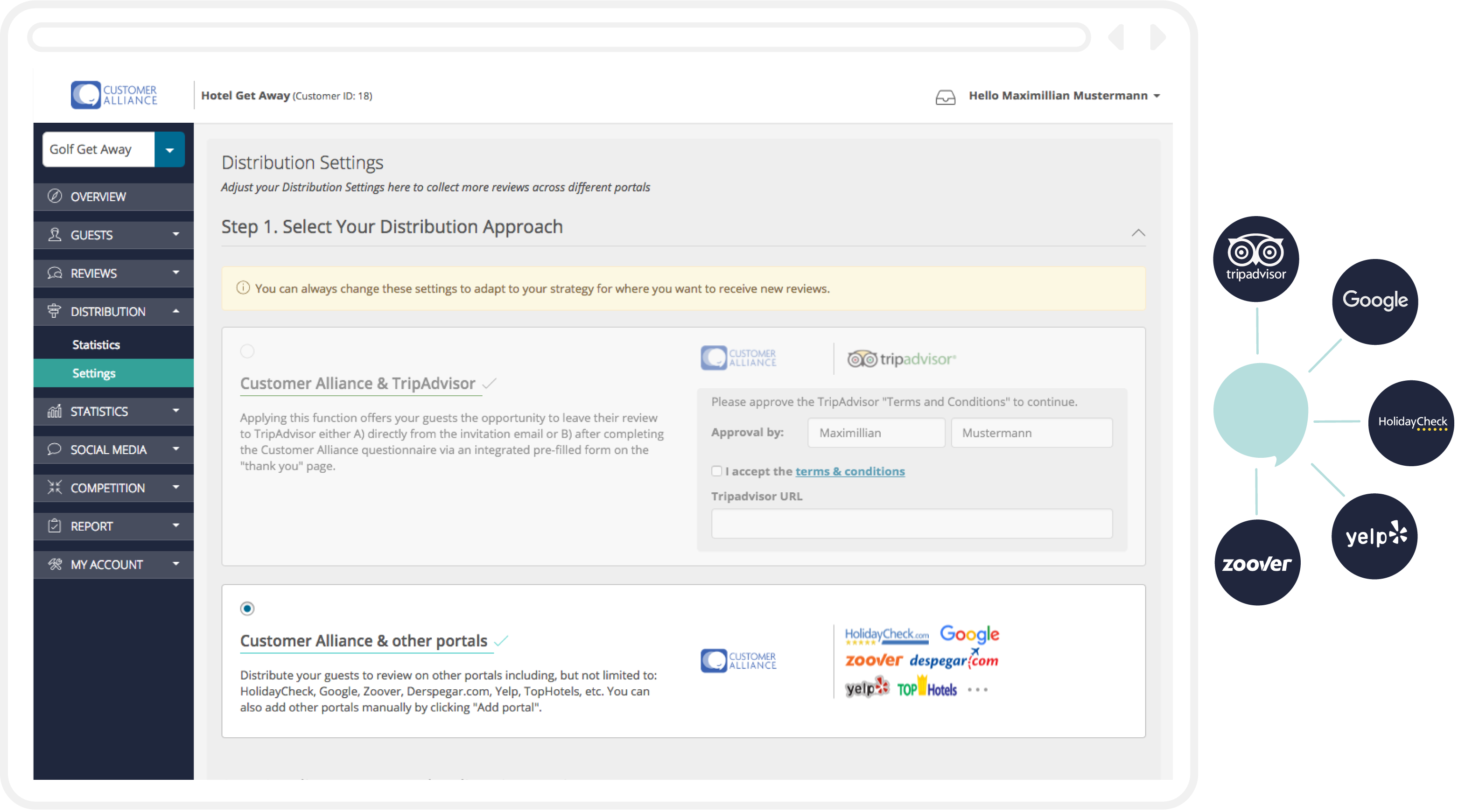
Consequently, this could mean great things for your company as having 9 fresh reviews earn businesses 52% more than average (4).
Similarly, harnessing social media to understand the voice of the customer can be a powerful VoC tool to add to your arsenal.
87% of customers say that they use social media to help them decide what to buy. Additionally, half of them say that seeing user-generated content would increase the chance that they purchase from a brand through social media (5,6).
Consumers will make purchasing decisions based on how a brand interacts with its customers on social media and based on how much authentic input they see from your company’s customers.
The voice of the customer matters!
The Mandela Hotel in Berlin boasts not only luxurious accommodation. It has a Michelin-starred restaurant, a bar and a spa.
The hotel opted to collect feedback using Customer Alliance’s voice of the customer tools. They obtained feedback while guests were onsite at each of its unique offerings rather than wait until the guests had left to get it.
After that, the company enjoyed improved guest satisfaction by individualising a customer journey for each of its offerings as all industries—from ecommerce, automotive to telecom—should do.
For a breakdown of this successful strategy for voice of the customer, see this case study. How the Mandala Hotel leverages the instant survey to improve guest experiences.
Acquario di Genova is one of the most well-known aquariums in the world. However, it found itself ranking 7th on TripAdvisor’s “Things to do in Genova” list.
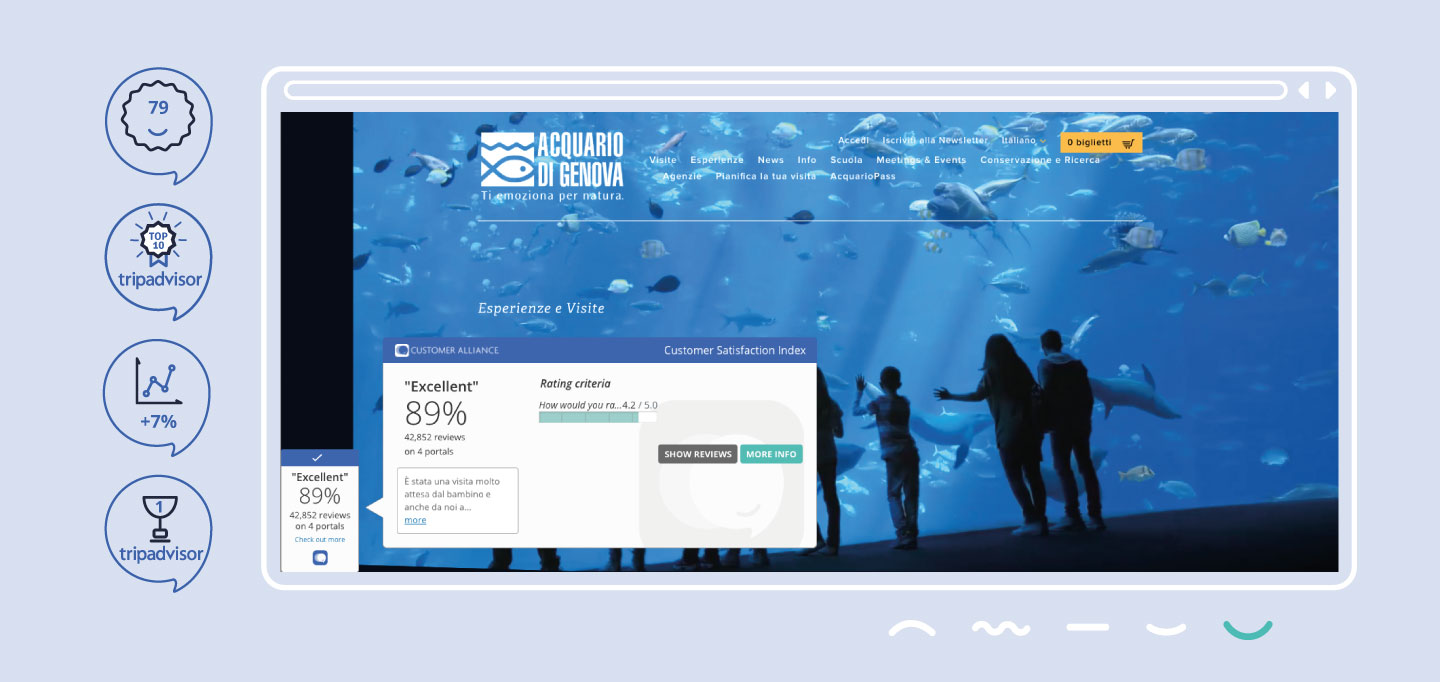
The aquarium decided to utilise a VoC tool that allowed it to proactively collect online reviews.
In just two months with Customer Alliance, Acquario di Genova collected 3,000 certified customer reviews. Subsequently, they ranked 1st on the Genova TripAdvisor list. Talk about making your voice of the customer work for you!
Moreover, after one year and learning provided by 22,000 reviews, the aquarium improved its customer satisfaction index by 7% and had an NPS score of 79.
Curious to know how? Read the following voice of the customer case study. How Acquario di Genova became one of the World‘s Top 10 Aquariums on TripAdvisor.
In conclusion, 9 out of 10 businesses competing mainly on customer experience (7). You don’t want to be the one that isn’t focusing your resources on this area.
No matter your size, there are many flexible voice of the customer programs out there. Get the VoC tools that match your needs. It’s okay to start small. What’s important is that you start focussing on the voice of the customer as soon as possible.

Customers expect an excellent experience both in-store and online. Even if your enterprise doesn’t have a physical store, the consumer experience is still a defining factor. The voice of the consumer is what your shoppers say about their experience with your brand. Use consumer feedback to put your shop in front of the competition.
Read on to see how you can harness the power of feedback to elevate your ecommerce shop.
Voice of the customer, also called voice of the consumer, is now the leading way to understand your customer. Be proactive about asking for feedback. Let consumers tell you what they want and need to remove the guesswork from discovering their desires. To review, see The Voice of the Customer Guide: Importance, VoC tools and examples.
89% of consumers worldwide make the effort to read reviews before buying a product (1).
This stat alone reveals how influential the voice of the consumer is to other potential consumers. What others have to say about your products often provides more value and trust to your brand than what you have to say about your own shop.
Investigate what is being said about your company. If it’s good, use it to promote. If not, use the feedback to improve. Let’s dive into how you can collect this feedback.
The opportunities for feedback collection are plentiful. Consider these ways to capture your voice of the consumer data.
Send out a questionnaire to ask for feedback regarding different stages of the customer journey.
You can also send out questionnaires to loyal customers to test out new concepts. For more examples, see 5 ways to use the new questionnaire that you haven’t thought of yet!.
Just because your shop operates online does not discount the importance of interviews. Interviews offer a great way to obtain the raw, unfiltered voice of the consumer data and it will build trust with those whom you interview.
Conduct the interview over the phone or even by email at the convenience of your client. Make sure to ask them if you can record the interview and even use them on your website for customer quotes.
Our suggestion: Don’t wait and simply hope customers leave reviews. Why?
Your customers are much more willing to give reviews than you think:
76% of consumers will leave a review if asked (2).
So don’t be shy. Why not automate a review invitation after every purchase? There are many providers offering this solution.
These online reviews will provide valuable insight on what you consumers think about your brand, their customer journey and your products/services. See this article: 5 reasons to use a tool to manage reviews for your online store.
If you have the capabilities, use live chat to talk to customers when they’re on your site. They’ll love the convenience of a quick answer and will find their purchasing made easier as they could quickly get an answer to their question.
Additionally, to reduce cart abandonment, consider putting a live chat on your checkout page or pricing page.
We believe the above tools are the best to help ecommerce sites gather the voice of the consumer feedback. Check out Voice of the Customer Tools to Improve Customer Experience for a few more techniques to look into.
Show you care by taking reviews seriously. Many customers find that brands don’t respond to their reviews at all and guess what? When you don’t respond to reviews, you risk increasing your customer churn by 15%. (3)
Respond well to negative feedback. And yes, consumers look for how a company responds to negative feedback. If you end up collecting a lot of reviews (as you should!), you’re bound to have a few negative ones. But you know what? That works to build trust. 30% of consumers will not believe your reviews to be real if you don’t have any negative ones (4).
Additionally, by responding quickly and appropriately, you might be able to convince a consumer to edit their rating or review of your shop and end up with another positive review.
Negative customer feedback is also always an opportunity to learn from the voice of the consumer. Perhaps they’ll enjoy your product overall, but mention a small pain point in a review or questionnaire. Fix it to increase sales and customer satisfaction.
Oh, and another thing we’ve heard to be helpful: Optimise product descriptions based on feedback. Then your consumers’ expectations are more likely to match your product or service. And then they’ll be happy, and likely loyal!
Improve your shop based on customers’ likes and dislikes. This goes beyond your company’s offerings, but also includes the customer experience:
Evolve whether it’s positive, neutral, or negative. Analyse the results and make actionable decisions.
As the ecommerce industry is online, it relies heavily on consumer reviews and ecommerce shops need quite a bit of reviews per product to drive revenue. Look:
Reviews of 50 or more per product can mean a 4.6% increase in conversion rates (4).
Increase your ecommerce shop’s conversion rate by using voice of the consumer data directly on your website. Many companies encourage purchasing by displaying consumer reviews.
For example, here at Customer Alliance, we offer a widget that clients can integrate on their website to display the customer feedback they receive.

Lastly, it’s important to distribute consumer feedback among various review portals to build your online presence. Make sure you have reviews on all relevant review platforms. By doing so, you’ll attract new consumers to your website.
In conclusion, investing in a voice of the consumer solution is an excellent step to building your ecommerce site’s online visibility and promoting customer trust.
Sources:
Related Content:
The Voice of the Customer survey for competitive customer insights
Hotel VoC: The key to guest satisfaction is voice of the customer
VoC Restaurant 101: Develop a Voice of the Customer Strategy

We’re so excited to announce the launch of in-app and in-web surveys! Also known as microsurveys, they offer a short, targeted and timely way to collect customer feedback right inside your website or app.
With lots of use cases and instant, actionable data, we can’t wait to see how microsurveys will get you even better results. But first, let’s dive in and learn more about this powerful feedback tool. Here we go!
Traditional surveys are multi-question or multi-page and are often sent to the customer via email. These types of surveys still hold tremendous value, providing deep insights that are key to any Voice of the Customer program.
But there are some instances where bigger isn’t necessarily better. Microsurveys are the perfect complement to traditional surveys, targeting the here and now of specific customer scenarios.
Microsurveys ask just one core question (with an optional conditional question), making them quick and easy to complete. By reducing the number of steps the customer needs to take, microsurveys reduce friction.
As they appear right on the screen, they also eliminate the need to leave the website or app to give feedback. This results in a higher response rate and even more valuable data for your business.
Microsurveys allow you to ask the right questions at the right time with customisable triggers. Your microsurvey could appear on a certain page, like a booking confirmation. Or it could pop up when a customer clicks a specific button, for example after hitting ‘Send’ on a message. This helps capture feedback when the topic is still fresh in the customer’s mind (which will again make them more likely to respond!)
In-web and in-app surveys can be used for many different question types depending on your business goals. This includes:
Let’s take a look at a few ways microsurveys can be used in practice.
In a bid to increase revenue, a hotel is looking to optimise its booking process. To do this, they collect opinions using one simple question that appears when a user has completed a booking.
This Customer Effort Score (CES) question offers a simple way to learn how easy the user found the booking process. Depending on the score given, the in-web survey could also include a follow-up, free text question, like:
A car dealership wants to know why some customers cancel their maintenance plan so they can improve their offer. To do this, they ask a single, multiple-choice question to users of their app when they have completed a cancellation.
The car dealership can then analyse the responses for trends to steer the direction of their service. For example, if most respondents answered ‘It was too expensive’, the dealership may consider lowering the monthly cost or introducing an additional service into the plan.
A company wants to identify their most loyal customers and convert them into brand ambassadors. A single Net Promoter Score (NPS) question gives them the ideal solution.
Again, the company could ask a follow-up question that changes depending on the score given. Run continuously, this microsurvey will also allow them to track changes in overall customer loyalty.
Simply schedule a call with your Customer Success Manager who will answer your questions and help you get set up! Alternatively, if you are not yet working with Customer Alliance but would like to find out more, you can schedule a free, no-obligation demo with us by clicking the button below.

“We know that people want to hear other people’s experiences to help them make decisions.”
That’s what Google say about the development of Search Generative Experience (SGE). Soon, being found online won’t just be about optimised websites and targeting keywords. It will be about your entire digital footprint, including how other people talk about your brand.
In this article, we’ll explore how this evolution is set to shift the way businesses approach online visibility and give you a clear strategy going forward.
Understanding and adapting to these changes is crucial for anyone looking to stay ahead in the digital marketplace. So let’s demystify SGE–your roadmap to mastering the future of online search starts here.
To understand why external content will be so powerful for online visibility, first, we need to get familiar with the goal of SGE.
According to Google:
“With the new generative AI functions, search becomes even more efficient. Thanks to these advances, you can understand a topic more quickly, gain new perspectives and insights, and complete your tasks more easily.”
What does this mean in practice? Imagine a traveller, let’s call her Sarah, planning a trip to Paris. She’s not just looking for any accommodation; she wants to stay in a quintessentially Parisian boutique hotel. It has to be pet-friendly because her dog Roscoe goes wherever she goes. Sarah also cares about sustainable practices and wants to make the most of Paris’s café scene.
Traditionally, Sarah might search “pet-friendly boutique hotels near Eiffel Tower”. She would likely click on a few different pages, weigh up the amenities, read vague descriptions, and cross-reference locations. Then once she’d narrowed down her best options, she might check for sustainability credentials and search the areas for local cafés.
SGE aims to condense Sarah’s quest into a single, intuitive search query: “Eco-friendly pet-friendly hotel in Paris near cafes”.
The websites that Google’s AI thinks are the most relevant for that query will show up at the top of the page, above organic rankings (and sometimes even above paid ads).
So how can you feed Google the information it needs to ensure your business shows up where it matters most?
As we pointed out at the start of this article, Google is interested in hearing what other people think of your brand, not just how you present yourselves.
That’s not to say that you needn’t bother optimizing your website for search—far from it—but it means that external content is just as important. This includes:
Together, these create a complete picture of your brand authority that tells Google how to include you in the search results. Their goal is to provide the most relevant content for their users, so the more information they have about you, the more accurately their algorithms can figure out where to place you.
Of the types of external content we mentioned above, we think reviews will become one of the most important factors for ranking when SGE rolls around. Why? Not only do reviews provide insights from people who’ve actually used your products or services, they also tell Google more about what you do well and how certain demographics might experience your business.
To prepare for SGE, we recommend three things:
Most businesses take a hands-off approach to reviews. They expect some, though not all, happy customers to share their feedback and leave their review volume up to chance.
If you want to reap the benefits of reviews for SGE, you need to take a more proactive approach. There are many ways you can encourage customers to leave reviews. The key is to make it as quick, convenient and easy as possible.
Here are a few ideas to get you started:
Pro tip 💡 use review management software to automate review collection. Platforms like Customer Alliance offer the most efficient way to consistently increase your reviews. Our software sends automatic invitations that allow your customers to leave public reviews in a matter of seconds, with no manual work on your end.
Many reviews are surface-level, and don’t go into detail about their experience. This is fine if you just want to build up your review score on portals like Google or Yelp. However, to give search algorithms more information about your business your reviews need to include relevant keywords.
Simple prompts can help you get richer reviews that offer more information for potential customers and Google alike. For example, rather than simply asking guests you leave a review, you could ask them if there was anything they particularly enjoyed about their experience or the nature of their visit.
You can also think about this strategically. Say you’re a general manager of a hotel, and one of your unique selling points is your proximity to a popular tourist attraction. In this case, you might encourage guests to mention how they found the location convenient for their sightseeing plans.
Questions like, “Did our proximity to [Tourist Attraction] enhance your stay?” or “How did you find the convenience of getting to [Tourist Attraction] from our hotel?” can guide guests to provide reviews that highlight this key aspect of your hotel.
Remember, it’s important to make these prompts as natural and unobtrusive as possible. The aim is to encourage guests to share their genuine experiences in a way that also feeds directly into SGE’s demand for specificity and personalisation
The quality of your responses can be just as influential as the reviews themselves in shaping public perception and improving your SGE rankings. Responding to all types of reviews, not just the positive ones, shows a well-rounded and authentic approach to customer service. It provides additional content for SGE algorithms to scan, improving your search relevance and demonstrating active engagement with your customer base.
A good review response should be personalised, addressing the customer by name if possible, and reflect genuine appreciation for their feedback. Whether the review is positive or negative, acknowledge the customer’s experience.
For positive reviews, express gratitude and reiterate any specific points they praised, subtly incorporating relevant keywords. For example, if a review mentions the high-quality breakfast at your hotel, you could suggest the guest might enjoy the restaurant’s signature three-course tasting menu during their next stay.
In the case of negative reviews, respond with empathy and a commitment to improve. Apologise for any issues they faced, and if appropriate, offer a way to rectify the situation. This not only demonstrates good customer service but also reassures potential customers reading the reviews.
Pro tip 💡 use AI to keep up with your review responses.
As you collect more reviews, you may find that it’s hard to respond to each one manually. Customer Alliance’s AI Reply Assistant will drastically reduce the time spent replying while generating consistently high-quality, personalised responses.
With SGE on the horizon, your customer reviews are set to become more crucial than ever. They’re not just snapshots of customer sentiment. They’re the blueprint for how you show up online.
The key isn’t just getting more reviews–it’s getting richer, more detailed feedback. Engage with these reviews genuinely–thank your customers, address concerns, and show you’re listening. It’s not just good customer service; it’s smart SEO strategy.
Embrace this shift. Use your reviews to paint a vivid picture of your business for Google’s AI. Do this, and you’re not just adapting to the future of search–you’re owning it.

It’s a Monday morning, and you settle into your chair, cup of coffee in hand, ready to check your latest reviews. A stream of positive feedback flows by, validating your team’s hard work. But then, you spot it—a harsh, critical review that makes your heart sink. As you read closer, though, something’s off. This isn’t a dissatisfied customer; it’s a fake review.
But before the panic sets in, know this: you’re not powerless. By the end of this article, you’ll know how to combat fake reviews and minimise their impact on your business.
Before you tackle the suspicious review, let’s review Google’s guidelines. They’ve provided clear rules about which reviews can be removed.
After acquainting yourself with Google’s guidelines, revisit the review in question. Does it violate any of the above policies?
If you’re unsure, it’s still worth flagging the review. Google’s support team will then assess its validity. It’s always better to bring a potential issue to their attention than to let a possible fake review tarnish your business’s reputation.
Fortunately, requesting that Google remove a review is fairly straightforward. Here are step-by-step instructions to guide you through the process.
Finding the review on your profile:

Once you’ve identified the fake review:

Describing the review:
After clicking the flag:

It’s disheartening when a clearly fake review remains on your profile even after you’ve reported it. However, Google provides another way to assert your case – a one-time appeal. Here’s how to navigate this process:
Understanding the criteria for re-evaluation: Before proceeding, it’s essential to know that Google will only re-evaluate reviews based on their guidelines and policies. This means that the content of the review should clearly violate these guidelines for a successful appeal.
Steps to launch your appeal:
How to make your appeal stand out
After submitting an appeal for a review on Google, the response time can vary. Typically, you can expect to hear back from Google within 3 to 5 business days, although this can be longer during peak times or for complex cases. It’s essential to remain patient and periodically check your email, including the spam folder, for any notifications from the Google My Business team.
While it’s frustrating when Google won’t take down a fake review, it’s not the end of the world. In fact, how you respond can make a significant difference in how potential customers perceive your business.
Responding to a review—especially a fake one—requires tact and professionalism. Your response can influence potential clients and show that your business values feedback and integrity.
Tips for crafting a professional response
Remember, your response isn’t just for the person who left the review—it’s for all the potential customers reading it. By showcasing your professionalism and dedication to customer satisfaction, even a fake review can become an opportunity to highlight your business’s integrity.
Pro tip 💡 Customer Alliance’s AI Reply Assistant wites high-quality, personalised responses with just one click, making it easy to respond to even the trickiest reviews.
A single negative or fake review can disproportionately sway potential customers. However, one of the most effective ways to counteract this is by amplifying the voices of your genuine, satisfied customers.
Launching a review campaign can help spotlight these authentic, positive experiences. Here’s how you can get started:
Get new reviews on autopilot
Review management software like Customer Alliance enables you to send review invitations to your customers automatically. Since they constantly run in the background, they make sure you always have a steady stream of reviews coming in. This helps you maintain a strong online reputation while counteracting any isolated negative or fake feedback.
Fake Google reviews can be a challenge, but they’re manageable with the right approach. While it might be tempting to react emotionally to unjust feedback, it’s essential to remain calm and strategic. By staying informed and understanding the tools at your disposal, you can tackle these challenges head-on.
Remember, how you handle adversity often speaks louder than the adversity itself. Engage with reviews professionally, be transparent in your communications, and always prioritize the concerns of genuine customers.
Instead of getting frustrated with fake feedback, use it as an opportunity to showcase your business’s strengths. Your proactive approach to managing reviews, both real and fake, can set you apart from the rest.
A: If you believe a review is fake, the first step is to familiarize yourself with Google’s content and review policies. This helps you determine if the review in question violates any of their guidelines. If it does, you can proceed to report or flag it through your Google Business Profile.
Ensure you document the review (like taking a screenshot) before any actions, as you might need it later for reference or appeals.
A: If you’ve flagged a review and Google didn’t take action, it doesn’t mean the end of the road. You can submit a one-time appeal for a re-evaluation. Navigate to the Google My Business Help Center, choose “Contact Us”, and follow the prompts related to reviews.
When appealing, provide a clear, concise explanation about why you believe the review is fake, and if possible, share any evidence (like correspondence or transaction records) that supports your claim.
A: Absolutely! If a fake review can’t be removed, it’s important to respond to it professionally. A well-crafted response can reassure potential customers of your dedication to service.
Mention any discrepancies in the review without being confrontational and offer a way for the reviewer to contact you directly. Additionally, consider running a review campaign to encourage genuine, positive reviews from your satisfied customers, which can overshadow the negative impact of a fake one.
Picture settling into your office chair on a Monday morning, your cup of coffee steaming beside your computer. You start your week by scrolling through the latest customer reviews. There’s a mix of glowing praise and a couple of critiques. With your day’s tasks already piling up, you wonder — is it worth taking the time to respond?
It’s a scenario that any business professional can relate to. That nagging question of whether or not to engage with online reviews might seem trivial. But what if it impacts more than just your relationship with customers? What if it’s tied to the heartbeat of your online visibility—your search engine ranking?
Let’s delve into whether responding to reviews really does help SEO, and how this seemingly small task could have big implications for your business.
To understand the impact of responding to reviews on SEO, who better to turn to than Google itself? While the tech giant doesn’t hand out step-by-step instructions on how to rise in the rankings, they do sprinkle clues throughout their support documentation and resources.

The screenshot below is taken directly from Grow with Google, created by the search engine with the goal of helping people improve their digital skills. They advise:

“According to consumers, businesses that respond to reviews are seen as 1.7X more trustworthy than businesses who don’t (76% vs. 46%). Not only does responding to reviews support trust-building, it also gives you an opportunity to humanize your business, show customers you care, and demonstrates professionalism.”
What’s clear from this statement is Google’s emphasis on valuing customer interaction. While they might not say it directly, the underlying message resonates with their broader philosophy: creating meaningful connections with users and providing relevant content.
It’s worth pausing to consider what this means in the grander scheme of SEO. Google’s algorithms are notoriously complex, but user experience is at the heart of their design.
By valuing your customers and their feedback by engaging with reviews, you align with the principles that guide Google’s algorithm. The more you do so, the more you build your online visibility, enjoy better search rankings and establish a more authoritative presence in your industry.
Now we know what Google says about replying to reviews, but why exactly is it so important? Let’s take a look at some specific ways engaging with your reviews helps boost your search rankings.
Google pays attention to the keywords within your responses to reviews. By “reading” these reviews and your responses, it gets a clearer picture of the products and services your business offers and optimises its relevance to user searches.
For example, say you’re a car dealership and you have lots of five-star reviews raving about the smooth drive and advanced features of a particular model. Let’s call it the Vortex Sedan. You can use responses to these reviews to amplify your rankings for searches related to this model in your area.
A fitting response to a review like this might be:
“Hi [Customer Name], thank you for choosing [Dealership Name] for your recent purchase. We’re ecstatic to hear you’re loving the comfort and cutting-edge features of the Vortex Sedan. It’s customers like you who make our job in [City] so rewarding. Safe travels on the road, and remember, our team is always here should you need anything in the future!”
By incorporating specific model names and your dealership’s location in your responses, you better position your listing for potential customers seeking similar vehicles or experiences.
We know that most people (some studies show as many as 89%!) check reviews online before making a buying decision.
When you respond to reviews, it encourages people to spend longer on your listing reading through your replies. It means they’re more likely to be curious about your offering, leading them to click on your website or contact details for more information.
More time spent on your listing and higher click-through rates send a strong signal to Google. It tells them that users find your listing valuable and relevant to their search. If there’s one thing we know about Google, is that the search engine giant is all about relevance. So, the more you engage, the better your chances of climbing those search rankings over time.
Writing a personalised response to a review does a few things. It:
All this works together to build trust in your business, leading to increased engagement with your website as visitors feel more connected and understood.
Now, let’s talk about SEO. Trust isn’t just a warm, fuzzy feeling; it has tangible implications for your site’s performance. A trusting visitor is more likely to explore multiple pages, spend more time on your site, and less likely to “bounce” back to the search results.
These factors–bounce rate and time on page–are recognised SEO signals. They tell search engines that your site is providing value, and in turn, this can improve your ranking.
If you knew that a business owner would respond to your feedback, would you be more likely to leave a review yourself?
People are inherently influenced by their peers. When customers see their feedback being valued and acknowledged, it motivates others to share their own experiences. This has a knock-on effect on your SEO.
User-generated content, like reviews, adds freshness and relevance to your site. Search engines love content that is updated regularly and resonates with the audience.
By encouraging more reviews through your active response, you indirectly fuel your SEO engine, making your online presence more attractive to users and search algorithms alike.
When it comes to improving your search engine rankings, don’t underestimate the impact of responding to reviews.
Every response is a nudge to Google, signalling that your business is not just another name in the list. It’s active, it’s relevant, and it’s connected with its audience. Beyond the metrics and the algorithms, it’s this human touch that can set you apart.
So, next time you come across a review, positive or negative, think of it as an invitation to build your business’s online presence. In the world of SEO, it’s these seemingly small gestures can lead to monumental shifts in visibility.
Consistency is key. Aim to respond to all reviews, both positive and negative, promptly. Regular interactions signal that your business is active and values customer feedback. While there isn’t a strict frequency that guarantees SEO improvements, the general rule is the sooner and more consistently you respond, the better it is for building trust and online presence.
Pro tip 💡: Don’t have the time or resources to reply to all your reviews efficiently? Our AI Reply Assistant generates unique, personalised review replies in just one click.
Yes, the content of your response does matter. By incorporating relevant keywords naturally into your replies, you can subtly reinforce the products or services you offer, and this can aid in improving local SEO. However, always prioritise genuine engagement and clarity over keyword stuffing.
Absolutely. Responding to negative reviews constructively and professionally showcases your commitment to customer service. It not only helps in damage control but can also turn a negative experience into a positive one.
From an SEO standpoint, search engines don’t differentiate between positive or negative reviews; it’s the engagement and relevant content that matters. Addressing issues and providing solutions can also lead to enhanced user trust and brand credibility.
If you’re not sure of the best way to respond to negative reviews, head over to our most popular resource with 20 Google review response templates.

In hospitality, the guest experience is everything. But knowing what your guests want can present a challenge. A platform that helps you collect and understand feedback enables you to make tangible improvements to your business without getting lost in the noise.
Customer Alliance (that’s us 👋) and ReviewPro are two of the most popular platforms in the hospitality space. Here’s the lowdown of how they compare.
Both platforms share similar review management features, including:
However, Customer Alliance has a few additional features to increase your review management’s efficiency.
Customer Alliance offers a flexible approach to distributing reviews across different platforms, allowing you to be more targeted with your review management strategy.
This makes Customer Alliance particularly useful for hotels targeting specific countries with their own popular review portals (for example Zoover, where close to 90% of its traffic comes from the Netherlands).
You can add additional review sites to distribute to. However, the feature is only compatible with open portals – meaning those where the reviewer doesn’t need to have made a booking through the platform to leave a review.
See how Distribution works in our interactive demo
Both platforms allow you to reply directly to reviews from your dashboard, but Customer Alliance uses AI to save your staff time.
AI Reply Assistant makes Customer Alliance particularly well-suited for hotels with a high volume of reviews that need to be managed efficiently without overwhelming your staff. This capability is especially valuable for larger hotels or hotel chains where managing guest feedback at scale is crucial.
See AI Reply Assistant in action in the interactive demo
Both platforms share similar guest feedback management features, including:
However, Customer Alliance has a few additional features that help you get more comprehensive guest feedback and insights into satisfaction.
Customer Alliance allows you to gather feedback across the whole guest journey, from the first time a guest visits your website to after they’ve checked out.
This flexibility positions Customer Alliance as an ideal choice for hotels seeking to gather feedback directly from guests while their experiences are still fresh in their minds. Capturing insights across various touchpoints also helps you quickly address any guest preferences and concerns.
This proactive approach encourages continuous improvements, leading to higher satisfaction scores by ensuring that guest expectations are consistently met and exceeded throughout their stay.

See how Relais Castello di Casiglio uses surveys to increase guest satisfaction. Read the case study here.
Both platforms have features that help analyse your guest feedback and reviews, but Customer Alliance offers the flexibility to customise your data parameters for more precise reporting.
The ability to tailor your data parameters and reporting makes Customer Alliance particularly well-suited for larger organisations. With more detailed reporting options, different stakeholders can get the precise information they need. Reports can be created quickly and easily, saving time and allowing your team to focus on making faster, more confident decisions about how to increase satisfaction.

Choose Customer Alliance if:
Choose ReviewPro if:
See how AI insights, automated workflows, and unified dashboards can reduce manual work and increase satisfaction across your hotel.
get personalized demo


