
.png)

Every day, hotels receive detailed opinions about guest experiences, through reviews on OTAs and direct feedback from structured surveys. This is where Guest Feedback Intelligence begins.
Guests explain which room made them uncomfortable, which staff member turned a bad check-in into a memorable stay, and whether breakfast justified the price. They describe, in their own words, what would bring them back and what would send them to a competitor instead.
This is not just feedback. It is intelligence. And for most hotels, it is going largely to waste. Not because teams aren’t listening. They are. But listening to reviews one by one, platform by platform, language by language, is not the same as understanding what thousands of guests are collectively telling you.
The difference between reading feedback and truly understanding it is the difference between noise and strategy.
Guest Feedback Intelligence is the approach of bringing together everything your guests say, across different OTAs, languages, and time, and turning it into structured, shared, and actionable understanding across your entire operation.
It brings feedback from across different portals into one view, organises it at scale, and enables teams to respond, identify patterns, prioritise actions, and make decisions based on what guests are consistently experiencing.
It is a way of treating guest feedback not as individual comments, but as a continuous source of visibility, reputation, and insight that informs how the hotel operates and improves.
In 2026, guest feedback is no longer just a reflection of past experiences, it is a direct driver of visibility, trust, and revenue.
Travellers are not making decisions based on a single score. They read recent reviews, compare specific aspects of the experience, and look at how hotels respond. According to the Expedia Group Traveler Value Index, reviews are a key decision factor, and 80% of travellers under 40 are willing to pay more for accommodation with better reviews. What guests say about your breakfast, cleanliness, or service today directly influences booking decisions tomorrow.
At the same time, trip planning itself is changing. Roughly one in three travelers is open to letting AI‑powered travel assistants (like ChatGPT, Gemini Travel, or the Trip.com AI planner) actually discover hotels for them, and many are willing to let these systems book their stays too.
Instead of browsing listings across multiple OTAs, travellers are increasingly asking AI-powered tools and answer engines for recommendations, and receiving a shortlist instantly. Visibility is no longer only about ranking on a page, but about being selected as part of an answer. These systems rely on signals hotels already know well: guest reviews, consistency of information, and recent performance.
The scale of guest feedback has also grown beyond what teams can process manually. Tripadvisor reported nearly 80 million contributions in 2025, including over 31 million reviews, alongside photos and videos, an increase year over year. Hotels are also expected to respond: more than 11 million reviews received a response from business owners, reflecting both the volume of feedback and the expectation of active engagement.
This is consistent across platforms. Booking.com stated in early 2026 that its Traveller Review Awards were based on more than 370 million verified reviews. Feedback is continuous, multi-channel, and generated at every stage of the guest journey.
For hotel teams, this creates a clear challenge. The issue is not only collecting feedback, but acting on it and understanding it. Without structure, this volume turns into noise. Patterns are harder to identify, recurring issues remain hidden, and decisions are based on isolated impressions rather than consistent signals.
Guest Feedback Intelligence addresses this shift. It makes it possible to work with feedback at scale, bringing clarity to what guests are consistently experiencing, and providing a reliable foundation for decisions across the entire operation. And like any approach, it has a structure. It rests on four pillars that together form a continuous cycle.
Guest Feedback Intelligence is built on four pillars: capture, understand, share, and act. Each pillar matters, but it is how they work together, continuously reinforcing each other, that creates lasting competitive advantage.
Capture means bringing every piece of guest feedback into one unified view. Reviews from Google, Booking.com, TripAdvisor, Expedia. Post-stay survey responses. Direct feedback from your own channels. In multiple languages, from different guest segments, across every touchpoint of the journey. Once you capture feedback in one place, you are able to centralise it, respond to it, and start seeing patterns.
Understanding means knowing what your guests are actually telling you, not just what the overall score says. A general score like 8.1 on Booking.com gives hotels a signal, but not a picture.
The picture appears when satisfaction is broken down by area: breakfast, cleanliness, room CSAT. When hotels start looking at feedback this way, something shifts. Patterns begin to emerge. You see which parts of your hotel are consistently strong and which are quietly declining. You notice that breakfast has been trending down for three months, or that room scores dropped right after a change in housekeeping, for example.
Share means making that understanding visible to the people who need it. Insight locked in a dashboard that nobody opens does not drive change. It only becomes valuable when it becomes part of how teams work.
When the team responsible for breakfast understands guest sentiment based on survey responses, when a revenue manager can point to feedback trends to justify a renovation, or when a general manager has a clear view of recurring issues across the property.
Sharing also extends outwards. When you know which aspects of your hotel consistently perform well, you can communicate that with confidence, using real guest sentiment across your website and booking platforms.
Act means turning that understanding into decisions. Not every complaint deserves equal attention, and not every positive comment reflects a genuine strength. The value lies in knowing the difference. Guest Feedback Intelligence allows teams to distinguish patterns affecting hundreds of guests from isolated comments, and to prioritise accordingly.
Together, these four pillars create a structured, actionable understanding of guest feedback across the entire hotel. Decisions about renovations, operational adjustments, service improvements, and staff training become evidence-based rather than intuition-based. Results become measurable, as teams can track whether changes improve category scores, overall ratings, and sentiment over time.
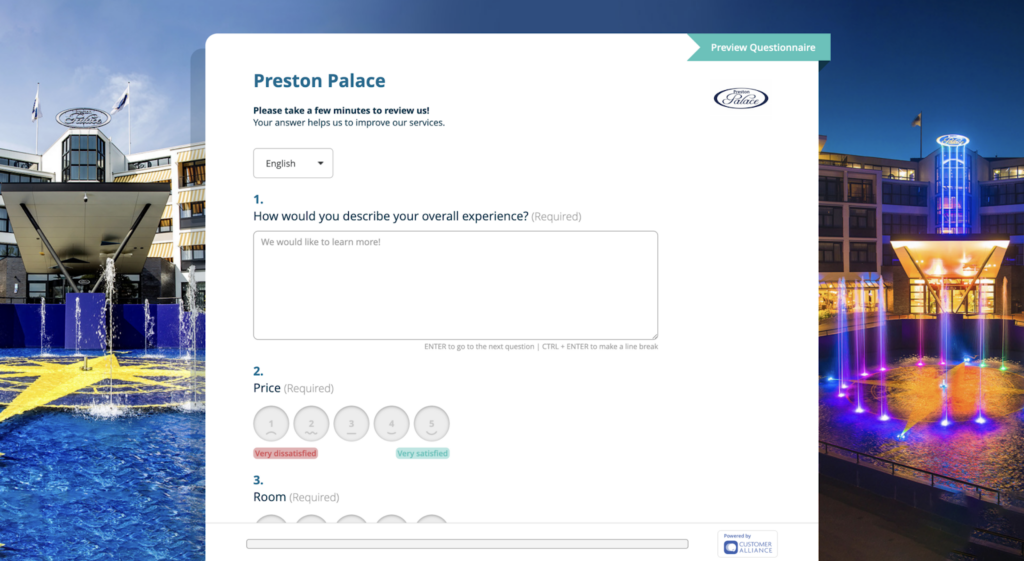
The clearest way to understand Guest Feedback Intelligence is to see it in practice. Preston Palace, a 324-room all-inclusive resort in the Netherlands, serves approximately 500,000 guests annually. Over a 12-year partnership with Customer Alliance, guest feedback has evolved from something the team monitors into something the team uses to run the business.
Instead of reacting to individual comments, the team works with a structured view of guest feedback across time, platforms, and categories.
Ryan Dingjan, Project Coordinator and Revenue Manager at Preston Palace, describes this shift clearly:
“Thanks to the data from Customer Alliance, we can respond quickly to facts and not assumptions. When someone hears a negative story or staff sense a problem, they turn to Customer Alliance to see whether it is a pattern ‘living among our public’ or just a one-off.”
This shift, from reacting to stories to validating patterns, is what Guest Feedback Intelligence looks like in practice.
When room satisfaction scores showed a consistent decline over time, the team did not rely on assumptions. The pattern was clear across guest feedback. This led to a full renovation of all 324 rooms, supported by data rather than instinct.
When guests repeatedly mentioned issues with buffet temperature, this was not treated as isolated feedback. It appeared as a recurring topic across reviews and surveys. The team made targeted operational changes, which contributed to increasing breakfast satisfaction to approximately 9.0.
In each case, the process is the same. Feedback is captured across sources, structured into clear themes, shared across teams, and used to guide decisions.
That is Guest Feedback Intelligence in action.
Turning Guest Feedback Intelligence into a daily practice requires more than access to data. It requires a system that can handle the scale, structure feedback automatically, and make it usable across the entire organisation.
Customer Alliance is built to do exactly that, bringing together the capabilities needed to understand guest feedback at scale and act on it consistently.
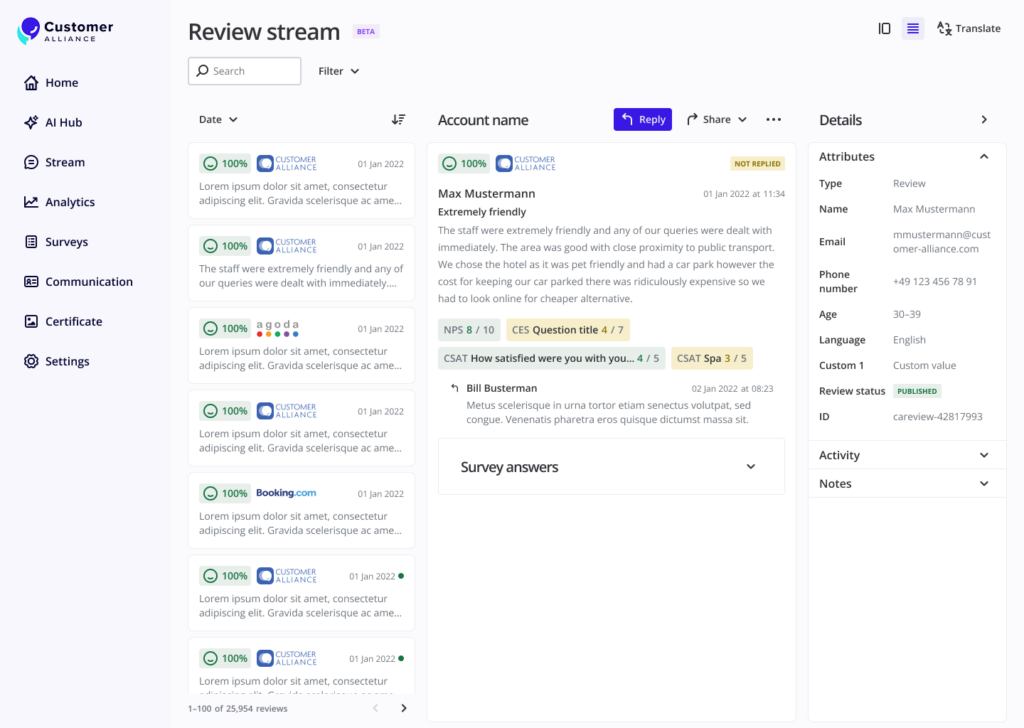
Customer Alliance brings all guest feedback into one organised Review Stream, aggregating reviews from 19 platforms including Booking.com, Expedia, Google, TripAdvisor, and HolidayCheck, alongside post-stay surveys and direct feedback. Instead of switching between extranets, teams work from a single, complete view of what guests are saying across all channels.
Beyond centralisation, the platform enables direct action. Through two-way integrations with major OTAs and review platforms, teams can respond to reviews directly from the dashboard
Language is no longer a limitation. Built-in translations across more than 40 languages allow teams to understand and respond to guest feedback regardless of origin. To support scale, the AI Reply Assistant generates responses in seconds and adapts over time based on how teams edit and refine replies. This allows teams to maintain a consistent tone while handling large volumes of reviews without increasing workload.

Once feedback is centralised and managed, the next step is influencing where new reviews are generated.
While hotels cannot control how OTAs collect reviews, they can actively guide guests toward open platforms such as Google, TripAdvisor, or HolidayCheck. Customer Alliance allows teams to distribute review requests across these platforms by splitting traffic automatically, ensuring a consistent flow of new reviews where visibility can be influenced.
This has a direct impact on performance. At Gorki Apartments in Berlin, review distribution played a key role in reaching the number one position on TripAdvisor. By consistently directing guests to share feedback on the platform, the hotel increased both review volume and recency, two factors that directly affect ranking and visibility.
Hotels can choose how to distribute traffic depending on their priorities. Whether the focus is TripAdvisor rankings, Google visibility, or a balanced presence across platforms, distribution ensures that feedback is not only collected, but actively shaped where it has the most impact.
Guest feedback does not happen in one place, and it does not come from one moment.
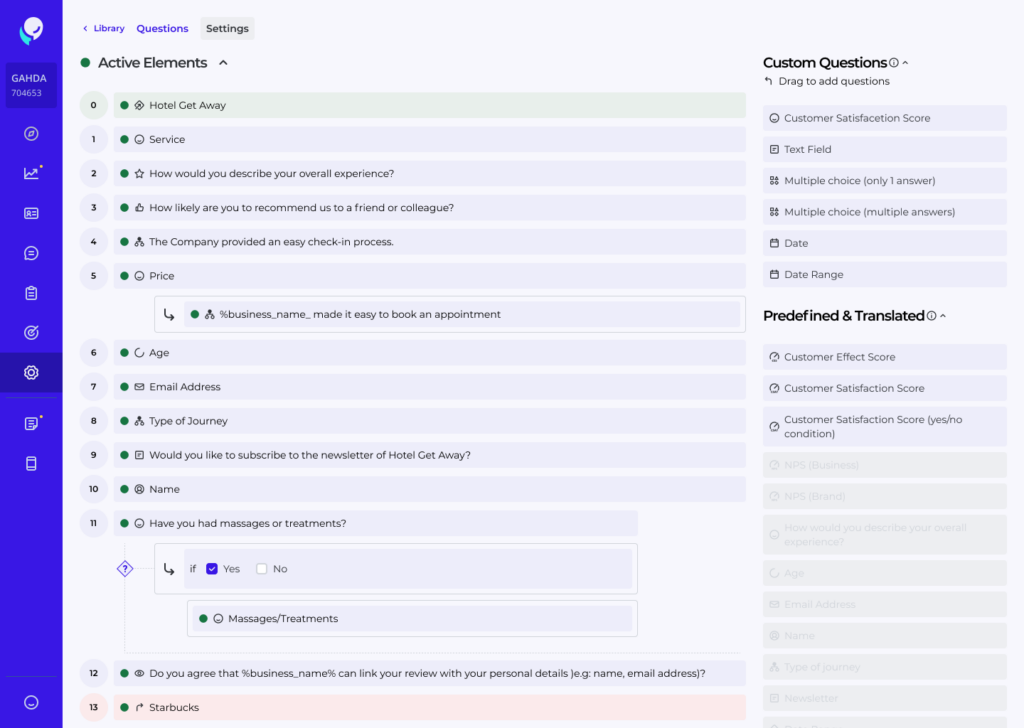
Customer Alliance surveys allow hotels to collect the specific feedback they need, from quick pulse checks to more detailed questionnaires. Instead of relying only on what guests choose to share publicly, teams can ask targeted questions and understand how guests experience different parts of the stay.
Feedback can be captured across multiple touchpoints. During the stay, short check-in surveys make it possible to identify and resolve issues while the guest is still in-house. After the stay, automated questionnaires collect structured feedback that feeds into the overall view of performance.
This extends beyond the room. Hotels can track satisfaction across different areas such as restaurant, spa, gym, or MICE, allowing teams to see how each part of the operation contributes to the overall guest experience.
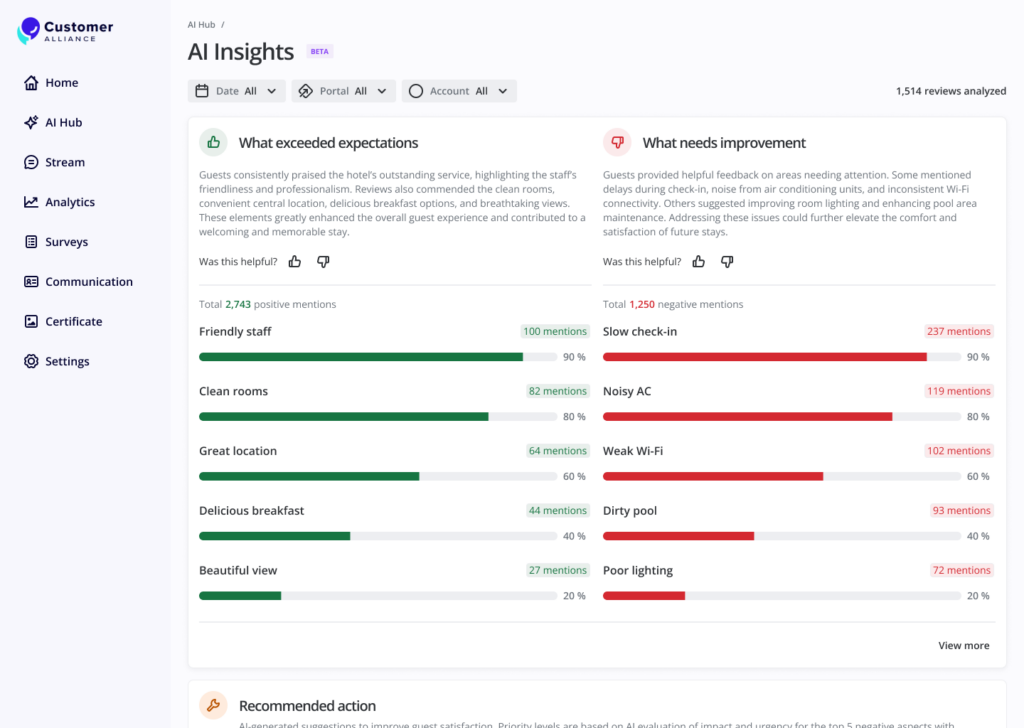
AI Insights groups guest feedback into themes, making it possible to see which topics appear most frequently and how they evolve over time. Instead of reading reviews individually, teams can immediately identify recurring issues, consistent strengths, and changes in guest sentiment.
This is particularly important at scale. When feedback comes in across multiple platforms, languages, and formats, patterns are not visible without structure. AI Insights provides that structure, allowing teams to move from individual comments to a clear overview of what is happening across the property.
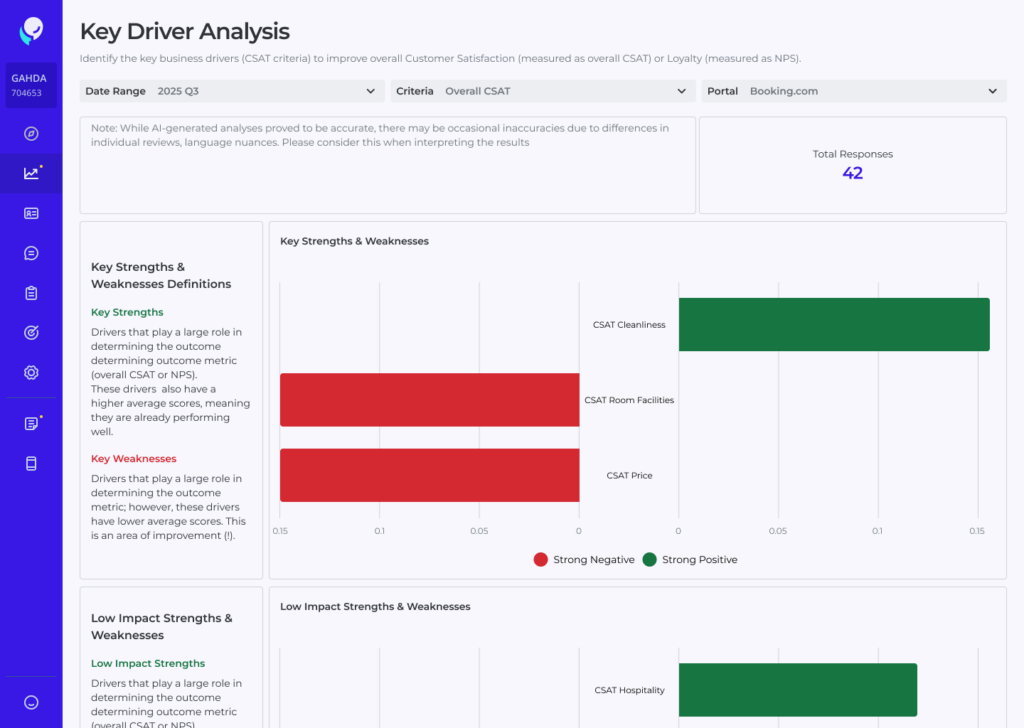
Not every topic has the same influence on guest satisfaction. Key Driver Analysis connects feedback with performance metrics such as CSAT and NPS to identify which areas have the strongest impact on overall scores. This makes it possible to prioritise actions based on measurable influence rather than frequency alone.
For example, a topic that appears less often but has a strong negative impact on satisfaction can be addressed before more visible but less critical issues. This shifts decision-making from volume-based to impact-based.
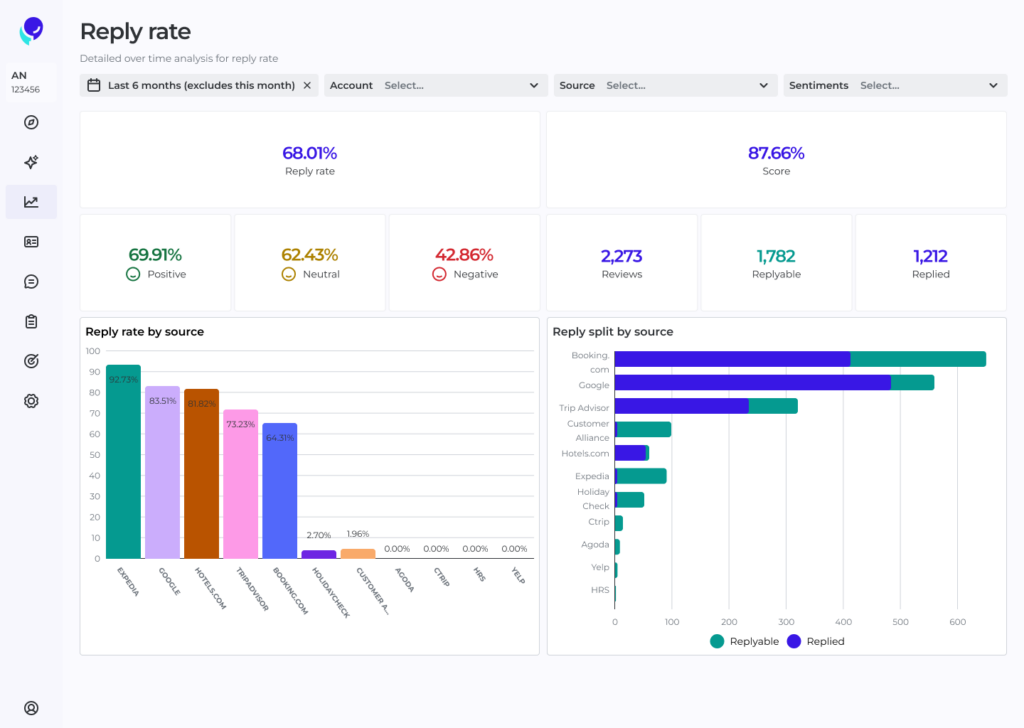
For feedback to influence decisions, it needs to be consistently visible.
Customer Alliance dashboards provide a shared view of performance across teams, with access to scores, trends, and feedback breakdowns. This ensures that operations, revenue, and management teams work from the same information.
Reports can be scheduled and distributed automatically, making it easier to integrate feedback into regular workflows such as weekly meetings or performance reviews. Alerts highlight significant changes, allowing teams to react quickly when something shifts.
With the right structure in place, feedback becomes part of how the hotel operates. Instead of reacting to individual comments, teams can identify patterns, understand their impact, and decide what to address first.
Guest Feedback Intelligence becomes part of daily operations—not as an additional layer, but as a continuous input into how the hotel improves.
Customer Alliance brings these capabilities together into one system, where feedback is collected, structured, and used across the organisation.
That is what Guest Feedback Intelligence looks like in practice.
If you would like to see how this works in your property, you can book a demo and speak with our team.
Online reviews are the backbone of your hotel’s reputation. Whether you manage an independent property or a large hotel group, you already know how important it is to appear and perform, across different booking platforms.
In this article, we focus on one of the biggest: Expedia. Expedia Group powers major travel sites like Expedia, Hotels.com, Vrbo, and Orbitz, giving it one of the largest global travel audiences.
Reviews on these platforms shape traveler decisions long before a booking happens. In fact, 97% of travelers read reviews before choosing where to stay, and according to Expedia Group’s own 2025 Traveler Value Index, 75% are even willing to pay more for lodging with better reviews. Every thoughtful reply does double duty: it reassures past guests and convinces future ones.
If that wasn’t reason enough to keep your reputation management sharp, there’s now another layer to consider. Travel planning itself is changing fast. A 2025 survey found that 40% of global travelers have already used AI-based tools to plan their journeys, and 62% are open to using them in the future.
Reflecting that shift, Expedia and Booking.com recently integrated directly into ChatGPT, allowing travelers to plan trips through AI-powered conversations that surface real-time listings, reviews, and even management replies.
In this new landscape, your online reputation doesn’t just influence what guests see on Expedia, it also shapes how your property appears in emerging AI-driven booking experiences. Your hotel’s reviews and responses are key signals for visibility in these next-generation travel searches.
That’s why we’ve put together 15 Expedia review response examples to help you strengthen trust, manage feedback effectively, and boost your performance, both on Expedia and within emerging AI-powered travel searches.
If you also want inspiration for other platforms, check out our guide on Google review response examples.
Replying to Expedia reviews matters because it improves visibility, builds trust, and directly influences booking decisions. When travelers see thoughtful management responses, they feel more confident choosing your property over others.
This influence is only growing. With the October 2025 integration of Expedia and Booking.com into ChatGPT, travelers can now plan trips through AI chat interfaces that surface real-time Expedia listings and guest reviews. Properties with strong, well-managed reviews and professional replies are more likely to appear and be recommended in these new conversational searches, making response quality a visibility factor not just within Expedia, but across emerging AI-driven booking channels.

A good Expedia review response is timely, professional, and personal. It shows that you value guest feedback, take concerns seriously, and care about improving the experience for future travelers.
Respond quickly
Aim to reply within 24 to 48 hours. Timely engagement shows attentiveness and increases traveler confidence. Industry research shows that properties replying within 24 hours reach an average occupancy rate of 53.3%, compared to 39.5% when responses take longer. Quick replies not only improve guest perception but also have a measurable impact on business performance.
Be professional and courteous
Your public reply reflects your brand. Use polite and respectful language, even when handling critical feedback.
Acknowledge and address experiences
Thank guests for positives and be transparent about negatives. If improvements are being made, state them clearly.
Be consistent
Make replying to reviews a routine. Properties that respond regularly to reviews are perceived as more trustworthy and proactive. According to Expedia’s own guidance and research, consistent review management supports stronger visibility and performance on their marketplace, making it an essential habit for long-term success.
A guest leaves a short review with a high score, like “Nice hotel.”
Response Example:
“Thank you for sharing your experience.We are glad you enjoyed your stay and appreciate your kind words. Every bit of feedback helps us stay focused on delivering memorable stays, and we hope to welcome you again soon.”
Why it works: Even short reviews get a meaningful acknowledgment, showing attentiveness.
Case: A guest leaves an overall score with no long comment, but Expedia shows Liked: cleanliness, staff & service.
Response example:
“Thank you for your positive rating and for highlighting our cleanliness and staff service. We are glad these aspects made a difference during your stay, and we will continue focusing on providing this level of comfort and care. We look forward to welcoming you again.”
Why it works: Even without a detailed written review, you can personalize your reply by referencing the “Liked” categories Expedia displays. This shows attentiveness to guest feedback and reinforces your property’s strengths.
A guest mentions they stayed for an anniversary or birthday.
Response example:
“Dear [Guest Name], we are honored you chose our property to celebrate such a special occasion. Knowing your stay was memorable means a lot to us. We hope to welcome you back for future celebrations.”
Why it works: Acknowledging milestones creates an emotional connection and positions your hotel as part of their special memories.
A guest mentions being a One Key member or highlights using rewards for their booking.
Response example:
“Thank you for your review and for choosing to stay with us through One Key. We are delighted your experience met expectations and look forward to welcoming you again on a future trip.”
Why it works: Loyalty members often book repeatedly on Expedia. Acknowledging their membership builds goodwill and encourages repeat stays.
A guest highlights how helpful or friendly the staff were.
Response example:
“Dear [Guest Name], thank you for your kind words about our team. It is wonderful to hear that their efforts made a positive difference during your stay. We will be sure to share your feedback with them, as recognition like this truly motivates us to keep delivering warm hospitality.”
Why it works: It goes beyond a generic thank you by acknowledging the team as individuals, which adds sincerity and strengthens trust with future guests.
Personalizing your response with the guest’s name turns even a short review into a meaningful exchange.
Response example:
“Hello [Guest Name], thank you for your kind words. We truly appreciate your feedback and are happy to know you enjoyed your stay. It was a pleasure hosting you, and we hope to welcome you back soon.”
Why it works:
Whether the review is brief or detailed, addressing the guest by name transforms a simple thank-you into a personal acknowledgment. It shows attention to detail and makes the guest feel individually valued, which helps build stronger connections.
Guest leaves a low overall score with a vague comment like “Not what I expected.”
Response example:
“Dear [Guest Name], we are very sorry to hear that your stay did not meet expectations. This is not the impression we want to leave, and we sincerely apologize for the inconvenience.”
Why it works: A direct apology shows empathy and professionalism. Even without much detail in the review, this type of response shows accountability and respect.
Guest leaves Disliked: staff & service or Disliked: cleanliness.
Response example:
“Dear [Guest Name], thank you for sharing your feedback. We are sorry that [specific issue, e.g., staff service] did not meet expectations. Your comments have been shared with our team, and we are taking steps to improve. We hope to provide you with a much better experience in the future.”
Why it works: Expedia makes “Disliked” categories visible, so addressing them directly shows you paid attention to what mattered most to the guest.
Guest says the stay was overpriced or disappointing overall.
Response example:
“Dear [Guest Name], we regret that your stay was not as enjoyable as it should have been. We would value the opportunity to make it right. If you decide to return, please contact us directly so we can assist with your booking and ensure a smoother experience.”
Why it works: Extending an invitation builds confidence that this was not a typical stay and shows commitment to service recovery.
Guest leaves a low score without an explanation, or only a generic comment.
Response example:
“Dear [Guest Name], thank you for sharing your review. We are sorry your stay did not fully meet expectations. If you would be open to it, we would appreciate more details about your experience so we can address it properly and make improvements.”
Why it works: Many Expedia reviews are brief. Asking for more input shows openness to learning and creates a chance to resolve issues.
Guest gives a 7/10 with Liked: staff & service and Disliked: breakfast.
Response example:
“Dear [Guest Name], thank you for highlighting our staff and service. We are glad they made a positive impression. We are also sorry the breakfast did not fully meet expectations. Your comments have been shared with our kitchen team as we continue to improve.”
Why it works: Addressing both sides of a review directly matches Expedia’s format. It demonstrates attentiveness and shows potential guests that praise is celebrated while criticism is acted upon.
Guest leaves only a mid-range score, such as 7/10, with little comment.
Response example:
“Dear [Guest Name], thank you for sharing your rating with us. Every piece of feedback matters, and we would love the chance to make your next stay even more enjoyable. We look forward to hosting you again.”
Why it works: Even without details, acknowledging the review signals attentiveness. It reassures future guests that all feedback, detailed or not, is valued.
Guest leaves a short comment such as “The staff was friendly, but the room was small.”
Response example:
“Dear [Guest Name], we are very pleased that our team made you feel welcome. At the same time, we are sorry that the room size was not ideal for you. Your comments will be taken into account as we continue to refine the guest experience.”
Why it works: Starting with the positive sets a respectful tone, while still showing you take the not-so-positive point seriously.
Guest comments that the stay was “fine overall” but mentions one area for improvement.
Response example:
“Dear [Guest Name], thank you for sharing your honest feedback. We are glad to know your stay was comfortable overall, and we appreciate your note about [specific issue]. We are committed to making improvements and hope you will notice the difference on your next visit.”
Why it works: This approach communicates openness to change, which makes both the reviewer and future guests feel heard and valued.
Customer Alliance is directly integrated with Expedia, as well as other platforms like Google, Booking.com, and HolidayCheck. That means you can see and respond to every review in one place through the Review Stream, instead of switching between different portals. This keeps your responses consistent and ensures no guest feedback is overlooked.
Inside the platform, you can also use AI Reply, a built-in functionality that creates personalized drafts in your brand voice. This allows you to reply faster without sounding generic. For recurring situations, you can save response templates to keep your tone consistent across the team. Drafts can also be stored and reviewed by colleagues before publishing, making collaboration simple and efficient.
Once reviews are under control, the next step is using them strategically. With Customer Alliance, you can go beyond replies by running targeted guest surveys to understand specific parts of your service, such as the restaurant, spa, or housekeeping.
You can also leverage AI Insights to analyze feedback from Expedia, Google, Booking.com, and other portals. Instead of reading through every review manually, you’ll see grouped themes at a glance — from what guests praise most to recurring points of criticism. This makes it easy to identify patterns, adjust operations, and uncover new growth opportunities.
By combining faster responses with actionable insights, Customer Alliance helps hotels strengthen their reputation, improve guest experience, and turn feedback into measurable results.
As AI-driven tools like ChatGPT start connecting directly to Expedia and Booking.com, hotels that actively manage and respond to reviews will be better positioned to stand out in these next-generation travel searches. Combining timely responses with smart insights ensures your property remains visible wherever travelers start their journey.
👉 Curious to see how Customer Alliance can support your hotel’s reputation and feedback strategy? Book a free demo today.

Responding to Booking.com reviews is not just good hospitality. It is a vital part of online reputation management. Nearly every traveler reads reviews before booking, with 97% of hotel guests consulting them when choosing where to stay.
Since so many travelers rely on reviews, they also notice how hotels respond to them. A thoughtful reply shows attentiveness, reassures potential bookers, and can even turn criticism into an opportunity. This interaction builds trust, influences booking decisions, and contributes to stronger visibility on Booking.com.
But finding the right words is not always easy. That is why we have put together 15 Booking.com review response examples you can adapt for positive, neutral, and negative reviews. Use them as inspiration to strengthen your reputation and improve your performance on Booking.com.
If you also want inspiration for other platforms, take a look at our guides on Google review response examples and Expedia review response examples.
A good Booking.com review response shows guests that their feedback matters and that the hotel is attentive, professional, and committed to continuous improvement. The most effective responses strike a balance between authenticity, professionalism, and empathy, reassuring both the reviewer and future guests reading along.
To achieve this, hotels should follow these best practices:
A review can generally be positive, neutral, or negative. Positive reviews stand out because they highlight what guests appreciated most about their stay. They are golden opportunities: not only do they celebrate what is going well, but they also provide a stage to showcase strengths to future guests. Whether the feedback is a simple “Great stay!” or a detailed account of what was loved, the right reply amplifies the good impression and makes the reviewer feel valued. Here are some ready-to-use examples for different scenarios.
Guest left a 10/10 score with a short comment like "Great stay!"
Response Example:
“Thank you so much for your positive feedback! We appreciate your kind words and are so glad that you had a great experience with us. Our goal is to provide the best guest service, and we’re glad to hear that we succeeded. Thanks again!”
Why it works: This example is perfect for when a guest leaves a positive review but doesn’t give you many details to work with. It's polite, appreciative, and professional. Every review requires a guest's time, and showing gratitude is the essential first step in any good response.
When a guest mentions amenities or team members they appreciated, acknowledge those details and celebrate your staff’s efforts.
Response Example:
“Dear [Guest Name], thank you so much for your wonderful review. We are delighted to hear that [insert specifics, e.g., a team member, our central location or breakfast buffet] made your stay memorable. Your kind words will be shared with our [culinary team], who will be thrilled to know their efforts stood out. We look forward to welcoming you back soon.”
Why it works: When a guest mentions something specific, reinforcing it in your reply is a form of subtle marketing. It confirms your property's strengths for future guests who are reading the reviews. If they praise a staff member, mentioning them by name in the reply is a fantastic way to boost team morale and show you value your employees.
Guest mentions that this isn't their first time staying with you.
Response Example:
“Welcome back, [Guest Name]! It was a pleasure to host you again. We are so thrilled that we continue to meet your expectations here in [City Name]. Our team is already looking forward to your next visit!”
Why it works: Loyalty is priceless in the hospitality industry. When a repeat guest leaves a positive review, your response should be extra warm. Acknowledging their loyalty makes them feel like a valued part of your community and shows potential new guests that your property is a place worth returning to.
Guest notes that they were staying for an anniversary, birthday, or other event.
Response Example:
“Dear [Guest Name], thank you for choosing to celebrate such a special occasion with us! We are so happy to hear that we could help make your anniversary memorable. It was an honour to be a part of your celebration, and we hope to see you again for many more in the future. Warm regards from the entire team.”
Why it works: Guests often choose specific hotels for milestone events. Responding to these reviews shows that your property is more than just a place to sleep, it's a place where memories are made. This creates a powerful emotional connection with past and future guests.
If a reviewer praises a feature you’re currently upgrading or expanding, use the opportunity to share exciting news.
Response Example:
“Dear [Guest Name], thank you for your kind words about [insert amenity, e.g., our spa]. We are delighted to hear it made your stay so enjoyable. We’re always working to enhance the guest experience, and we’re excited to let you know that [insert upcoming improvement, e.g., a new range of spa treatments] will be available soon. Please keep an eye on our website for updates, and we look forward to welcoming you back to enjoy it.
Why it works: Giving an update does two things. First, it shows the customer (and anyone else reading) that you are always working to improve your offering. Second, it gives that happy customer a great incentive to come back. They enjoyed the spa the first time, and now they have a new reason to return and experience something that wasn't available before. It's a win-win.
Guest comment positively on an aspect of your hotel that is tied to a core value, such as your restaurant's fresh ingredients.
Response Example:
“Dear [Guest Name], thank you so much for your kind words! We are delighted that you enjoyed your stay, and especially that you appreciated the quality of our breakfast. Here at [Hotel Name], we believe in sustainability and supporting our local community, which is why we partner with local farms for our ingredients. It’s a commitment we’re very proud of. Thank you for your support!”
Why it works: Including your company values in your replies helps to build your brand identity and provides key information to potential guests. Take the example above. If a traveler is specifically looking for an eco-conscious hotel that supports local businesses, they no longer need to search your website for details. This reply makes it clear that your commitment isn't just a slogan, but something you actively practice. For the right guest, this can be the deciding factor to book with you.
No one wants to get a bad review. However, while the goal is a perfect stay for every guest, there will be times when expectations aren't met. When that happens, a thoughtful and professional response is crucial. Here’s some inspiration for how you can respond.
Reviewer leaves a low score with a comment that shows they were somehow dissatisfied, such as “Not what I expected” or “Disappointing stay.”
Response Example:
“Dear [Guest Name], we are truly sorry to hear that your experience fell short of expectations. This is not the impression we want to leave, and we sincerely apologize for the inconvenience you faced.”
Why it works: Beginning with empathy and a direct apology sets the right tone. It shows accountability without making excuses.
Guest points out a specific problem, such as check-in delays or poor Wi-Fi.
Response Example:
“Dear [Guest Name], thank you for bringing this to our attention. We are very sorry for the issue you experienced with [specific problem]. Please know that we have already shared your feedback with our team and are working to ensure this does not happen again.”
Why it works: It confirms that action is being taken, which reassures both the reviewer and future guests.
Reviewer says the stay did not live up to expectations or felt overpriced.
Response Example:
“Dear [Guest Name], we regret that your stay was not as enjoyable as it should have been. We would greatly value the chance to provide a better experience. Should you decide to return, please contact us directly so we can assist with your booking and ensure a smoother stay.”
Why it works: Extending an invitation to come back shows confidence, service recovery, and care for the guest relationship.
Reviewer leaves a vague comment like “Not worth it” without providing specifics.
Response Example:
“Dear [Guest Name], thank you for sharing your thoughts. We are sorry that your stay was disappointing. If you would be open to it, we would appreciate more details about your experience so we can address it fully and make improvements.”
Why it works: It handles unclear criticism gracefully, demonstrating transparency and willingness to learn.
The reviewer highlights both positives and negatives but leaves an overall low score.
Response Example:
“Dear [Guest Name], we are sorry to hear that some aspects of your stay did not meet your expectations. At the same time, we are grateful for your feedback on what you did enjoy. Your comments help us identify where we need to improve, and we hope to welcome you back for a better experience in the future.”
Why it works: It acknowledges the negatives without ignoring the positives, striking a balanced and professional tone.
Guest leaves a negative review about slow service or poor communication.
Response Example:
“Dear [Guest Name], thank you for sharing your feedback. We are very sorry for the delay you experienced and understand how frustrating that must have been. Your comments have been passed on to our team, and we are already working on improvements to avoid similar situations in the future. Best regards, Anna Keller – Guest Relations Manager”
Why it works: Ending with a name and title makes the response more personal and accountable. It reassures the reviewer that a real person is taking responsibility and signals to future guests that management is actively involved in resolving issues.
Some reviews are neither fully positive nor entirely negative. They often include praise alongside constructive criticism. These mixed reviews are an excellent chance to show appreciation while also demonstrating that you take improvement seriously.
Guest says something like “The staff was friendly, but the breakfast could have been better.”
Response Example:
“Dear [Guest Name], we are very pleased to hear that our team made you feel welcome and that you enjoyed the service. At the same time, we are sorry that the breakfast did not fully meet your expectations. Your comments will be shared with our kitchen team as we work to improve this part of the guest experience.”
Why it works: Leading with what the guest enjoyed keeps the tone warm and professional, while also showing that you take the not-so-positive feedback seriously and use it to drive improvements.
The reviewer mentions a generally good stay but highlights one area for improvement.
Response Example:
“Dear [Guest Name], we are glad to know that you had an overall pleasant stay and thank you for pointing out [specific issue]. We are always looking for opportunities to improve, and your feedback will help us make the necessary adjustments. We hope to welcome you again so you can experience the difference.”
Why it works: It communicates openness to feedback and positions your hotel as proactive, which reassures both the reviewer and future guests.
Managing Booking.com reviews can quickly become overwhelming, especially when there are dozens of comments to reply to across multiple platforms. Customer Alliance makes this process easier and faster by bringing everything together in one place.
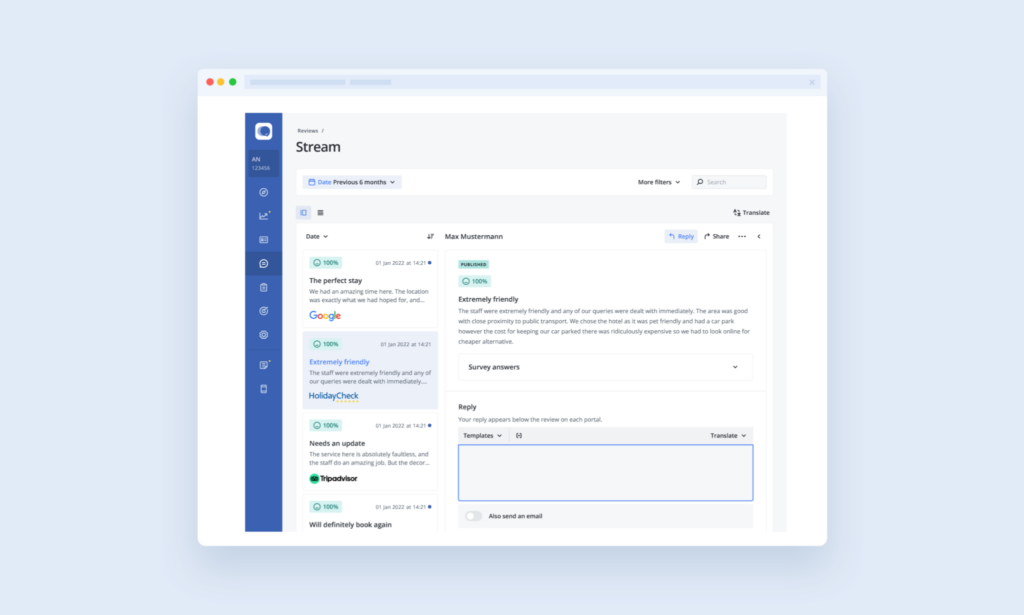
Hotels can view all their Booking.com reviews directly from their Customer Alliance dashboard and reply without switching platforms. This ensures no feedback is missed and every guest receives a timely, thoughtful response. Reviews from other platforms, such as Google and Expedia, can also be managed in the same dashboard, keeping everything consistent and centralised.
To save even more time, the AI Reply Assistant can generate personalized answers in seconds, analysing each review and suggesting replies that sound natural and professional. Hotels remain in full control, with the freedom to edit or adjust before sending, so responses always stay on brand.
This combination of centralised review management and AI-powered assistance helps hotels reply faster, maintain consistency, and keep their Booking.com reputation strong.
Reviews on Booking.com shape how guests see a property before they even arrive. A thoughtful response, whether to praise, criticism, or mixed feedback, shows professionalism and builds trust, which can directly influence booking decisions.
The 15 examples in this article give hotels a practical starting point for crafting replies that are timely, personal, and effective. Consistency in responses not only strengthens reputation but also improves visibility on Booking.com and turns guest feedback into a driver of loyalty.
Templates help with the daily task of replying, but the real advantage comes from understanding the bigger picture. Customer Alliance turns feedback into actionable insights through AI-powered analysis and data-driven tools. From collection to execution, the platform enables smarter, faster decisions that elevate the guest experience and turn feedback into measurable results.
👉 Book a call to see how Customer Alliance helps hotels transform guest feedback into strategic insights, improve satisfaction, and drive long-term growth.
.svg)
For years, online reviews influenced how guests chose their next stay. Today, those same reviews are influencing how artificial intelligence decides which hotels to recommend. What once guided only human decisions is now shaping the algorithms behind AI that answer traveler queries.
The change is happening quickly. A 2025 survey found that 40% of global travelers have already used AI-based tools to plan their journeys, and 62% are open to using them in the future.
As adoption accelerates, travelers are already asking AI-powered assistants questions such as:
From ChatGPT to Gemini, these AI-powered platforms are becoming the new travel agents. They do not just display lists of options, they filter, interpret, and recommend. Some early tools are even experimenting with handling parts of the booking process, leaving only the payment step to the traveler.
The question is: when AI answers, will your hotel be mentioned?
Despite the many unknowns of ranking in generative AI, there is already a lot we do know. Most tools follow similar logic and rely on the digital footprint left by hotels and their guests. Instead of guessing, AI connects the dots across different data points:
These signals directly influence whether a hotel appears in recommendations. Research shows that 81% of travelers read reviews before booking, and 70% say a hotel’s reputation directly affects their choice. If reputation already shapes how travelers decide, it also becomes a natural input for AI systems that are designed to mirror traveler preferences. Reviews, responses, and consistency now guide not only guest perception but also the algorithms deciding which hotels to surface.
As one industry guide explains, “online reviews significantly impact both traditional SEO rankings and AI recommendations… AI systems recognize active engagement as a positive signal, and potential guests see responsive management as a sign of quality service” (Femaleswitch).
If review scores are inconsistent, information is outdated, or feedback is not recent, a hotel may be left out of AI recommendations entirely.
AI powered search It is already a fast growing booking channel. Semrush data shows that referrals from ChatGPT to websites increased by 300% in only a few months, proving how influential these tools have become.
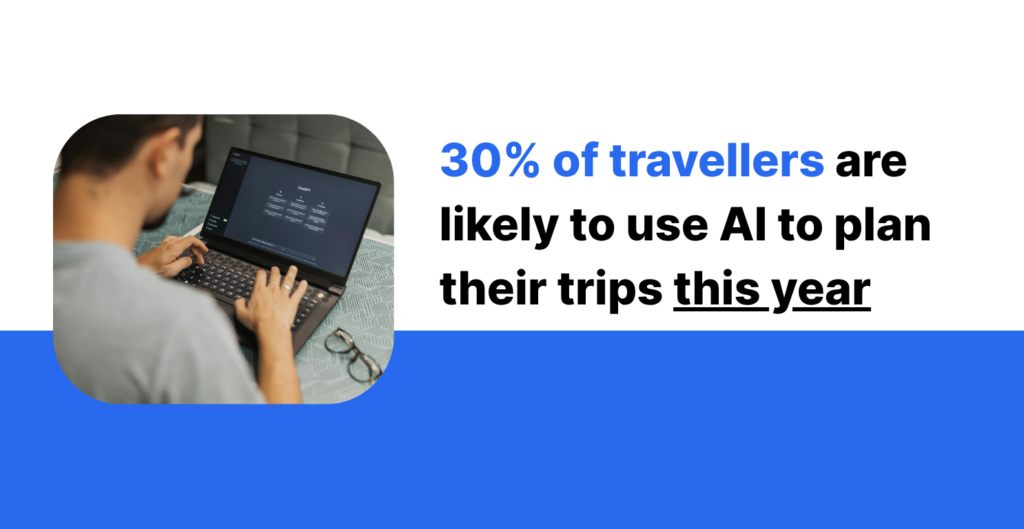
Travelers are also turning to AI for planning. A recent survey reported that 30% of travelers are likely to use AI to plan their trips this year.
For hotels, this is not just about reputation, it directly affects bookings, pricing power, and visibility at the earliest stage of the guest journey. In fact, our ROI of reputation management for hotels article explores how improving online reputation translates into measurable revenue growth.
Properties that optimize their digital presence for AI powered rankings have already shown gains in bookings, stronger Revenue Per Available Room (RevPAR), and improvements in operational efficiency, supported by industry case studies and academic research. The question is no longer if AI will influence visibility, but how hotels can adapt their strategy to be part of these recommendations.
There are practical steps that can strengthen a hotel’s position in AI powered recommendations. Many of them focus on refining what already exists online, making sure information is consistent, reputation signals are strong, and guest feedback is actively managed.
Keep your information consistent and up to date across Google Business Profile, OTAs, review platforms, and social media. Even small gaps or outdated details can weaken visibility.
Use clear descriptions and structured content so AI systems can easily understand what your hotel offers. FAQs for common guest questions and schema markup for essentials such as address, amenities, and pricing make your site easier for machines to read.
AI tools do not work exactly like search engines, but the same principles matter. Structured data, well organized content, review replies and fast, mobile friendly pages all improve how information is processed and trusted.
Mentions from credible sources carry weight. Publishing articles, collaborating with local tourism boards, or being featured in travel publications all help position your hotel as a reliable choice.
Encourage satisfied guests to share their experiences on platforms such as Google, Booking.com, TripAdvisor, and Expedia. A steady flow of fresh reviews strengthens trust for both travelers and AI systems.
AI also observes how management handles feedback. Timely and respectful replies to both positive and negative reviews send a clear signal of accountability. Use natural and conversational language
Travelers now phrase their searches in everyday terms. Descriptions such as “family friendly hotel in Valencia with pool” or “quiet rooms for remote work in Munich” help AI connect your property to real queries.
If reviews are one of the most influential factors in how hotels are perceived, both by guests and by AI, then how you respond to them becomes just as important as collecting them. As a reputation management and guest feedback insights platform, we see that responses are not only about customer service but also about signal-building. Every reply contributes to how algorithms and travelers interpret your brand.
Once your hotel is collecting consistent feedback, the next step is knowing how to respond in a way that both reassures guests and strengthens AI signals. Large language models don’t just register ratings, they learn from the language around your brand. The tone, context, and details within your replies can all shape your visibility in AI-driven recommendations.
Write replies in the same conversational style travelers use when searching online. Instead of generic thank-yous, mention specific experiences:
“We’re thrilled you enjoyed our rooftop view and proximity to Barcelona’s old town.”
These natural phrases reinforce the same context AI engines look for when recommending hotels for queries like “best hotels near Barcelona old town with great views.”
In positive reviews, echo the attributes you want AI, and travelers, to associate with your brand: “family-friendly,” “quiet rooms,” “eco-conscious,” or “business-ready.” Over time, these recurring terms build semantic links that strengthen your hotel’s identity in AI-driven discovery.
AI models (and guests) detect emotional tone. Replies that acknowledge issues and explain solutions convey accountability and transparency — two major trust indicators. For example:
“We’re sorry about the delay at check-in. Since then, we’ve adjusted staff scheduling to improve arrival times.”
Such context signals to AI systems that your hotel is responsive and service-oriented rather than passive or defensive.
Recency matters. Frequent, up-to-date replies show both travelers and AI crawlers that your property is active and your information current, a ranking signal shared across SEO and generative AI systems.
Ensure your tone and information align across Google, Booking.com, TripAdvisor, and Expedia. Inconsistent naming, descriptions, or messaging can confuse algorithms and weaken your perceived trust score.
AI can recognize mechanical or templated replies. Simple touches like addressing the guest by name, referencing details of their stay, or using a natural sign-off (“We hope to welcome you again soon”) make responses sound genuine — improving perceived quality both for humans and machines.
Responding thoughtfully to reviews does more than protect your reputation, it expands your digital footprint, one of the key factors that influence AI-driven visibility. Each authentic response adds fresh, meaningful language about your hotel online. This not only reinforces your identity to future guests but also helps large language models understand what makes your property trustworthy, relevant, and worth recommending.
Many of the steps that improve AI discoverability for hotels are closely tied to reputation management. Earning strong reviews, replying consistently, and using natural language are not only good for guests but also strengthen the signals AI tools rely on.
Customer Alliance collects reviews from major platforms such as Google, Booking.com, and Expedia, and centralizes them in a single dashboard. From there, hotel teams can respond directly with the help of AI Reply, ensuring faster responses in multiple languages while keeping the hotel’s own tone of voice. AI Insights highlights the topics guests mention most often, giving hotels a clearer picture of what defines their reputation online and how it is perceived across the web. By combining frequently mentioned topics with sentiment across sources, it also offers a snapshot of how a hotel might be perceived externally, including by AI systems.
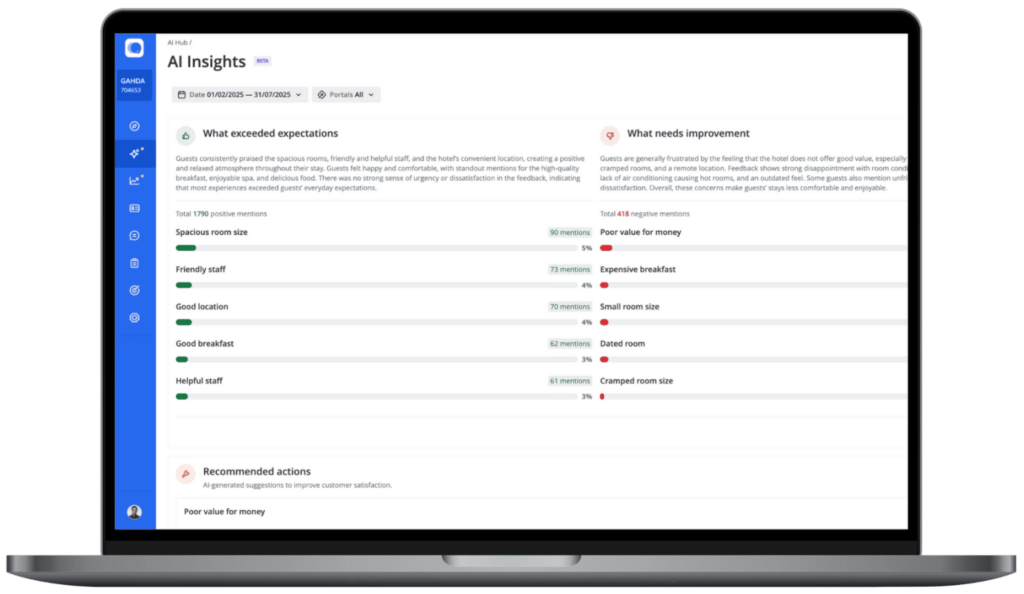
In a world where hotels are not only delivering experiences to guests but also being read and ranked by algorithms, this kind of clarity makes a real difference. Seeing both the guest experience from the inside and how it is reflected externally puts hotel teams in a stronger position to make the right decisions.
With surveys and data analysis added to the mix, Customer Alliance provides hotels with a reputation management system that not only builds guest trust but also supports visibility at a time when AI is reshaping travel choices.
Strong reputation management means happier guests, better visibility, and more bookings. Schedule a call with us and discover how Customer Alliance can support your hotel’s growth.


