




A paper patient survey alone is no longer enough to get the best healthcare insights. Today, the most savvy organisations know that to improve the patient experience they must push beyond simply collecting feedback. Instead, the focus should be on implementing a program that also measures that feedback, analyses it and helps inform key business decisions.
It may sound like a tall order, but setting up a patient satisfaction program is easier than you think! Here’s everything we’ll cover in this article (to skip to a specific section just click on the link).
[ca-form id="194451" align="left" var1="http://www.customer-alliance.com/wp-content/uploads/2022/06/customer-alliance-article-guide-setting-up-a-patient-satisfaction-program-EN-download.pdf"]
With more and more hospitals and clinics to choose from, today's patients look for the best possible experience. That doesn't just include the quality of care but things like good communication, getting timely appointments and easy access to information.
The challenge is gathering patient feedback in a consistent, measurable and organised way. That's where a patient satisfaction program comes in!
Rather than simply collecting feedback, a patient satisfaction program also allows you to analyse that feedback at scale so you can identify any actions you need to take. It's hands down the best and most efficient way to get the information you need and empowers you to make business decisions based on real data.
Some patient satisfaction programs are more effective than others. Introducing digital patient surveys is a great step in the right direction. However, to get the best results you should combine different, complementary initiatives to help reach your goals. Here are the key aspects of all good patient satisfaction programs.
One of the best ways to find out what your patients think is to simply ask them! Patient satisfaction surveys are great for gathering feedback and allowing you to identify areas for improvement. When you take action on these insights, this ultimately leads to not only better care, but happier patients.
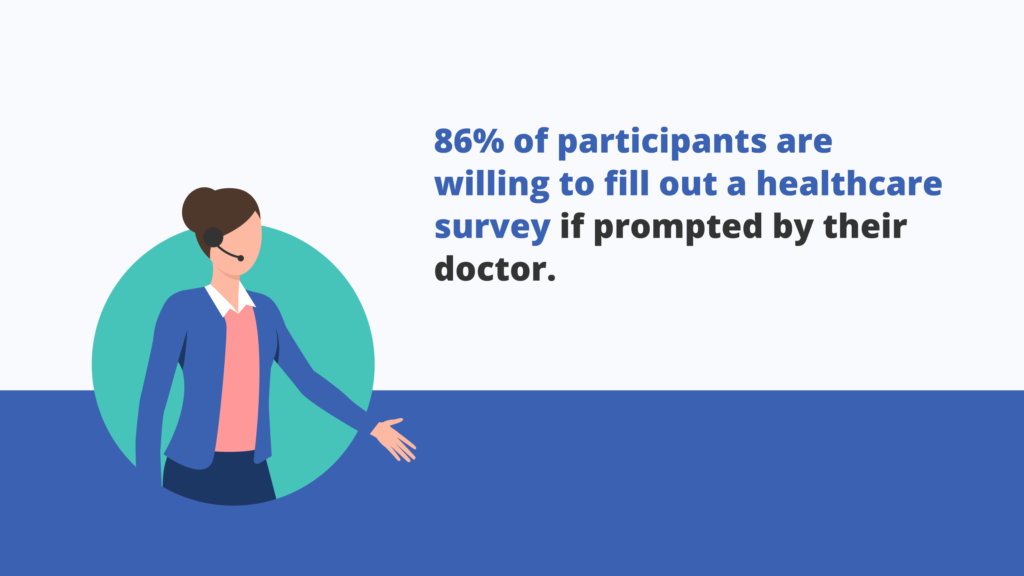
Plus, getting a response is easier than you might think! In fact, one study by West Corporation showed that 86% of participants were willing to fill out a healthcare survey if prompted by their doctor (1).
One of the keys to getting as many responses as possible is to make your surveys convenient and easy. In other words, ditch the pen and paper! You can send digital surveys through multiple channels like via email, SMS or even right on your website.
Second, you’ll want to think about what questions to ask. Generally speaking, what’s most important for healthcare companies is quality of care, access to that care, and interpersonal relationships between patients and staff.
While you can get feedback on all kinds of topics, it’s important not to overwhelm your patients. Instead, you might like to focus on these three main areas and ask only the most essential questions. This will also help you to get great response rates and even more valuable feedback.
So what kinds of questions might you ask in your patient survey? Here are some examples that relate to the three key areas we touched on above:

Take another look at those questions. Almost all of them can be answered using some kind of ratings scale, for example a scale of 1-10 or even a simple star rating. Why? Using a scale will make it much easier for you to measure and analyse your results.
Today, there are a number of satisfaction metrics specifically designed to provide the kind of data businesses need to improve. You should employ at least one of these metrics in your patient survey (though it's best to use them in tandem). Let’s take a look at some of the most popular:
Follow-up questions can help to give more context into patient satisfaction and strengthen your data. For example, while NPS tells you how your organisation is performing, it doesn’t tell you how respondents have reached their decision.
For example, if a patient gives a low NPS rating of 6 or under, a follow-up question might be: "What can we do to improve?" This allows for a more comprehensive view of patient satisfaction and will help you get more valuable insights.
To get a more in-depth look at these, and other satisfaction metrics, check out our guide: How to measure customer satisfaction KPI: NPS, CSAT, CES, & CLI.
When researching healthcare providers, people are increasingly starting their search online, with 81% relying heavily on online reviews to make their choice (2). Why? When it comes to health, it’s important that patients have the best possible experience. Seeing glowing reviews from other patients helps to build confidence that they will be in safe hands.
[ca-form id="44600" align="right"]
But remember, collecting reviews isn’t the only goal here. By taking the time to respond to your reviews (both positive and negative) you can help attract even more patients to your facility. It shows that you genuinely care about your patients’ experiences and the quality of the care you are giving them.
Once you start building up your online reviews, it’s time to show them off! Google and Facebook reviews are great in their own right, but why not make it even easier for potential patients and showcase reviews right on your website?
A review widget will combine all your reviews together and clearly display your scores in an attractive and unobtrusive way. If they like, visitors to your website can then click on the widget for more information and to take a closer look at what previous patients are saying.
The feedback and data you collect will be of little use unless you have a way to bring it all together and extract the most important information. A good patient satisfaction program includes all kinds of tools to help you automatically analyse your results. It may include things like:
These kinds of tools and features massively reduce the amount of manual work required to deal with your feedback. Not only that, but they will make it much easier to start making improvements and supercharge your patient satisfaction!

As you can see, there are many moving parts when implementing a patient satisfaction program. That’s why technology is key to success.
Using software that will collect, measure and analyse feedback for you will help make the process as seamless as possible, allowing you to spend time where it matters most - with your patients!
The best patient satisfaction programs should cause as little disruption as possible to your day-to-day work. After all, they are there to help you improve, not cause additional stress! Here are a few things to consider when looking at patient satisfaction platforms:
If you're starting completely from scratch, you might prefer to begin with just a couple of key initiatives. A patient survey and review collection are a great place to start and will give you enough data to start making real improvements. With the right software on your side, you can easily introduce more advanced initiatives (like text analytics and patient journey mapping) at a later date.
Make sure that staff members see how your new program will help your organisation and how important they are to the process. Increasing patient satisfaction will always involve some organisational change and there may be some barriers you have to navigate along the way. However, ensuring that staff are on board will go a long way in making your program a success. Before you introduce it, set up a meeting outlining not just what the program entails but the many benefits it will have for your business.
Investing in a comprehensive patient satisfaction program is a surefire way to get the most valuable insights for your healthcare organisation and implement real change. At Customer Alliance, we have helped companies collect, measure and analyse their data since 2009 and know first-hand how impactful the right software can be. So if you’d like to see how our platform works, why not book a free, custom demo? Alternatively, you can get in touch with a member of our sales team who will be happy to help.
Sources
[hubspot portal="2001288" id="cbe89657-7dce-41a2-858a-a3efc3b58732" type="form"]
Erfahren Sie, wie KI-Erkenntnisse, automatisierte Workflows und einheitliche Dashboards die manuelle Arbeit reduzieren und die Zufriedenheit in Ihrem Hotel steigern können.
Holen Sie sich eine personalisierte Demo


