A paper patient survey alone is no longer enough to get the best healthcare insights. Today, the most savvy organisations know that to improve the patient experience they must push beyond simply collecting feedback. Instead, the focus should be on implementing a program that also measures that feedback, analyses it and helps inform key business decisions. It may sound like a tall order, but setting up a patient satisfaction program is easier than you think! Here’s everything we’ll cover in this article (to skip to a specific section just click on the link). Why Set Up A Patient Satisfaction Program? [ca-form id="194451" align="left" var1="http://www.customer-alliance.com/wp-content/uploads/2022/06/customer-alliance-article-guide-setting-up-a-patient-satisfaction-program-EN-download.pdf"] With more and more hospitals and clinics to choose from, today's patients look for the best possible experience . That doesn't just include the quality of care but things like good communication, getting timely appointments and easy access to information . The challenge is gathering patient
A paper patient survey alone is no longer enough to get the best healthcare insights. Today, the most savvy organisations know that to improve the patient experience they must push beyond simply collecting feedback. Instead, the focus should be on implementing a program that also measures that feedback, analyses it and helps inform key business decisions.
It may sound like a tall order, but setting up a patient satisfaction program is easier than you think! Here’s everything we’ll cover in this article (to skip to a specific section just click on the link).
With more and more hospitals and clinics to choose from, today's patients look for the best possible experience. That doesn't just include the quality of care but things like good communication, getting timely appointments and easy access to information.
The challenge is gathering patient feedback in a consistent, measurable and organised way. That's where a patient satisfaction program comes in!
Rather than simply collecting feedback, a patient satisfaction program also allows you to analyse that feedback at scale so you can identify any actions you need to take. It's hands down the best and most efficient way to get the information you need and empowers you to make business decisions based on real data.
What Makes Up A Good Patient Satisfaction Program?
Some patient satisfaction programs are more effective than others. Introducing digital patient surveys is a great step in the right direction. However, to get the best results you should combine different, complementary initiatives to help reach your goals. Here are the key aspects of all good patient satisfaction programs.
Surveys
One of the best ways to find out what your patients think is to simply ask them! Patient satisfaction surveys are great for gathering feedback and allowing you to identify areas for improvement. When you take action on these insights, this ultimately leads to not only better care, but happier patients.
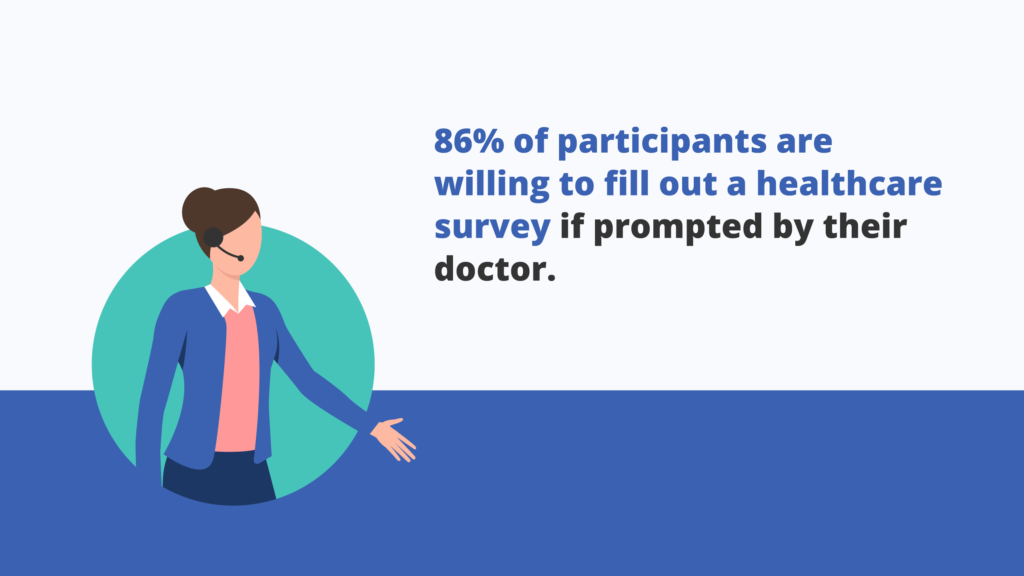
Plus, getting a response is easier than you might think! In fact, one study by West Corporation showed that 86% of participants were willing to fill out a healthcare survey if prompted by their doctor (1).
One of the keys to getting as many responses as possible is to make your surveys convenient and easy. In other words, ditch the pen and paper! You can send digital surveys through multiple channels like via email, SMS or even right on your website.
You may be surprised how many patient survey responses you get!
Second, you’ll want to think about what questions to ask. Generally speaking, what’s most important for healthcare companies is quality of care, access to that care, and interpersonal relationships between patients and staff.
While you can get feedback on all kinds of topics, it’s important not to overwhelm your patients. Instead, you might like to focus on these three main areas and ask only the most essential questions. This will also help you to get great response rates and even more valuable feedback.
Patient Survey Question Examples For The Healthcare Industry
So what kinds of questions might you ask in your patient survey? Here are some examples that relate to the three key areas we touched on above:
Was it easy to book your appointment?
How satisfied are you with the care that you received?
How would you rate the helpfulness of our receptionist?
Based on your overall experience at our clinic, how likely are you to recommend us to a colleague or friend?
How satisfied were you with your waiting time at the clinic?
How satisfied are you with the cleanliness of the facility?
Was there anything we could have done to improve your experience?
How easy did you find the billing and payment process?
How well did your doctor explain your treatment?
Asking the right questions is key to getting valuable patient feedback
Satisfaction Metrics
Take another look at those questions. Almost all of them can be answered using some kind of ratings scale, for example a scale of 1-10 or even a simple star rating. Why? Using a scale will make it much easier for you to measure and analyse your results.
Today, there are a number of satisfaction metrics specifically designed to provide the kind of data businesses need to improve. You should employ at least one of these metrics in your patient survey (though it's best to use them in tandem). Let’s take a look at some of the most popular:
Net Promoter Score (NPS)
This metric measures customer loyalty by asking how likely the patient is to recommend you on a scale of 0-10. From the score, respondents are split into three groups: Detractors (who scored 0-6), Passives (7-8) and Promoters (9-10). The numbers in each group are then used to calculate your final Net Promoter Score.
Customer Satisfaction Score (CSAT)
As the name suggests, this metric evaluates patient satisfaction and can be used for overall experiences or specific areas of your service. The range for CSAT generally varies between 1-3, 1-5 and 1-10. The final score is calculated by simply dividing the number of positive responses by the total patient survey responses received.
Customer Effort Score (CES)
This metric lets you know if patients are having difficulty carrying out certain tasks, for example making an appointment. Again, CES uses a simple scale and is calculated by dividing the total sum of responses by the number of patient survey responses received.
Getting Additional Insights
Follow-up questions can help to give more context into patient satisfaction and strengthen your data. For example, while NPS tells you how your organisation is performing, it doesn’t tell you how respondents have reached their decision.
For example, if a patient gives a low NPS rating of 6 or under, a follow-up question might be: "What can we do to improve?" This allows for a more comprehensive view of patient satisfaction and will help you get more valuable insights.
When researching healthcare providers, people are increasingly starting their search online, with 81% relying heavily on online reviews to make their choice (2). Why? When it comes to health, it’s important that patients have the best possible experience. Seeing glowing reviews from other patients helps to build confidence that they will be in safe hands.
[ca-form id="44600" align="right"]
But remember, collecting reviews isn’t the only goal here. By taking the time to respond to your reviews (both positive and negative) you can help attract even more patients to your facility. It shows that you genuinely care about your patients’ experiences and the quality of the care you are giving them.
Once you start building up your online reviews, it’s time to show them off! Google and Facebook reviews are great in their own right, but why not make it even easier for potential patients and showcase reviews right on your website?
A review widget will combine all your reviews together and clearly display your scores in an attractive and unobtrusive way. If they like, visitors to your website can then click on the widget for more information and to take a closer look at what previous patients are saying.
Reporting And Analysis
The feedback and data you collect will be of little use unless you have a way to bring it all together and extract the most important information. A good patient satisfaction program includes all kinds of tools to help you automatically analyse your results. It may include things like:
Text analytics that will identify the key topics mentioned in patient reviews. Split into positive, neutral and negative mentions, you will then be able to dive deeper into each topic and learn where changes should be made.
Acustomer journey tool for you to plot out each touchpoint along your patient journey and easily compare satisfaction scores and get an overall view of satisfaction.
Statistics where all your metrics are collated and displayed in a way that is easy to understand. You should be able to filter and download your data to create your own reports.
A review stream where your reviews from all different platforms are displayed in one place. Ideally, this should also include alerts when you receive a critical review so you can quickly identify and resolve the issue.
These kinds of tools and features massively reduce the amount of manual work required to deal with your feedback. Not only that, but they will make it much easier to start making improvements and supercharge your patient satisfaction!
Software like Customer Alliance will help you get the most from your patient satisfaction program
How To Launch A Successful Patient Satisfaction Program
As you can see, there are many moving parts when implementing a patient satisfaction program. That’s why technology is key to success.
Using software that will collect, measure and analyse feedback for you will help make the process as seamless as possible, allowing you to spend time where it matters most - with your patients!
Ask The Right Questions
The best patient satisfaction programs should cause as little disruption as possible to your day-to-day work. After all, they are there to help you improve, not cause additional stress! Here are a few things to consider when looking at patient satisfaction platforms:
Is customer support readily available? Do you have your own Customer Success Manager or a general support team? If support is available, is it for the duration of your contract or only for a limited time?
Do you have any existing platforms, for example an external booking system? If so, it will likely need to be integrated. Find out if the patient satisfaction program already has this integration in place. If not, ask how long it will take to set up.
Does your organisation have multiple locations? Or perhaps you're looking to expand in the future? Make sure that the program works just as seamlessly for different locations as it does for single locations (or even better, has features designed specifically for this purpose!)
Can you book a free demo or take advantage of a free trial? It's one thing to read about a platform, but seeing it in action will give you a better indication of how well it fits your needs.
Start Small
If you're starting completely from scratch, you might prefer to begin with just a couple of key initiatives. A patient survey and review collection are a great place to start and will give you enough data to start making real improvements. With the right software on your side, you can easily introduce more advanced initiatives (like text analytics and patient journey mapping) at a later date.
Communication Is Key
Make sure that staff members see how your new program will help your organisation and how important they are to the process. Increasing patient satisfaction will always involve some organisational change and there may be some barriers you have to navigate along the way. However, ensuring that staff are on board will go a long way in making your program a success. Before you introduce it, set up a meeting outlining not just what the program entails but the many benefits it will have for your business.
Conclusion: (Patient Survey, Metrics & More) Setting Up A Patient Satisfaction Program
Investing in a comprehensive patient satisfaction program is a surefire way to get the most valuable insights for your healthcare organisation and implement real change. At Customer Alliance, we have helped companies collect, measure and analyse their data since 2009 and know first-hand how impactful the right software can be. So if you’d like to see how our platform works, why not book a free, custom demo? Alternatively, you can get in touch with a member of our sales team who will be happy to help.
Sources
Fierce Healthcare, 'Industry Voices - 6 types of healthcare surveys that can improve patient experiences'
Choosing a reputation management software becomes more complex as a hotel portfolio grows.
With multiple properties, regions, teams, review portals, surveys, and systems involved, the question is no longer simply whether a platform can collect and respond to feedback. It also needs to give teams a consistent view across the portfolio, while still making it possible to understand what is happening at individual properties.
So what should hotel groups actually look for when comparing platforms?
In this article, we break down six criteria that matter when evaluating guest feedback management software, from review coverage and integrations to multi-property reporting and the ability to identify what is really driving guest satisfaction.
Key takeaways
A portfolio with 50 properties and 7 review portals is managing lots of separate feedback feeds, no regional team can read that volume one review at a time.
The complaint guests mention loudest and the complaint actually dragging down your score are rarely the same one; only ranked driver analysis tells you which to fund first.
Dorint Hotels & Resorts runs guest feedback for nearly 60 hotels through Customer Alliance, with visibility scoped by property, region, or brand.
Customer Alliance unifies review coverage across 20+ portals, CSAT/NPS/CES surveys, AI-generated Brand Voice replies, and Key Driver Analysis in one platform, used by 5,000+ hospitality businesses including Marriott, Radisson, BWH, and Dorint.
Why do hotel groups need multi-property guest feedback management?
Centralized reputation management software gives large hotel chains one view of guest feedback across the whole portfolio, visibility into which properties are struggling and which issues repeat across locations, and central oversight that still lets each property manage and respond to its own reviews. For a chain running 50 properties across 7 review portals, that's the difference between reading every review one at a time and seeing the whole portfolio at a glance.
Without that layer, feedback stays fragmented across portals, surveys, and teams, and patterns that are obvious at the portfolio level get missed at the property level: a cleanliness complaint recurring at three hotels in the same region, for instance, or guest expectations that differ noticeably from one market to the next. Centralized reporting surfaces those patterns for head office, while each property keeps owning its own response.
What centralized reputation management software does for a hotel chain:
Consolidates reviews, surveys, and guest feedback from every property and portal into one system
Surfaces cross-property patterns, like a recurring complaint or a regional gap in guest expectations
Keeps response and action local, even as reporting rolls up centrally
Scales by level: HQ sees the portfolio, a regional manager sees their cluster, a GM sees their propert
Dorint Hotels & Resorts is a working example of this in practice: it manages guest feedback across nearly 60 hotels on Customer Alliance, giving headquarters portfolio-wide visibility while each property still handles its own guest responses and local follow-up. See how Dorint runs its feedback program across the group.
What criteria should a hotel group use when comparing guest feedback management software?
Work through these six criteria in order. Each one is a capability a portfolio specifically needs, and each one is something Customer Alliance was built around.
Criterion 1: Review and portal coverage
Confirm the software pulls reviews from every portal that matters to your portfolio, including region-specific ones like HolidayCheck where a meaningful share of guests actually leave reviews, not just Google and Expedia, for example.
Guest feedback isn't only public reviews: check that the software also runs CSAT, NPS, and CES surveys at key moments in the guest journey, not just an email review request.
Criterion 3: Response automation and brand voice consistency
Ask for a live demo of AI-generated replies and check whether they hold a consistent brand voice across different properties and languages, not a generic template.
Criterion 4: Multi-property reporting and analytics
Reporting needs to be scoped by level: HQ sees the whole portfolio, a regional manager sees their cluster, and a GM sees their own property, while still letting you drill from a portfolio average down to the property behind it. Ask how granular that access actually gets, and how many steps it takes to go from a portfolio number to a specific property; a flat, one-size-fits-all view won't tell you which property needs help.
Criterion 5: PMS, CRM, and revenue integrations
Check that the software connects to your existing PMS and CRM to automate guest-data syncs and trigger surveys on stay events, rather than requiring manual list uploads. Customer Alliance offers 100+ integrations with PMS, CRM, and revenue systems, connecting via OAuth or API-key exchange.
Criterion 6: Diagnostic and evaluative intelligence, not just management
Ask whether the software can rank which feedback topics most influence your satisfaction score and confirm whether a specific operational change, a renovation, a new breakfast supplier, a staffing change, actually moved the number. This is where Customer Alliance's Key Driver Analysis and AI Insights go furthest: software that only collects and organizes feedback is managing it; Customer Alliance ranks what to fix first and proves whether it worked, which is what makes it a guest feedback intelligence platform rather than a review-management tool.
How does Customer Alliance meet all six criteria?
In practice, this runs as one workflow. Reviews and completed surveys land in a single inbox, filterable by portal, property, date, or sentiment; the AI Reply Assistant drafts a reply in the hotel's Brand Voice, which staff edit and send, posting directly on connected portals or copying to clipboard for the rest. Surveys trigger automatically off PMS stay events.
Reporting rolls up to whichever level of the portfolio you're looking at: HQ, a region, or a single property, rather than adding a new sub-menu every time a metric gets added. Trends, per-portal breakdowns, sentiment, competitor benchmarking, and survey performance sit in the same window, with core tiles: total reviews, average score, reply rate, average time to reply, and unreplied negative reviews you can click straight into, always visible alongside them. Because not every hotel group tracks the same things, you can also build a custom pivot table or chart from the underlying data and save it alongside the built-in dashboards, or schedule any view as a PDF report for stakeholders who don't log in.
Underneath all of it, AI Insights reads every open-text review and survey comment to surface what's going well and what needs improvement, and Key Driver Analysis ranks which of those topics actually moves the score.
Criterion
What Customer Alliance delivers
Review and portal coverage
Google, Expedia, HolidayCheck, and 16+ other portals in one inbox
Multichannel feedback capture
CSAT, NPS, and custom surveys across the guest journey, plus 3M+ surveys processed
Response automation and brand voice
AI Reply Assistant drafting on-brand replies in seconds, editable before sending
Multi-property reporting and permissions
Consolidated dashboards and role-based access by property, region, or brand
System integrations
100+ integrations with PMS, CRM, and revenue systems
Diagnostic and evaluative intelligence
AI Insights and Key Driver Analysis ranking what to fix first, and confirming whether it worked
What results do hotels see once they close the loop on feedback?
Early results on Customer Alliance show satisfaction scores and review visibility moving together.
Choose a software that gives you feedback intelligence, not just review management
Working through all six criteria: coverage, multichannel capture, response automation, multi-property reporting, integrations, and diagnostic intelligence, surfaces which platforms actually hold up at portfolio scale before a bad rollout costs you time and budget.
For hotel groups and chains specifically, the Customer Alliance platform is built around this exact shortlist: group-level insight with local-level action.
Ready to run your own shortlist against it? Book a demo and see how it stacks up for your portfolio.
Frequently asked questions (FAQ)
What is guest feedback intelligence?
Guest Feedback Intelligence is the approach of bringing together everything your guests say, across different OTAs, languages, and time, and turning it into structured, shared, and actionable understanding across your entire operation. It brings feedback from across different portals into one view, organises it at scale, and enables teams to respond, identify patterns, prioritise actions, and make decisions based on what guests are consistently experiencing. It is a way of treating guest feedback not as individual comments, but as a continuous source of visibility, reputation, and insight that informs how the hotel operates and improves.
Does Customer Alliance meet all six criteria for enterprise hotel groups?
Yes. Customer Alliance combines review and portal coverage, multichannel surveys, AI-generated brand-voice replies, multi-property reporting and permissions, 100+ integrations, and AI Insights in one platform, and is used by hotel groups.
What features should you prioritize when choosing a reputation management tool for a hotel chain?
Prioritize six features: coverage of every review portal your guests actually use, not just Google and Expedia; multichannel capture through CSAT, NPS, and CES surveys; AI-generated replies that hold a consistent brand voice across properties and languages; multi-property reporting you can drill from a portfolio average down to a single hotel; integrations with your PMS and CRM; and diagnostic intelligence that ranks which issues are actually driving your satisfaction score. Most tools stop at collecting and organizing feedback. The last one is what turns a review tool into a guest feedback intelligence platform.
What does reputation management for hotel chains need beyond standard review monitoring?
Review management for hotel chains has to add multi-property permissions, portfolio-wide reporting, and consistent brand voice across every location on top of monitoring and responding to reviews. Customer Alliance is built around those requirements, with Dorint Hotels & Resorts managing nearly 60 hotels on one account as an example.
Does better guest feedback management actually increase bookings?
Review scores and volume influence ranking and visibility on OTAs and in search, which affects both indirect and direct bookings. Beyond visibility, a stronger, well-managed reputation increases traveler confidence at the point of booking — which is why Customer Alliance customers like Gorki Apartments and My Arbor have seen both review-score gains and stronger booking-related outcomes after closing the loop from feedback to action.
The new Customer Alliance platform brings guest feedback intelligence to hotels. It's an AI-first platform that unifies reviews, surveys, and direct feedback in one place, helping teams capture, understand, and act on guest feedback to improve the guest experience, reputation, and revenue. Great hotels already run on great systems that keep the operation moving; guest feedback is what connects all of that to the people it's for, your guests, showing you what's working, what to improve next, and what keeps them coming back.
The new Customer Alliance platform is AI-first, built for hotel reputation management and guest feedback intelligence. It's available now to hotels and groups worldwide.
Guest feedback intelligence unifies every guest voice (reviews, surveys, and direct feedback) into one structured, shared, and actionable view. It's how a hotel moves from reading comments one by one to understanding what guests are consistently experiencing, and acting on it.
The platform runs one connected cycle: capture, understand, share, and act. Feedback moves from collection to analysis to a decision without leaving the tool.
It is trusted by 5,000+ hospitality businesses, including Marriott, Radisson, BWH, and Dorint.
Early results are measurable. Preston Palace saw a 14% rise in cleanliness satisfaction, My Arbor a 55% increase in Google reviews, and Gorki Apartments reached #1 on TripAdvisor in Berlin with a 12% review-score gain in six months.
What is the Customer Alliance Platform?
The Customer Alliance platform is an AI-first guest feedback intelligence platform for hotels, built by Customer Alliance and trusted by more than 5,000 hotels worldwide. It brings reviews, surveys, and direct feedback into one place, helping hotels capture, understand, share, and act on guest feedback, and it combines review management across major portals with customized CSAT and NPS surveys, AI Insights, and analytics. To date it has processed over 3 million guest surveys and collected more than 90 million reviews, delivering insights to the teams that need them through 100+ integrations with PMS, CRM, and revenue systems.
With the Customer Alliance platform, a hotel can:
Centralise reviews from across portals and its own surveys in one place
Reply to reviews on Google, Booking.com, Expedia, HolidayCheck and 16 other portals, with AI-generated replies adapted to the hotel’s Brand Voice.
Measure CSAT, NPS, and key moments of the guest journey with customized surveys
See which issues most influence satisfaction with AI Insights and Key Driver Analysis
Prove whether a renovation or operational change moved the score
Share insights with GM, revenue, operations, quality, and regional teams through 100+ integrations with PMS, CRM, and revenue systems
Why did we rebuild the platform now?
AI has changed how hotels compete and make decisions, and that makes structured guest feedback more valuable than ever. It can no longer sit in scattered review portals, spreadsheets, and isolated reports, read one comment at a time.
So we rebuilt the platform on an AI-first foundation and improved every core feature, from review collection and replies to surveys, based on what our customers asked for. It now makes guest feedback easy to structure, understand, and act on across a hotel's teams and tools, and it's ready to support whatever they build next.
"Guest feedback is nothing new; hotels have always had it. The real question is how AI can transform that feedback into insights, priorities, actions, and measurable improvements. That's what we mean by guest feedback intelligence: not just collecting reviews and surveys, but making sense of them so hotels know where to focus and what to do next," said Steffen Schmickler, CEO of Customer Alliance.
What can hotels do with the new platform?
The platform runs one connected cycle: capture, understand, share, and act, so a hotel can move from only collecting feedback to also acting on it. Two lenses sit at the centre of that cycle: an evaluative lens that judges whether operations are landing, and a diagnostic lens that ranks what to fix next.
The evaluative lens answers "did it work?"When a property changes its breakfast buffet, the only way to know whether the change actually landed with guests is to track their satisfaction quarter over quarter against the date it happened. It's exactly how Preston Palace confirmed the impact of refreshing its restaurant, helping lift breakfast satisfaction to around 9.0 out of 10. That is how a GM proves to ownership that an investment paid off, or learns quietly that it did not.
The diagnostic lensanswers "what should we fix first?"No hotel can fix everything, so the value is in the ranking. Key Driver Analysis can show that staff friendliness is already excellent with little room to move the score, while room quietness is mediocre and one of the strongest drivers of satisfaction, redirecting the next investment to where it actually returns.
What's inside the new Customer Alliance platform?
The new Customer Alliance platform includes a review inbox, a survey builder, AI Insights with Key Driver Analysis, a consolidated analytics view, reports, website widgets, and a dedicated integrations area. The reputation management essentials (review collection, replies, and surveys) have been refined with input from hoteliers, and together these bring every stage of the feedback cycle into one workspace. Below is a walkthrough of each area, in the order feedback flows through it.
Dashboard: see guest satisfaction at a glance
The dashboard gives you an immediate, high-level snapshot of guest satisfaction across a single property or your whole portfolio. A global date filter in the top right: Last 7, 30, or 90 days, or a custom range, updates every metric on the page at once.
Four core performance tiles: Total Reviews, Average Score, Replied Reviews, and Unresolved Negative Reviews, the last flagged as a critical action item so service recovery gets prioritised.
Performance trends and sentiment breakdown: see when scores dipped or climbed, with an AI-driven read on whether guest perception is shifting.
Per-platform scores and a live review feed: compare Google, Booking.com, and TripAdvisor at a glance, and click any recent review to open the full stream.
Real-time alerts: the bell icon notifies you when a review crosses a score threshold or when a teammate tags you on a review.
Review Inbox: collect and reply to feedback in one place
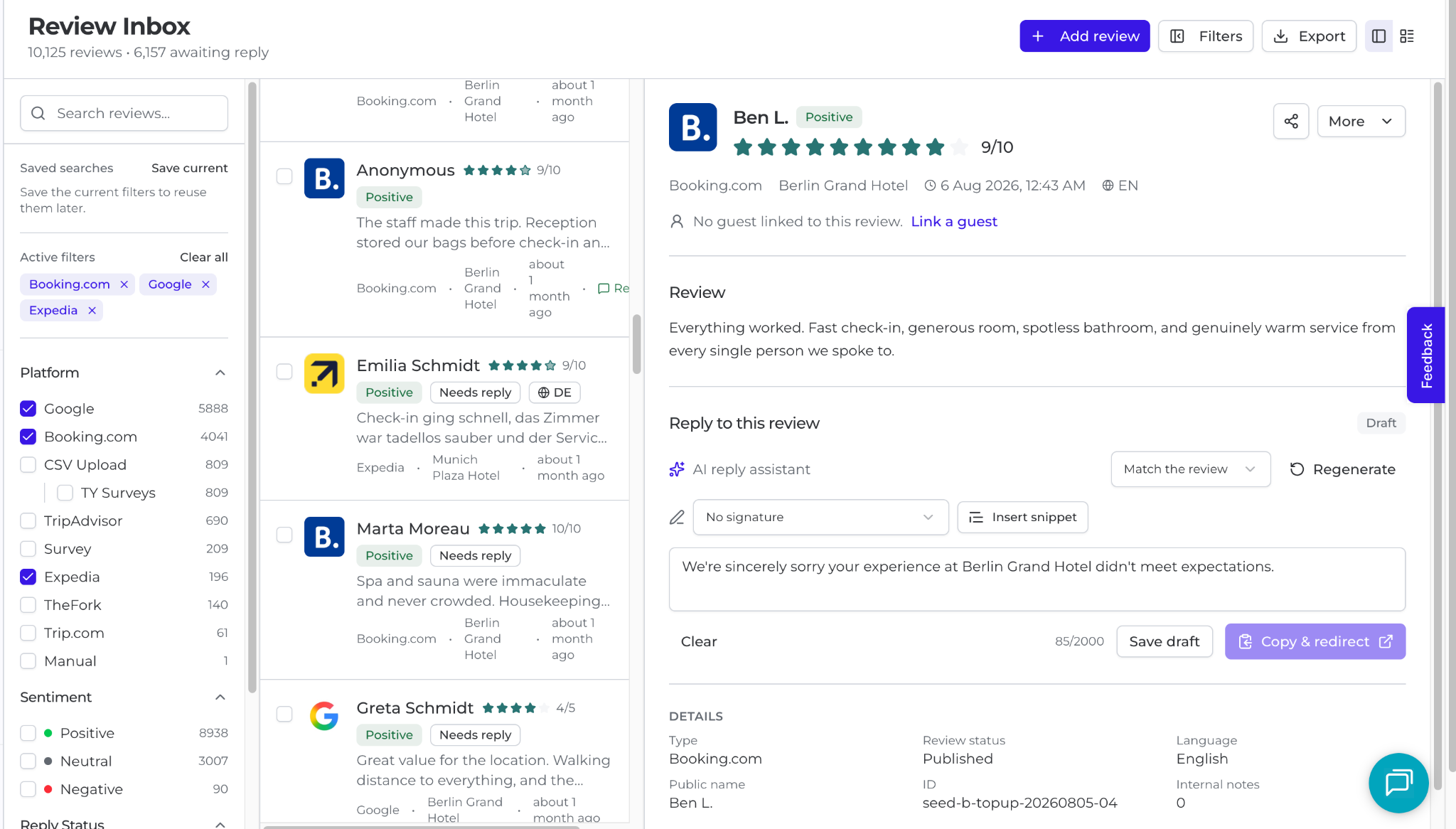
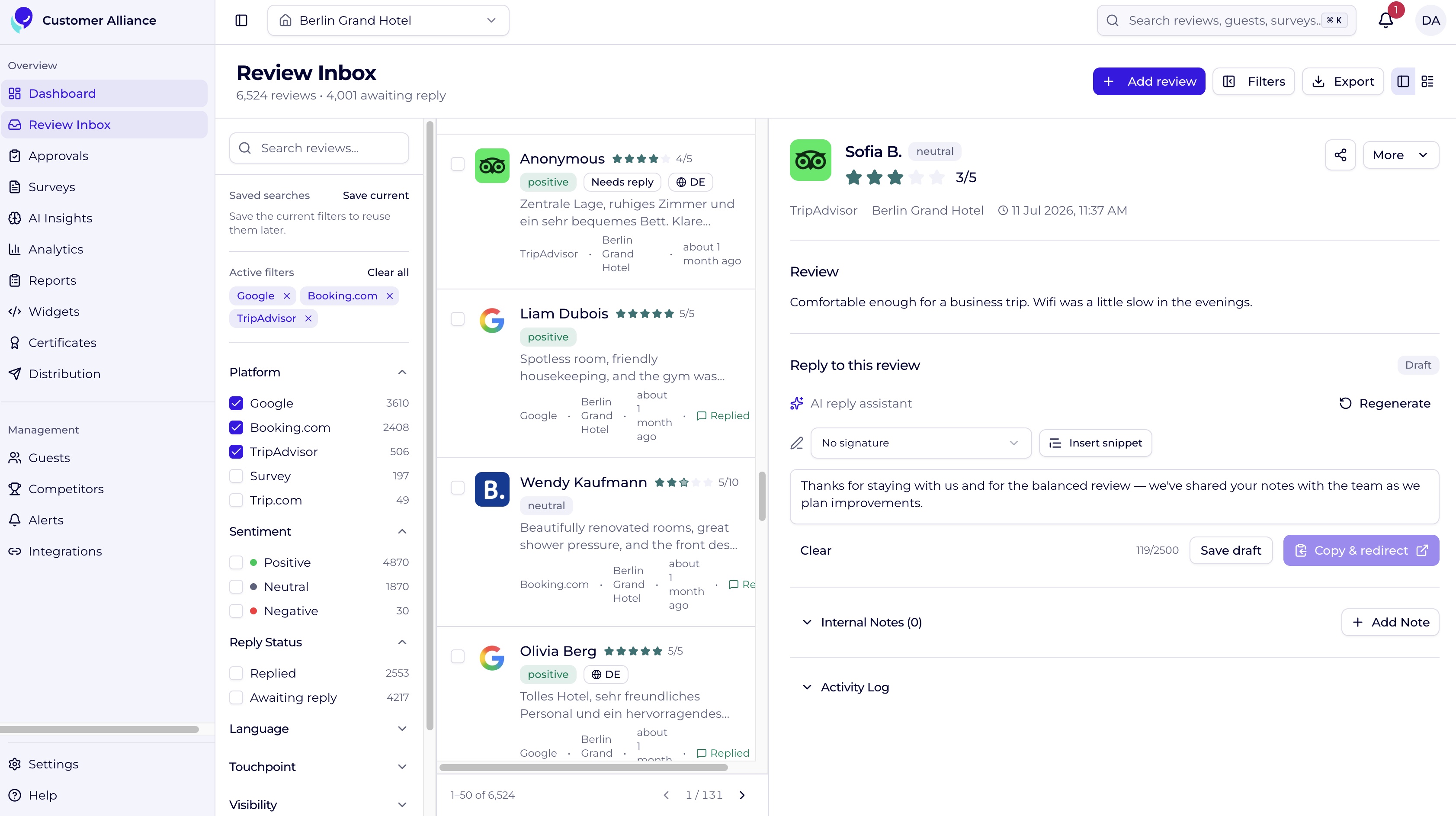
The Review Inbox is a live, unified feed of reviews from third-party portals alongside completed guest surveys. A filter bar lets you isolate feedback by platform, date, score, sentiment, or reply status, so you focus on what matters right now.
Each review card shows reviewer name, average score, a sentiment indicator, and reply status; expanding it reveals full text and sub-question scores.
Reply manually or generate a draft in your defined brand voice, then edit before sending.
For directly connected portals, click to post instantly; for external portals, your reply is copied to the clipboard and you're redirected to paste and send.
Schedule replies for later, tag teammates for escalation, and import offline or paper feedback by uploading a CSV that flows straight into your analytics.
Surveys: get targeted feedback beyond public reviews
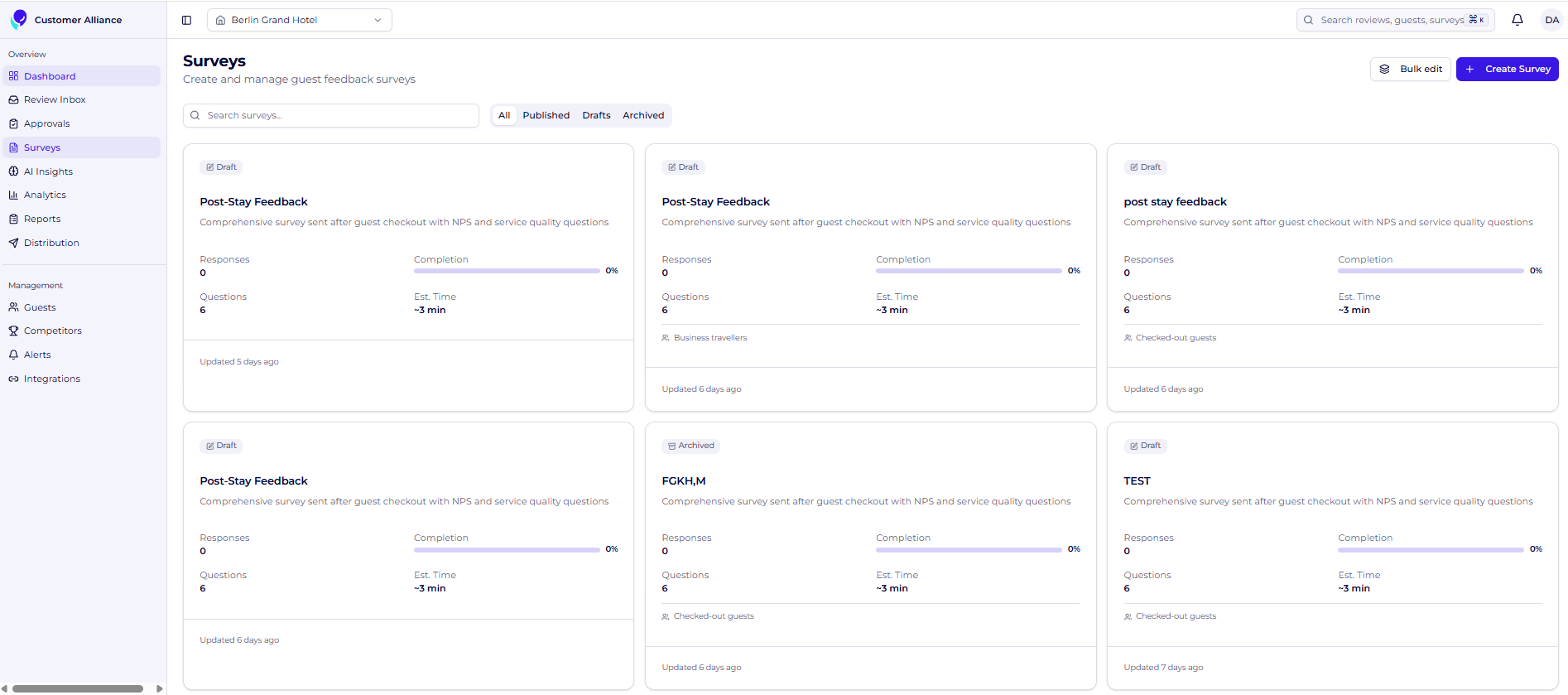
The redesigned, drag-and-drop survey builder lets you ask guests about the moments that shape their stay and send surveys to targeted audiences. Distribute them by automated email or a static link in QR codes, digital signage, or your Wi-Fi login page.
Start from a blank survey or a pre-built industry template.
Choose from NPS, CSAT, CES, 1–5 star, emoji ratings, short and long text, and single- or multi-select questions.
Add conditional sub-questions: for example, an automatic follow-up when a guest gives a detractor score, to gather depth without cluttering the survey.
Preview on desktop and mobile, save drafts automatically, and publish so surveys fire when your triggers are met. Unlimited surveys are available on plans that include them.
Distribution: send feedback requests to the right guests at the right time
Distribution is where you build, send, and monitor the campaigns that get your surveys in front of guests at the right moment. Using data from your PMS integration, you can segment your audience and reach guests before they arrive, during their stay, or after they check out.
See account-wide performance: open rates and click-through rates at the top of the dashboard, with real-time stats for every active campaign below.
Create a campaign in a few steps: name it, choose automated (triggered by system events) or manual delivery, link the survey and its trigger (for example, two days after check-out), write the subject and body, and apply your branding.
Deploy across multiple channels and let automated campaigns run in the background once they're live.
Analytics: understand your feedback in depth
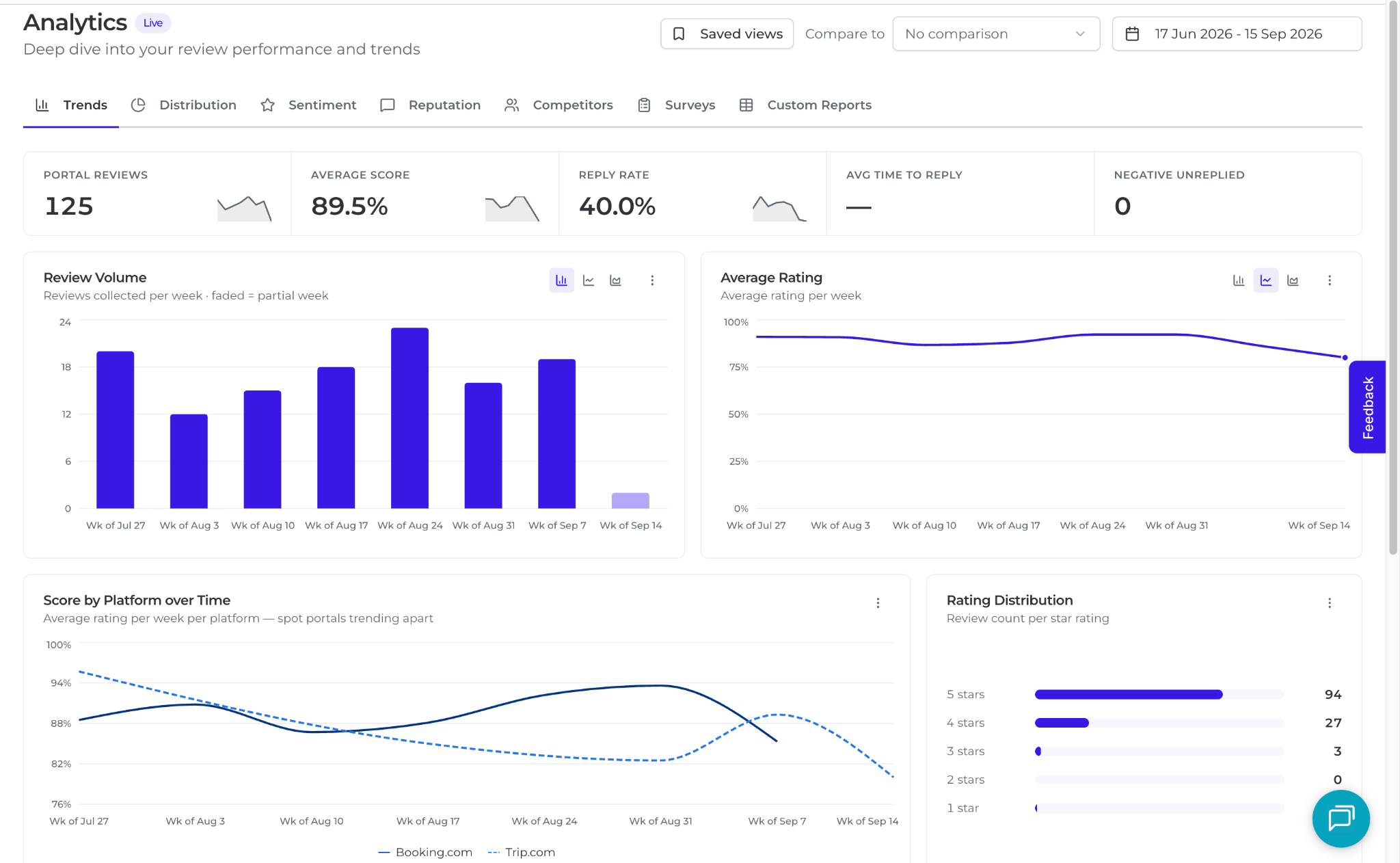
Inside the new Customer Alliance platform you find the Analytics area, where hoteliers can drill into specific data points. The top cards mirror your home dashboard, and a global date filter updates four specialised sub-dashboards at once.
Trends: review volume, average rating, and per-property performance over time.
Distribution: volume and score per platform, direct survey performance, and a multi-property matrix by channel.
Sentiment: positive, neutral, and negative counts, plus property-by-property sentiment mapping.
Competitor overview: a streamlined health check against configured competitors, with a dedicated Competitors module for deeper benchmarking.
AI Insights and Key Driver Analysis: know where to act
AI Insights reads across all your open-text reviews and survey comments and synthesises thousands of guest words into clear, actionable themes, so you stop reading feedback one review at a time.
A summary section with Performance Momentum shows which operational areas are improving and which are declining versus the previous period.
"What's Going Well" and "What Needs Improvement" group sentiment by category; click into any category to see the exact quotes and sub-themes driving it.
The AI generates tailored, on-site recommendations, with a thumbs-up / thumbs-down feedback loop that trains the model for your specific property.
Key Driver Analysis identifies the exact levers that move your overall satisfaction most, measuring not just what guests talk about, but how heavily each topic influences their final score. If breakfast is a primary negative driver, it can pinpoint whether food temperature or service speed will yield the biggest rating increase once resolved, so you invest where it matters.
Reports: share performance with leadership and teams
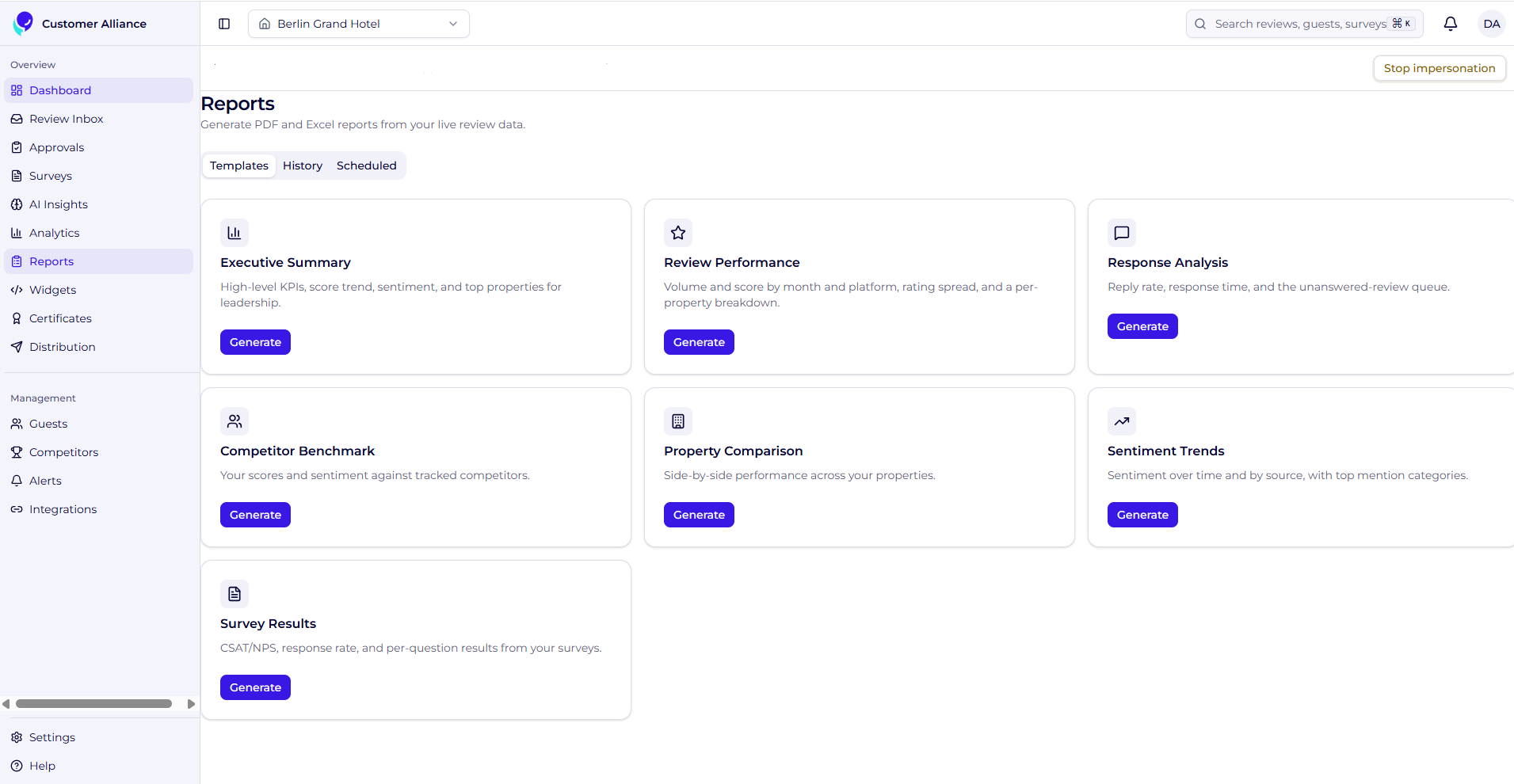
Reports export clean, professional PDFs for leadership, stakeholders, and teammates who don't log in. Use built-in templates (previewable before you generate), or build a custom report by selecting the exact modules and charts you need. The Schedule tab automates recurring delivery to stakeholder inboxes, and the History tab keeps an audit log of what was sent and to whom.
Website widgets: show guest feedback on your website
Website widgets are floating JavaScript elements that display live review scores and guest feedback on your site as social proof. Choose a simple rating badge or a review carousel, then hand the generated code to your webmaster, or use the API for a fully custom, brand-matched widget.
Integrations: connect your hotel tech stack
The Integrations area is the central hub for connecting your digital ecosystem, so guest feedback flows into the tools your team already uses.
Review portals: manage direct API connections, or request a connection for channels without a native link.
Core systems: connect your PMS and CRM to automate guest-data syncs and trigger survey campaigns on stay events.
Collaboration channels: route real-time alerts into Slack or Microsoft Teams.
API keys and webhooks: generate secure tokens to pull raw data into analytics platforms and custom applications. New integrations connect via OAuth or API-key exchange and activate immediately.
Who is the Customer Alliance platform for?
The Customer Alliance platform is built for hotels, and grounded in the reality of how hoteliers actually work. It gives the people who own the guest experience (general managers, cluster and regional managers, and revenue teams) a single shared view of guest feedback, each reading it through the lens that matters to their role rather than working from separate reports.
It works the same way whether you run one property or hundreds. Independent hotels, hotel groups and chains, and hotel management companies all use Customer Alliance to keep standards consistent and ground their decisions in what guests actually experience, Dorint Hotels & Resorts, for example, manages guest feedback across nearly 60 hotels on the Customer Alliance platform.
For general managers, that means fewer fire drills and proof that operational changes landed with guests. For cluster and regional managers, it means portfolio-wide benchmarking and consistent reporting across properties. For revenue and commercial teams, it means a clearer read on the experience signals that shape reputation, visibility, and booking confidence.
Know what to improve, and prove it worked
Your systems keep the hotel running and show you what happened. Customer Alliance's new platform is built to show you how it landed with the guest, what to focus on next, and whether the last change worked. That is the shift from managing reviews to guest feedback intelligence. Hotels investing in this layer now aren't just adding a feedback tool; they're building the layer that makes everything else in their stack more valuable.
Ready to see the new Customer Alliance? Book a demo and discover how the platform helps your team collect better feedback, understand what guests value, and prove where to focus next.
Frequently asked questions
What is guest feedback intelligence?
Guest feedback intelligence is the practice of bringing together everything guests say, across review portals, surveys, languages, and time and turning it into structured, shared, and actionable understanding across the whole hotel. Built on four pillars (capture, understand, share, and act), it lets a hotel see what guests are consistently experiencing, which issues matter most, and whether recent changes worked, rather than reading feedback one comment at a time.
How is Customer Alliance different from other review management tools?
Other review management tools tell you what guests said and help you reply. Customer Alliance tells you which issue to fix first, whether your last operational change moved the score, and how the guest experience is shaping reputation and bookings. That decision-making layer is what makes it hard to drop without returning to guesswork.
What kinds of surveys can I build?
You can build surveys from a blank canvas or a template, using NPS, CSAT, CES, star and emoji ratings, text fields, and single- or multi-select questions. Conditional sub-questions let you trigger targeted follow-ups based on a guest's answer, and unlimited surveys are available on plans that include them.
Is the new Customer Alliance platform available now?
Yes. The AI-first platform is available now to hotels and groups worldwide, and existing feedback workflows; reputation management, review collection, replies, and surveys, remain core to it.
Does the platform integrate with a hotel's existing systems?
Yes. A dedicated Integrations area lets teams connect review portals, integrate a PMS and CRM, send alerts into Slack and Microsoft Teams, and access API keys and webhooks so feedback data can move wherever they work.
Customers expect an excellent experience both in-store and online. Even if your enterprise doesn’t have a physical store, the consumer experience is still a defining factor. The voice of the consumer is what your shoppers say about their experience with your brand. Use consumer feedback to put your shop in front of the competition.
Read on to see how you can harness the power of feedback to elevate your ecommerce shop.
Why is the Voice of the Consumer important for ecommerce?
Voice of the customer, also called voice of the consumer, is now the leading way to understand your customer. Be proactive about asking for feedback. Let consumers tell you what they want and need to remove the guesswork from discovering their desires. To review, see The Voice of the Customer Guide: Importance, VoC tools and examples.
89% of consumers worldwide make the effort to read reviews before buying a product (1).
This stat alone reveals how influential the voice of the consumer is to other potential consumers. What others have to say about your products often provides more value and trust to your brand than what you have to say about your own shop.
Investigate what is being said about your company. If it’s good, use it to promote. If not, use the feedback to improve. Let’s dive into how you can collect this feedback.
Methods of gathering customer feedback
The opportunities for feedback collection are plentiful. Consider these ways to capture your voice of the consumer data.
Questionnaires
Send out a questionnaire to ask for feedback regarding different stages of the customer journey.
Did they find your website intuitive?
Was checkout easy?
Were they satisfied with the product/service?
Would they recommend you to a friend? (Yes, this is a Net Promoter Score question.)
Just because your shop operates online does not discount the importance of interviews. Interviews offer a great way to obtain the raw, unfiltered voice of the consumer data and it will build trust with those whom you interview.
Conduct the interview over the phone or even by email at the convenience of your client. Make sure to ask them if you can record the interview and even use them on your website for customer quotes.
If you have the capabilities, use live chat to talk to customers when they’re on your site. They’ll love the convenience of a quick answer and will find their purchasing made easier as they could quickly get an answer to their question.
Additionally, to reduce cart abandonment, consider putting a live chat on your checkout page or pricing page.
Show you care by taking reviews seriously. Many customers find that brands don’t respond to their reviews at all and guess what? When you don’t respond to reviews, you risk increasing your customer churn by 15%. (3)
Turn negative feedback in your favour
Respond well to negative feedback. And yes, consumers look for how a company responds to negative feedback. If you end up collecting a lot of reviews (as you should!), you’re bound to have a few negative ones. But you know what? That works to build trust. 30% of consumers will not believe your reviews to be real if you don’t have any negative ones (4).
Additionally, by responding quickly and appropriately, you might be able to convince a consumer to edit their rating or review of your shop and end up with another positive review.
Negative customer feedback is also always an opportunity to learn from the voice of the consumer. Perhaps they’ll enjoy your product overall, but mention a small pain point in a review or questionnaire. Fix it to increase sales and customer satisfaction.
Optimise, optimise, optimise
Oh, and another thing we’ve heard to be helpful: Optimise product descriptions based on feedback. Then your consumers’ expectations are more likely to match your product or service. And then they’ll be happy, and likely loyal!
Improve your shop based on customers’ likes and dislikes. This goes beyond your company’s offerings, but also includes the customer experience:
Were they able to find all the information they needed?
If not, was help readily available?
How did they experience the checkout process?
Did the product description accurately reflect the product?
Evolve whether it’s positive, neutral, or negative. Analyse the results and make actionable decisions.
Use feedback to encourage purchases
As the ecommerce industry is online, it relies heavily on consumer reviews and ecommerce shops need quite a bit of reviews per product to drive revenue. Look:
Reviews of 50 or more per product can mean a 4.6% increase in conversion rates (4).
Increase your ecommerce shop’s conversion rate by using voice of the consumer data directly on your website. Many companies encourage purchasing by displaying consumer reviews.
For example, here at Customer Alliance, we offer a widget that clients can integrate on their website to display the customer feedback they receive.
Lastly, it’s important to distribute consumer feedback among various review portals to build your online presence. Make sure you have reviews on all relevant review platforms. By doing so, you’ll attract new consumers to your website.
In conclusion, investing in a voice of the consumer solution is an excellent step to building your ecommerce site’s online visibility and promoting customer trust.
Sources:
Trustpilot Report: The critical role of reviews in Internet trust
Learning Hub: 51 Customer Review Statistics to Make you Rethink Using Them
Chatmeter: Google Confirms Responding To Reviews Improves Your Local SEO
Vendasta Infographic: 50 Important Stats You Need to Know About Online Reviews
We’re so excited to announce the launch of in-app and in-web surveys! Also known as microsurveys, they offer a short, targeted and timely way to collect customer feedback right inside your website or app.
With lots of use cases and instant, actionable data, we can’t wait to see how microsurveys will get you even better results. But first, let’s dive in and learn more about this powerful feedback tool. Here we go!
In-Web And In-App Surveys vs “Traditional” Surveys
Traditional surveys are multi-question or multi-page and are often sent to the customer via email. These types of surveys still hold tremendous value, providing deep insights that are key to any Voice of the Customer program.
But there are some instances where bigger isn’t necessarily better. Microsurveys are the perfect complement to traditional surveys, targeting the here and now of specific customer scenarios.
What Makes In-Web And In-App Surveys Different?
Microsurveys ask just one core question (with an optional conditional question), making them quick and easy to complete. By reducing the number of steps the customer needs to take, microsurveys reduce friction.
As they appear right on the screen, they also eliminate the need to leave the website or app to give feedback. This results in a higher response rate and even more valuable data for your business.
Microsurveys allow you to ask the right questions at the right time with customisable triggers. Your microsurvey could appear on a certain page, like a booking confirmation. Or it could pop up when a customer clicks a specific button, for example after hitting ‘Send’ on a message. This helps capture feedback when the topic is still fresh in the customer’s mind (which will again make them more likely to respond!)
How To Use In-Web And In-App Surveys
In-web and in-app surveys can be used for many different question types depending on your business goals. This includes:
Numerical ratings (for metrics like NPS, CSAT and CES)
Star ratings (e.g. to share opinions on the quality of an article)
Free text fields (e.g. to provide suggestions about a product)
Multiple choice (e.g. to give a reason for cancellation)
Let’s take a look at a few ways microsurveys can be used in practice.
Improve A Process
In a bid to increase revenue, a hotel is looking to optimise its booking process. To do this, they collect opinions using one simple question that appears when a user has completed a booking.
This Customer Effort Score (CES) question offers a simple way to learn how easy the user found the booking process. Depending on the score given, the in-web survey could also include a follow-up, free text question, like:
Awesome! Anything else we can do to improve?
Thank you! How can we make the booking process easier?
Understand Customer Churn
A car dealership wants to know why some customers cancel their maintenance plan so they can improve their offer. To do this, they ask a single, multiple-choice question to users of their app when they have completed a cancellation.
The car dealership can then analyse the responses for trends to steer the direction of their service. For example, if most respondents answered ‘It was too expensive’, the dealership may consider lowering the monthly cost or introducing an additional service into the plan.
Measure Customer Loyalty
A company wants to identify their most loyal customers and convert them into brand ambassadors. A single Net Promoter Score (NPS) question gives them the ideal solution.
Again, the company could ask a follow-up question that changes depending on the score given. Run continuously, this microsurvey will also allow them to track changes in overall customer loyalty.
Sounds Great! How Do I Get Started With In-Web And In-App Surveys?
Simply schedule a call with your Customer Success Manager who will answer your questions and help you get set up! Alternatively, if you are not yet working with Customer Alliance but would like to find out more, you can schedule a free, no-obligation demo with us by clicking the button below.
“We know that people want to hear other people’s experiences to help them make decisions.”
That’s what Google say about the development of Search Generative Experience (SGE). Soon, being found online won’t just be about optimised websites and targeting keywords. It will be about your entire digital footprint, including how other people talk about your brand.
In this article, we’ll explore how this evolution is set to shift the way businesses approach online visibility and give you a clear strategy going forward.
Understanding and adapting to these changes is crucial for anyone looking to stay ahead in the digital marketplace. So let’s demystify SGE–your roadmap to mastering the future of online search starts here.
How SGE will change the way people search
To understand why external content will be so powerful for online visibility, first, we need to get familiar with the goal of SGE.
According to Google:
“With the new generative AI functions, search becomes even more efficient. Thanks to these advances, you can understand a topic more quickly, gain new perspectives and insights, and complete your tasks more easily.”
What does this mean in practice? Imagine a traveller, let’s call her Sarah, planning a trip to Paris. She’s not just looking for any accommodation; she wants to stay in a quintessentially Parisian boutique hotel. It has to be pet-friendly because her dog Roscoe goes wherever she goes. Sarah also cares about sustainable practices and wants to make the most of Paris’s café scene.
Traditionally, Sarah might search “pet-friendly boutique hotels near Eiffel Tower”. She would likely click on a few different pages, weigh up the amenities, read vague descriptions, and cross-reference locations. Then once she’d narrowed down her best options, she might check for sustainability credentials and search the areas for local cafés.
SGE aims to condense Sarah’s quest into a single, intuitive search query: “Eco-friendly pet-friendly hotel in Paris near cafes”.
The websites that Google’s AI thinks are the most relevant for that query will show up at the top of the page, above organic rankings (and sometimes even above paid ads).
So how can you feed Google the information it needs to ensure your business shows up where it matters most?
Look beyond your website
As we pointed out at the start of this article, Google is interested in hearing what other people think of your brand, not just how you present yourselves.
That’s not to say that you needn’t bother optimizing your website for search—far from it—but it means that external content is just as important. This includes:
Your customer reviews
Your social media profiles (and what you post there)
Mentions of your brand on other websites and social media
Together, these create a complete picture of your brand authority that tells Google how to include you in the search results. Their goal is to provide the most relevant content for their users, so the more information they have about you, the more accurately their algorithms can figure out where to place you.
Customer reviews: the next big thing for SGE ranking
Of the types of external content we mentioned above, we think reviews will become one of the most important factors for ranking when SGE rolls around. Why? Not only do reviews provide insights from people who’ve actually used your products or services, they also tell Google more about what you do well and how certain demographics might experience your business.
To prepare for SGE, we recommend three things:
Get more reviews
Encourage more detailed reviews
Reply to your reviews
1. How to get more reviews
Most businesses take a hands-off approach to reviews. They expect some, though not all, happy customers to share their feedback and leave their review volume up to chance.
If you want to reap the benefits of reviews for SGE, you need to take a more proactive approach. There are many ways you can encourage customers to leave reviews. The key is to make it as quick, convenient and easy as possible.
Here are a few ideas to get you started:
Generate a direct Google review link through your Google My Business listing. This will prevent a poor user experience where a customer has to navigate through multiple screens to share their feedback.
Add the link to your email signature for a subtle review reminder that is seen many times a day.
Add the link to your website in high-traffic areas like your homepage to prompt return visitors.
Create a template review request email to run strategic review campaigns. Great copy, personalisation and a direct link can help increase your review volume.
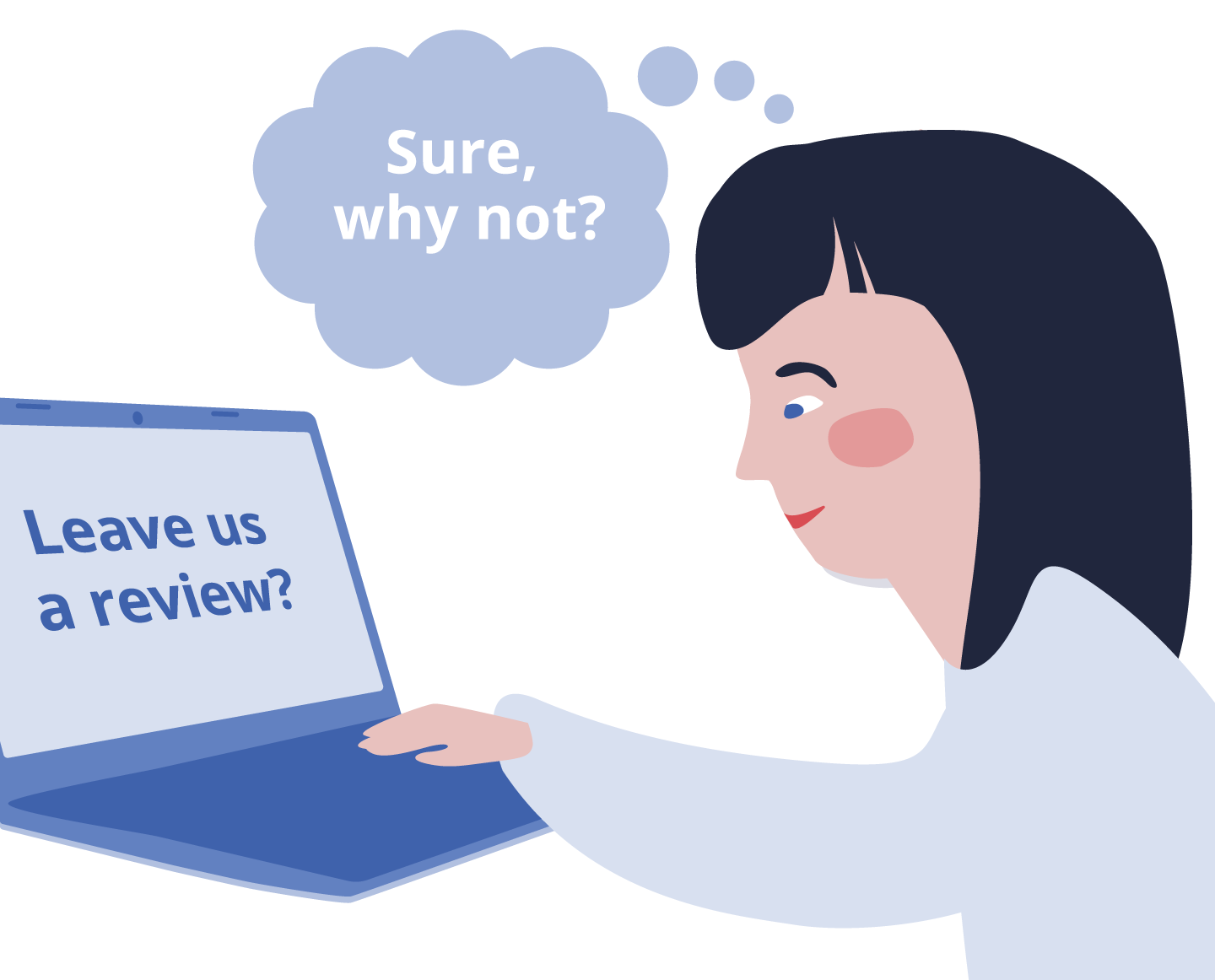
Design “Leave us a review” cards and a QR code with your review link. Distribute the cards with transactions or strategically place them around your business.
Add a review invitation to the end of your surveys. Since respondents have already shown a willingness to provide feedback, they’re more likely to take this extra step.
Pro tip 💡 use review management software to automate review collection. Platforms like Customer Alliance offer the most efficient way to consistently increase your reviews. Our software sends automatic invitations that allow your customers to leave public reviews in a matter of seconds, with no manual work on your end.
2. How to encourage more detailed reviews
Many reviews are surface-level, and don’t go into detail about their experience. This is fine if you just want to build up your review score on portals like Google or Yelp. However, to give search algorithms more information about your business your reviews need to include relevant keywords.
Simple prompts can help you get richer reviews that offer more information for potential customers and Google alike. For example, rather than simply asking guests you leave a review, you could ask them if there was anything they particularly enjoyed about their experience or the nature of their visit.
You can also think about this strategically. Say you’re a general manager of a hotel, and one of your unique selling points is your proximity to a popular tourist attraction. In this case, you might encourage guests to mention how they found the location convenient for their sightseeing plans.
Questions like, “Did our proximity to [Tourist Attraction] enhance your stay?” or “How did you find the convenience of getting to [Tourist Attraction] from our hotel?” can guide guests to provide reviews that highlight this key aspect of your hotel.
Remember, it’s important to make these prompts as natural and unobtrusive as possible. The aim is to encourage guests to share their genuine experiences in a way that also feeds directly into SGE’s demand for specificity and personalisation
3. How to reply to reviews
The quality of your responses can be just as influential as the reviews themselves in shaping public perception and improving your SGE rankings. Responding to all types of reviews, not just the positive ones, shows a well-rounded and authentic approach to customer service. It provides additional content for SGE algorithms to scan, improving your search relevance and demonstrating active engagement with your customer base.
A good review response should be personalised, addressing the customer by name if possible, and reflect genuine appreciation for their feedback. Whether the review is positive or negative, acknowledge the customer’s experience.
For positive reviews, express gratitude and reiterate any specific points they praised, subtly incorporating relevant keywords. For example, if a review mentions the high-quality breakfast at your hotel, you could suggest the guest might enjoy the restaurant’s signature three-course tasting menu during their next stay.
In the case of negative reviews, respond with empathy and a commitment to improve. Apologise for any issues they faced, and if appropriate, offer a way to rectify the situation. This not only demonstrates good customer service but also reassures potential customers reading the reviews.
Pro tip 💡 use AI to keep up with your review responses. As you collect more reviews, you may find that it’s hard to respond to each one manually. Customer Alliance’s AI Reply Assistant will drastically reduce the time spent replying while generating consistently high-quality, personalised responses.
Get SGE-ready with a solid review management strategy
With SGE on the horizon, your customer reviews are set to become more crucial than ever. They’re not just snapshots of customer sentiment. They’re the blueprint for how you show up online.
The key isn’t just getting more reviews–it’s getting richer, more detailed feedback. Engage with these reviews genuinely–thank your customers, address concerns, and show you’re listening. It’s not just good customer service; it’s smart SEO strategy.
Embrace this shift. Use your reviews to paint a vivid picture of your business for Google’s AI. Do this, and you’re not just adapting to the future of search–you’re owning it.
It’s a Monday morning, and you settle into your chair, cup of coffee in hand, ready to check your latest reviews. A stream of positive feedback flows by, validating your team’s hard work. But then, you spot it—a harsh, critical review that makes your heart sink. As you read closer, though, something’s off. This isn’t a dissatisfied customer; it’s a fake review.
But before the panic sets in, know this: you’re not powerless. By the end of this article, you’ll know how to combat fake reviews and minimise their impact on your business.
1. Check Google’s policy to see if the review qualifies for removal
Before you tackle the suspicious review, let’s review Google’s guidelines. They’ve provided clear rules about which reviews can be removed.
Spam and fake content: any reviews that are repetitive or showcase irrelevant content, and any reviews that aren’t based on a real experience or are from fake accounts, are against Google’s policies.
Off-topic reviews: reviews that don’t pertain to an actual experience, including ones that touch on political ideologies, social causes, or other unrelated issues, can be flagged for removal.
Restricted content: this includes reviews that share personal information, like someone’s address, phone number, or any other private data. It also covers reviews promoting illegal or harmful activities.
Illegal content: any review that promotes illegal activities or includes hateful speech against a group based on race, gender, religion, or other protected categories is against Google’s terms.
Sexually explicit material: any review containing explicit content or language will be removed.
Conflict of interest: reviews written by employees, owners, or competitors, which can be seen as biased or malicious, violate Google’s policies.
After acquainting yourself with Google’s guidelines, revisit the review in question. Does it violate any of the above policies?
If you’re unsure, it’s still worth flagging the review. Google’s support team will then assess its validity. It’s always better to bring a potential issue to their attention than to let a possible fake review tarnish your business’s reputation.
2. Flag the fake review in your Google Business Profile
Fortunately, requesting that Google remove a review is fairly straightforward. Here are step-by-step instructions to guide you through the process.
Finding the review on your profile:
Log in to your Google My Business account.
On the dashboard, select the location of your business (if you have multiple locations).
Click on “Read reviews” from the menu on the left
Browse through the reviews to locate the one you suspect is fake.
Once you’ve identified the fake review:
Directly to the right of the review, you’ll three dots
Click on the dots an then ‘Report review’
Describing the review:
After clicking the flag:
A window will pop up asking why you’re reporting the review
Choose the relevant reason and then ‘Send report’
3. Request denied? Submit a one-time appeal of the fake review
It’s disheartening when a clearly fake review remains on your profile even after you’ve reported it. However, Google provides another way to assert your case – a one-time appeal. Here’s how to navigate this process:
Understanding the criteria for re-evaluation: Before proceeding, it’s essential to know that Google will only re-evaluate reviews based on their guidelines and policies. This means that the content of the review should clearly violate these guidelines for a successful appeal.
Steps to launch your appeal:
Go to the Reviews Management Tool
Confirm your email address
Select your business and then click ‘Check the status of a review I reported previously and appeals options’
At the bottom of the page, select Appeal eligible reviews and then select the review you want to appeal
Click ‘Continue’ and then ‘Submit an appeal’
In the new tab, fill out the form and submit it
You’ll receive an email with the verdict of your appeal
How to make your appeal stand out
Clarity is crucial: while you need to be concise, ensure you’re clear about which guidelines the review violates. For example, instead of just stating it’s fake, specify how it may be from a biased source or contains false information about services/products you don’t offer.
Present your evidence: if you have any supporting evidence, like email correspondence that contradicts the reviewer’s claims or timestamps proving inaccuracies, make sure to include them. This added layer of verification can bolster your appeal.
Professional tone: always maintain a professional demeanor in your appeal. Even if the fake review has emotionally affected you, avoid using charged language. Stick to the facts and be objective.
After submitting an appeal for a review on Google, the response time can vary. Typically, you can expect to hear back from Google within 3 to 5 business days, although this can be longer during peak times or for complex cases. It’s essential to remain patient and periodically check your email, including the spam folder, for any notifications from the Google My Business team.
4. When removal isn’t possible: how to lessen the impact of a fake review
While it’s frustrating when Google won’t take down a fake review, it’s not the end of the world. In fact, how you respond can make a significant difference in how potential customers perceive your business.
Write a reply that showcases your credibility to other customers (while making it clear the review is not to be trusted)
Responding to a review—especially a fake one—requires tact and professionalism. Your response can influence potential clients and show that your business values feedback and integrity.
Tips for crafting a professional response
It’s natural to feel attacked by a fake review, but resist the urge to retaliate. Start by acknowledging the reviewer’s feedback, e.g., “Thank you for taking the time to leave a review.”
Without directly stating the review is fake, highlight any discrepancies. For instance, “We checked our records, and it seems there might have been some confusion. We don’t offer the service you mentioned.”
Show that you’re proactive about finding a resolution. “We value all feedback and want to understand your experience better. Please feel free to contact us directly at [your contact info] so we can address any concerns.”
End on a note that emphasises what you do best. “We pride ourselves on [a unique selling point, e.g., “providing top-notch customer service”], and we hope that all our customers leave feeling satisfied.”
Remember, your response isn’t just for the person who left the review—it’s for all the potential customers reading it. By showcasing your professionalism and dedication to customer satisfaction, even a fake review can become an opportunity to highlight your business’s integrity.
Pro tip 💡 Customer Alliance’s AI Reply Assistant wites high-quality, personalised responses with just one click, making it easy to respond to even the trickiest reviews.
Run a review campaign to drown out the fake review with genuine, positive reviews
A single negative or fake review can disproportionately sway potential customers. However, one of the most effective ways to counteract this is by amplifying the voices of your genuine, satisfied customers.
Launching a review campaign can help spotlight these authentic, positive experiences. Here’s how you can get started:
Identify customers who’ve had a recent positive experience with your business. Then, send personalised requests through your email marketing provider, asking them to share their experience on the relevant review platform. Pro tip: make it easy for them by sharing a direct link to write a review if possible.
It’s natural for some customers to overlook the initial request. Send a gentle reminder after a week or so, reiterating how valuable their feedback is. Ensure it’s not too pushy; the goal is to nudge, not annoy.
Try to respond to each new review you get. Engaging shows how much you value the customer’s feedback and plays a part in drowning out any negativity from the fake review.
Get new reviews on autopilot
Review management software like Customer Alliance enables you to send review invitations to your customers automatically. Since they constantly run in the background, they make sure you always have a steady stream of reviews coming in. This helps you maintain a strong online reputation while counteracting any isolated negative or fake feedback.
Take back control from fake Google reviews
Fake Google reviews can be a challenge, but they’re manageable with the right approach. While it might be tempting to react emotionally to unjust feedback, it’s essential to remain calm and strategic. By staying informed and understanding the tools at your disposal, you can tackle these challenges head-on.
Remember, how you handle adversity often speaks louder than the adversity itself. Engage with reviews professionally, be transparent in your communications, and always prioritize the concerns of genuine customers.
Instead of getting frustrated with fake feedback, use it as an opportunity to showcase your business’s strengths. Your proactive approach to managing reviews, both real and fake, can set you apart from the rest.
FAQs about how to remove fake Google reviews
Q: What’s the first step to take when I suspect a Google review is fake?
A: If you believe a review is fake, the first step is to familiarize yourself with Google’s content and review policies. This helps you determine if the review in question violates any of their guidelines. If it does, you can proceed to report or flag it through your Google Business Profile.
Ensure you document the review (like taking a screenshot) before any actions, as you might need it later for reference or appeals.
Q: I flagged a fake review, but Google didn’t remove it. What now?
A: If you’ve flagged a review and Google didn’t take action, it doesn’t mean the end of the road. You can submit a one-time appeal for a re-evaluation. Navigate to the Google My Business Help Center, choose “Contact Us”, and follow the prompts related to reviews.
When appealing, provide a clear, concise explanation about why you believe the review is fake, and if possible, share any evidence (like correspondence or transaction records) that supports your claim.
Q: Are there other ways to mitigate the impact of a fake review if it can’t be removed?
A: Absolutely! If a fake review can’t be removed, it’s important to respond to it professionally. A well-crafted response can reassure potential customers of your dedication to service.
Mention any discrepancies in the review without being confrontational and offer a way for the reviewer to contact you directly. Additionally, consider running a review campaign to encourage genuine, positive reviews from your satisfied customers, which can overshadow the negative impact of a fake one.

.png)



.png)

.webp)
.webp)