
.png)



Patient feedback matters. Consider this fact: A hospital reputation consisting of good online reviews and positive provider reviews boast 1.2 USD million more in their revenue than those with a poor hospital reputation (1). How’s your healthcare organisation’s reputation management? Do you use a hospital feedback form to collect patient experience feedback and patient feedback on doctors?
If not, you’re losing on the patient experience, which means you’re losing revenue unnecessarily. Read on to see how to change that.
Businesses across industries are rapidly employing the Voice of the Customer to listen to their customers by collecting feedback, analysing it, and acting to improve their offerings. The healthcare industry is no exception.
Your patients want to know their opinions matter and potential patients will research to see if the patient experience matters to your organisation. Check out the Feedback economy 101 for 8 solid reasons to invest in patient experience feedback with a patient experience survey.
Convinced? Let’s talk about how to start.
Potential patients will research your clinic’s or hospital’s reputation. If you have good reviews, they just might make an appointment. Potential patients will go from research, to interacting, to continual communication and engagement.
First, consider all touchpoints where your organisation interacts with the patient. It’s essential to capture their experience with a patient feedback questionnaire at all relevant touchpoints.
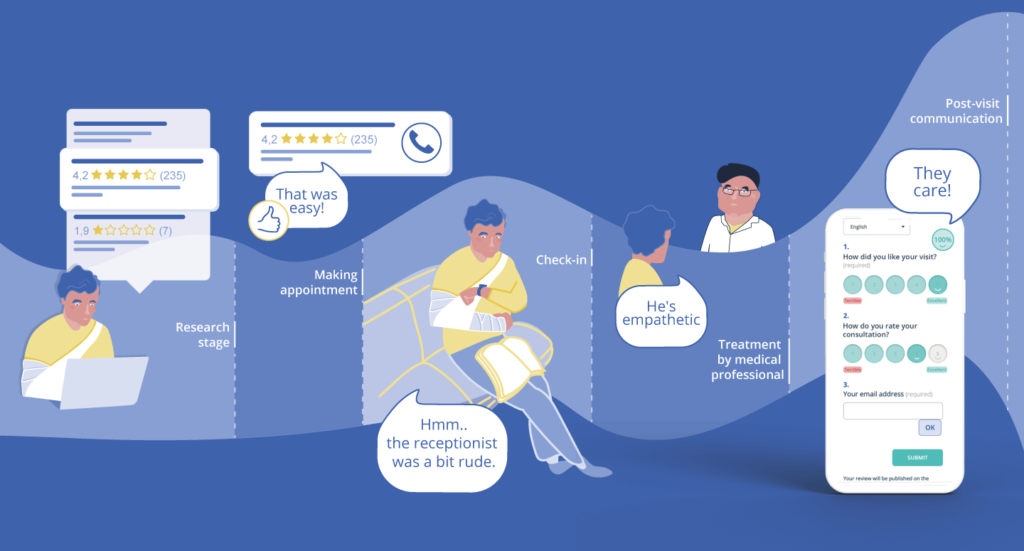
Determine what you want to learn from your patient feedback form. Then, formulate the questions accordingly.
Types of data you can use a survey to get:
Of course, you can also use a patient feedback questionnaire to gain information pre-visit. What’s the patient’s medical history, how’s their well-being, how did they find your healthcare organization, etc.?
Are you looking into patient satisfaction in healthcare, trying to get hospital feedback with a hospital feedback form, or wanting to create a patient experience survey?
How to give 360 feedback forms to your patients? After determining which touchpoints you wish to use for patient engagement, proactively communicate with them. Automated emails, surveys, and text messages are a great way to connect, inform, and show you care.
Consider utilising a patient surveying platform that will help you map out the customer journey, automate messages and surveys, provide analytics, and your online reputation management.
As mentioned, a VoC survey platform can provide you with semantic analytics that lets you know how your patients feel about certain topics. You'll also be able monitor important metrics such as a Net Promoter Score or Customer Satisfaction Score across multiple touchpoints and locations.
Set benchmarks to monitor patient satisfaction over time and locations. Dig into the patients’ emotions at different touchpoints. And then, see what their overall experience is like by asking them for reviews.
McKinsey & Company reports that many healthcare organisations heavily invest in advancing the patient experience. However, they fail to achieve their objectives. Why? They don’t understand what matters most to their patients (2).
Don’t just send out surveys to placate your patients. Send them to listen. Analyse them to learn. Then, of course, use them to improve.
There will be negative feedback, but you can use that to engage and advance. Studies show that when a patient’s negative feedback is addressed, patient satisfaction doubles. It increases to almost 99% (3). Don’t miss out by not acting.
As we’ve just said, you can make negative feedback work in your favour. Of course, positive feedback needs to be visible too. At the end of a survey, you can ask patients if they’re okay with publishing reviews to a public site like Google.
Almost 70% of patients view positive patient reviews as “very” or “extremely” important for selecting a healthcare provider (3).
So, don’t miss out on the opportunity to increase your online ratings.
We also recommend displaying your patient reviews directly on your website to build trust with future patients. Show the world you care about the patient experience.
To sum up, patient feedback is the best way to improve the patient experience. Insights gleaned from your patients offer so much more though.
So, it's clear. The importance of patient feedback cannot be underestimated. Start listening to them now.
When you receive negative feedback, first, take a moment to understand the core issues highlighted by your patients. This might involve specific aspects of care, such as wait times or staff behaviour. Then, engage in a structured review process with your team to develop actionable plans. For example, if patients frequently cite long wait times, you might implement a new appointment scheduling system or enhance patient communication regarding wait expectations.
To encourage more patients to provide feedback without feeling pressured, create a culture of openness and show genuine appreciation for their input. Explain how their feedback contributes to concrete changes in care. Use surveys at different points of the care journey, such as after appointments or procedures, and make these surveys accessible through various means like in-office tablets, emails, or text messages. Emphasize anonymity and confidentiality to ensure patients feel safe sharing their honest opinions.
Integrating technology like feedback management software fundamentally transforms the feedback process. These platforms offer patients a direct and convenient way to communicate their experiences in real-time, leading to richer, more detailed feedback. For healthcare providers, this means an increased volume of feedback that can be quickly analysed and acted upon. Furthermore, technology enables the automation of feedback requests after each patient interaction, ensuring a steady stream of insights into patient satisfaction and areas for improvement.
Sources:
[hubspot portal="2001288" id="bdbe298b-bab3-48d8-8400-ae6e80518a7d" type="form"]
Découvrez comment les informations issues de l'IA, les flux de travail automatisés et les tableaux de bord unifiés peuvent réduire le travail manuel et améliorer la satisfaction au sein de votre hôtel.
obtenir une démo personnalisée


