





If you’re a business owner or marketing manager, you know that online reviews can make or break your reputation. And when it comes to reviews, Google is one of the most impactful sites there is. That’s why it’s so important to learn how to reply to Google reviews like a pro. Whether they’re good, bad, or average, you need to know how to handle them. But it’s not always easy to know what to write. To help you out, we’ve put together 20 great Google review response examples. So take a look, get inspired, and start using them to reply to your business reviews.
Note: Even with great examples to hand, replying to all your reviews can be time-consuming. To help you reply to reviews 3x faster, we launched AI Reply Assistant. See how you can generate personalised, unique review responses in just one click.
Writing a good response to a Google review can be tricky – how do you make your customer feel heard and respected, while also showing that you took their feedback seriously? A good response strikes the perfect balance between authenticity, diplomacy, and respect. To do this, you should keep these five best practices in mind when replying to your customer reviews.
Responding to reviews in a timely manner is an important part of developing a strong relationship with your customers. In fact, 52% of customers expect a reply within 7 days of leaving an online review.
When customers take the time to leave feedback, they want to know that their opinion matters and that you care about what they have to say. By responding in a timely fashion, you show them that you respect their voice, their opinions, and value the time they took out of their day to provide feedback.
Plus, having quick reactions can remind potential customers that great customer service isn’t just something you talk about – it’s actionable and something your business stands by. Being proactive about reviews also helps you understand customer wants or needs so that your business can continue to improve. All in all, being timely when replying to Google reviews is essential for creating lasting relationships with your customers while building trust and credibility.

Personalising replies to your business’s Google reviews is a great way of demonstrating your commitment to customer satisfaction and building customer loyalty. With personalised responses, you can address every review in an individual manner, making sure customers receive tailored replies catered to their particular experience with your business.
Adding a personal touch doesn’t have to be time-consuming. It can be as simple as using the customer’s name and pinpointing specific things they mentioned in their review. It shows that you’re not just wheeling out a standard stock response, but have taken the time to really acknowledge their feedback and craft a thoughtful reply. This leaves a lasting impact on your customers, and also makes a great first impression for people encountering your business for the first time.
Being authentic in replies to customer reviews can make all the difference for your business. When customers leave reviews, it’s because they’re taking their time to interact with your business. So showing appreciation for that feedback and expressing genuine sincerity is paramount.
If a customer can tell that you’re truly listening to their opinion, then it can encourage them to keep interacting with your business and maybe become a repeat customer. Responding thoughtfully and honestly will also put you miles ahead of the competition. After all, customers appreciate feeling like more than just another purchase – so give them something truly valuable: authenticity.
Acknowledging customers’ opinions when replying to Google reviews is an essential part of providing good service. By acknowledging the customer’s opinion, you show them that their voice and experiences are valued. This encourages customers to leave more reviews, builds trust with potential customers, and may even help increase your ratings on Google.
Acknowledging what your customer says is even more important when it comes to negative reviews. No one wants to hear negative feedback about their business, but if you ignore the bad parts of a review you can give the impression you’re simply sweeping it under the rug. By showing you take notice of the not-so-great stuff (and proposing a solution, but more on that later), you’ll do wonders for your online reputation and maybe even win back some unhappy customers.
Courtesy is essential when responding to Google reviews, since it reflects the personality and culture of your business. Kindness can go a long way when managing customer relationships – especially online ones. Reviews often contain negative comments, but taking the time to show customers your appreciation for their feedback – even if that feedback has been critical – will make all the difference.
Demonstrating respect and courtesy in all interactions makes customers feel valued and cared for, which encourages them to spread good vibes about their experience at your business, creating more positive reviews in the future. Being polite and patient sets a professional tone that goes beyond just Google reviews; it has a subtle but powerful impact on how customers view you as a business.
Now we’ve covered what makes a good review response, it’s time to dig into some specific examples that you can use for your own reviews. Let’s start off on a good note and see how you can reply to positive feedback.
“Thank you so much for your positive feedback! We appreciate your kind words and are so glad that you had a great experience with us. We strive to provide the best customer service, and we’re glad to hear that we succeeded. Thanks again!”
This example is great for when a customer leaves a 5-star review, but doesn’t necessarily give you a lot of information to work with. Remember that even if it only took a couple of minutes, every review requires your customers to take time out of their busy day. Showing your gratitude for that (particularly if it’s a great review) is an essential ingredient of any review response.
“Thank you for the positive review! We are delighted to hear that you had such a great experience. We’re especially pleased that you enjoyed the friendly staff and the quality of our breakfast. We strive to provide excellent customer service and high-quality, regional ingredients, so we’re glad that we were able to exceed your expectations. We look forward to seeing you again soon!”
Repeating what specifically contributed to your customer’s good experience plays two roles here. First, you’re showing them that you took the time to fully read their review and didn’t just skim through it. Second, you’re reiterating these positive parts of your business to any potential customers who might be reading, reaffirming that your business is the one they should choose.
“Thank you for taking the time to leave us a review! We are so glad to hear that you enjoyed your experience with us and we would love to have you back soon!”
Of course, customers always know that they’re welcome to use your business again, but a reminder helps them to feel even more valued (and might increase the chance of them actually coming back).
“Hello Francesca. Thank you so much for your kind words! We really appreciate your positive review and it was great to have you as a customer. We look forward to serving you again soon.”
Simple, but effective. Using your customer’s name makes the online exchange feel that little bit more personal and helps build a human connection. Plus, it’s another indication that you’ve actually read their review and listened to what the customer has to say.
“Thank you so much for your kind words about our hotel! We are thrilled that you enjoyed your stay with us and had such a great experience at our spa. We are always looking for ways to improve our services and we are excited to announce that we will soon be adding to our range of new spa treatments. Keep an eye out on our website for more details in the coming weeks! We look forward to seeing you again soon.”
Giving an update does two things. First, it shows the customer (and anyone else reading) that you are always working to improve your offering. Second, it gives the customer a great incentive to come back again. They obviously enjoyed the spa the first time around, and next time they can experience a new treatment that wasn’t available before. A win-win.
“Thank you so much for your kind words! We are delighted that you and your dog Hugo enjoyed your stay with us. Here at [Hotel Name], we believe that dogs are part of the family and always do our best to make sure your pet feels comfortable, happy and safe. Thank you for your support!”
Including your company values in your review replies helps to build your brand reputation, while also providing key information to would-be customers checking you out online. Take the example above. If someone is looking for somewhere to stay with their dog, they no longer need to call or email and double-check. From this reply, it’s clear that dogs are not just tolerated at the hotel, but are welcomed with open arms.
“Thank you very much for your kind review of our business. We passed your comments about your meal onto our chef and it made her day! We’re so glad you had an enjoyable time at [business name] and hope to welcome you again soon.”
Making reference to a real person impacted by the positive review serves as a good reminder that there are real people behind your business. Showing the impact a good comment can have on your staff might encourage others to leave their feedback too. It only takes your customer a couple of minutes, but can make someone’s entire day that little bit brighter.
No one wants to get bad reviews for their business, but the reality is that not everyone will have a positive experience with you. When that happens, it’s important to know how to reply. Here’s some inspiration for how you can reply.
“Thank you for bringing this to our attention. We’re sorry to hear that you had a negative experience with us. We take customer feedback very seriously and are working hard to make sure that this doesn’t happen again in the future. Please accept our sincerest apologies for any inconvenience this may have caused.”
A simple “sorry” can go a long way. Often, when people feel disappointed by a business, all they really want is for the company to recognise that it didn’t live up to their expectations. Whether you believe that’s the case or not, what’s important is how your customer feels about it.
“Thank you for taking the time to provide us with your feedback. We take the cleanliness of our hotel very seriously, and we’re sorry that we didn’t meet your expectations. We have raised the issue with the relevant cleaning staff and arranged for a refresher training session to make sure that, going forward, our high standards are always met. We hope you will give us another chance to make it up to you by offering you a discounted stay the next time you visit. Thank you for bringing this to our attention, and we hope to see you soon.”
There are actually two solutions offered in this response. The additional training to avoid having the same problem in the future, and a discount on a future stay to make up for the guest’s inconvenience. Offering a solution to your customer shows that you take their feedback seriously and aren’t just paying lip service to their concerns. This can have a great impact on customer retention, as it makes it more likely that even dissatisfied customers will give you another chance.
“Thank you for taking the time to leave your review. We apologise that you had a negative experience with [insert issue]. We would like to invite you to get in touch with us so we can discuss this further and ensure that your expectations are met. Please feel free to contact us via [insert contact information]. We look forward to hearing from you.”
Inviting a personal conversation with the customer is another way of showing that you really care about the issue at hand. It demonstrates to the customer that you care about their experience and are willing to take the time to listen to their concerns and try to fix the problem. This can go a long way in building loyal customers, and is a way of going above and beyond (so much so that the customer might even tell their family and friends).
“Thank you for taking the time to share your experience with us. We apologise that your stay was not what you expected. We would like to learn more about your experience, so we can work to improve. Could you please provide us with more details about what went wrong? We value your feedback and hope to make it right!”
This works well in instances where the customer has left a bad review but not given you much information. If they get back to you, it allows you to address the customer’s concerns in a more personalised manner, so you can provide a tailored response that meets their specific needs. It could also provide valuable feedback that may help you to improve your products and services.
“Thank you for taking the time to share your feedback. We apologise for any inconvenience you experienced and want to assure you that we are taking your concerns seriously. We’re working to resolve the issue as quickly as possible by [insert action here] and will be in touch with you soon. Thank you for your patience.”
This response is a good option if the issue the customer raised isn’t an easy fix. It shows that you’re proactive in doing something about it, even if you’re not quite there yet. Including a specific action here is key, as it makes it clear that this is an ongoing process that will take some time to improve.
“Thank you for taking the time to leave a review. We’re sorry we didn’t live up to your expectations on this occasion and would love to make it up to you! We’d like to invite you to give us another chance to demonstrate the quality of our service. Please get in touch with us directly on [contact details].”
This is a good approach as it shows future customers reading the review that this bad experience was a one-off. In fact, you’re so confident in your service that you want the customer to come back and see for themselves. It’s a great response for when something happened that was completely out of your control, for example, bad weather that meant you were extremely understaffed or emergency repairs to essential facilities.
“Thank you for taking the time to provide feedback on your experience with our company. We strive to provide the best service possible to all of our customers and we are sorry that we did not meet your expectations. We are always looking for ways to improve our services and your feedback is valuable to us. Thank you again for your time.”
Sometimes bad reviews can be scathing, but you should always keep your cool and remain professional. No matter how rude the review might be, a negative response from you will only hurt your reputation.
“Thank you for bringing this matter to our attention. We are sorry that you had to wait for an extended period of time for your appointment. We value your feedback and take it very seriously. We are continuously working to improve our services and we strive to provide a great patient experience. We will take your feedback into account and work on improving our processes in order to make sure that our patients can get the care they need in a timely manner. Sincerely, Martin Hauck – Head of Reception”
Providing your name helps give a personal touch to review replies, and is especially important when responding to negative feedback. it demonstrates that you’re taking ownership of the situation, builds trust with the customer and allows them to feel more comfortable approaching you with future concerns.
“Thank you for bringing this to our attention. We take all feedback seriously and apologize that your experience at the pool was not up to our standards. We are dedicated to providing our guests with the best experience possible, and are taking steps to ensure the pool is kept clean in the future. We will be increasing our pool maintenance staff, and implementing a stricter daily cleaning schedule. We apologize again for any inconvenience this may have caused, and we hope to have the opportunity to host you again in the future.”
Show customers you care by explaining how you’ll address their concerns and resolve the issue. Demonstrate your commitment to customer feedback and satisfaction, while showcasing that your business is open to making changes. This can help build a positive reputation and bring in new customers.
Average reviews can be the trickiest of all to respond to, since they often lack the specificity of positive or negative reviews. This can make it more difficult to identify and address any issues the customer may have had, or to provide a meaningful response. Here are some average Google review response examples to help you out.
“Thank you so much for taking the time to leave us a review. We really appreciate your feedback about our service and facilities and hope to see you again soon.”
Even if the review isn’t the most complimentary, it’s still important to acknowledge the time the person took to leave it. It’s an easy way to offer a more detailed response than a simple “thanks”, while also showing that you appreciate your customers.
“Thank you for your review! We are so glad to hear that the front desk staff were friendly and helpful. We hope you had a pleasant experience with us and we look forward to seeing you again soon.”
Highlighting the more positive parts of an average review helps to emphasise them to any potential customers reading. As well as showing you actually read the review and didn’t just write a generic response, it can also help to divert attention away from the less impressive parts of their feedback.
“Thank you for your feedback! We apologize for the length of time you had to wait in our restaurant. We understand that it can be frustrating and we are working hard to improve our wait times. We value your opinion and we appreciate you taking the time to share your experience with us.”
Even though it’s good to start with the positive parts of a review, if the customer includes some negative feedback it’s important to acknowledge it. It can help you build trust with customers by showing that you are open to feedback and that you empathise with their frustrations.
“Thank you for taking the time to provide us with your feedback! We take all customer reviews seriously and strive to provide the best experience possible. We are committed to continuously improving our services and your feedback is invaluable to us. Thank you again for your review, and please feel free to contact us with any further comments or questions.”
Given the choice, most businesses would prefer a 5-star review over average feedback. Even when a review doesn’t quite match up to where you want to be, showing customers a willingness to provide an outstanding service goes a long way in growing your online reputation, attracting customers and getting the glowing feedback you deserve.
Struggling to keep up with replying to your reviews? You’re not alone. That’s why we created AI Reply Assistant – so you can quickly generate unique, personalised and meaningful responses in a fraction of the time it takes to write them from scratch. Rather than pump out generic replies, this smart AI-powered tool picks out specific topics and sentiments from each review to create thorough, human-like responses that your customers will love.
Allowing you to generate a reply in just one click, AI Reply Assistant takes the stress out of managing lots of customer reviews in one go, giving you time to focus on the important stuff. And don’t worry: you have complete control over every response before it’s sent, so you can make sure it perfectly matches your brand’s unique voice and tone.

The online reviews your business receives are a valuable asset, as they can help boost your reputation, help you get found online, and build trust with potential customers. It’s important to respond thoughtfully to both positive and negative feedback so that you maintain a good relationship with existing customers while also attracting new ones.
With the right response strategies in place, Google review responses can be an effective tool for improving customer experience and building brand loyalty. We hope that these Google review response examples have given you a solid starting point for creating great review responses of your own.
Next up, learn how to reply as efficiently as possible, so you can get back to doing what you do best. Head on over to our article, ‘5 time-saving strategies for responding to online reviews’ to find out how!


Mit dem Wachstum eines Hotelportfolios wird auch die Auswahl der richtigen Software für das Gästefeedback-Management komplexer.
Sobald mehrere Hotels, Regionen, Teams, Bewertungsportale, Umfragen und Systeme involviert sind, geht es nicht mehr nur darum, ob man über eine zentrale Plattform Feedback erfassen und beantworten kann. Sie muss den Teams auch einen einheitlichen Überblick über das gesamte Portfolio ermöglichen und gleichzeitig Einblicke in die Situation einzelner Hotels bieten.
Worauf sollten Hotelgruppen beim Vergleich verschiedener Plattformen also konkret achten?
In diesem Artikel stellen wir sechs Kriterien vor, die bei der Bewertung einer Software für das Gästefeedback-Management besonders wichtig sind – von der Abdeckung relevanter Bewertungsportale und Integrationen bis hin zum Multi-Property-Reporting und der Fähigkeit, zu erkennen, was die Gästezufriedenheit tatsächlich beeinflusst.
Für Hotelgruppen bedeutet das Management von Gästefeedback über mehrere Häuser hinweg mehr, als nur den Überblick über eine wachsende Zahl an Bewertungen zu behalten. Es geht darum, ein einheitliches Bild der Gästeerfahrung über das gesamte Portfolio hinweg zu schaffen.Ohne einen zentralen Ansatz bleibt Feedback über Häuser, Portale, Umfragen und Teams hinweg fragmentiert – mit der Folge, dass Leistungen schwer vergleichbar sind und relevante Muster über Standorte hinweg verborgen bleiben. Ein Gästefeedback-Management über mehrere Häuser hinweg gibt sowohl zentralen als auch regionalen Teams Einblicke, welche Hotels gut abschneiden, wo sich wiederkehrende Probleme abzeichnen und wie sich die Erwartungen der Gäste innerhalb der Gruppe unterscheiden. Gleichzeitig behalten die Teams vor Ort die Kontrolle über ihr eigenes Feedback und können direkt lokal handeln. Die Kombination aus zentraler Steuerung und granularen Einblicken auf Haus-Ebene ermöglicht es Hotelgruppen, einheitliche Standards sicherzustellen und Gästefeedback organisationsweit gezielter zu nutzen.
Dorint Hotels & Resorts zeigt, wie das in der Praxis funktioniert: Die Gruppe steuert das Gästefeedback für fast 60 Hotels über Customer Alliance und schafft damit zentrale Transparenz über das gesamte Portfolio. Gleichzeitig können die einzelnen Häuser eigenständig auf Gäste reagieren und gezielt vor Ort nachfassen. So verbindet Dorint zentrale Steuerung mit lokaler Umsetzung – und organisiert sein Feedback-Programm gruppenweit.
Gehen Sie diese sechs Kriterien der Reihe nach durch. Jedes davon ist eine Fähigkeit, die ein Portfolio konkret braucht, und Customer Alliance wurde gezielt entwickelt, um genau diese Anforderungen abzudecken.
Stellen Sie sicher, dass die Software Bewertungen von jedem für Ihr Portfolio relevanten Portal erfasst, einschließlich regional relevanter Portale wie HolidayCheck im DACH-Markt, auf denen ein erheblicher Teil der Gäste tatsächlich Bewertungen hinterlässt, und konzentrieren Sie sich nicht nur auf Google, Booking.com und Expedia zum Beispiel.
Gästefeedback geht über öffentliche Bewertungen hinaus: Prüfen Sie, ob die Software auch CSAT-, NPS- und CES-Umfragen entlang der gesamten Guest Journey ermöglicht – statt nur Post-Stay Bewertungsanfragen per E-Mail.
Lassen Sie sich eine Live-Demo der KI-generierten Antworten zeigen und prüfen Sie, ob diese über verschiedene Häuser und Sprachen hinweg eine einheitliche Markenstimme enthalten, statt einer generischen Vorlage.
Das Reporting sollte hierarchisch aufgebaut sein: Die Zentrale sieht das gesamte Portfolio, Regionalmanager ihre Cluster und General Manager ihr eigenes Haus – mit Drill-down vom Portfolio bis zum einzelnen Hotel. Entscheidend ist, wie granular die Zugriffsrechte sind und wie schnell sich von einer Kennzahl zum betroffenen Haus navigieren lässt.
Prüfen Sie, ob sich die Software in Ihr PMS und CRM integrieren lässt, um Gästedaten automatisch abzugleichen und Umfragen anhand von Aufenthaltsereignissen auszulösen – statt manuelle Listen-Uploads zu erfordern. Customer Alliance bietet dafür über 100 Integrationen mit PMS-, CRM- und Revenue-Systemen, angebunden per OAuth oder API-Key
Prüfen Sie, ob die Software Feedback-Themen danach priorisieren kann, wie stark sie die Gästezufriedenheit beeinflussen – und ob sich messen lässt, ob operative Veränderungen tatsächlich Wirkung zeigen. Genau hier setzen Key Driver Analysis und AI Insights von Customer Alliance an: Sie zeigen nicht nur, was Gäste sagen, sondern welche Themen zuerst angegangen werden sollten und ob Maßnahmen den gewünschten Effekt erzielen. So wird aus Feedback-Management echte Guest Feedback Intelligence.
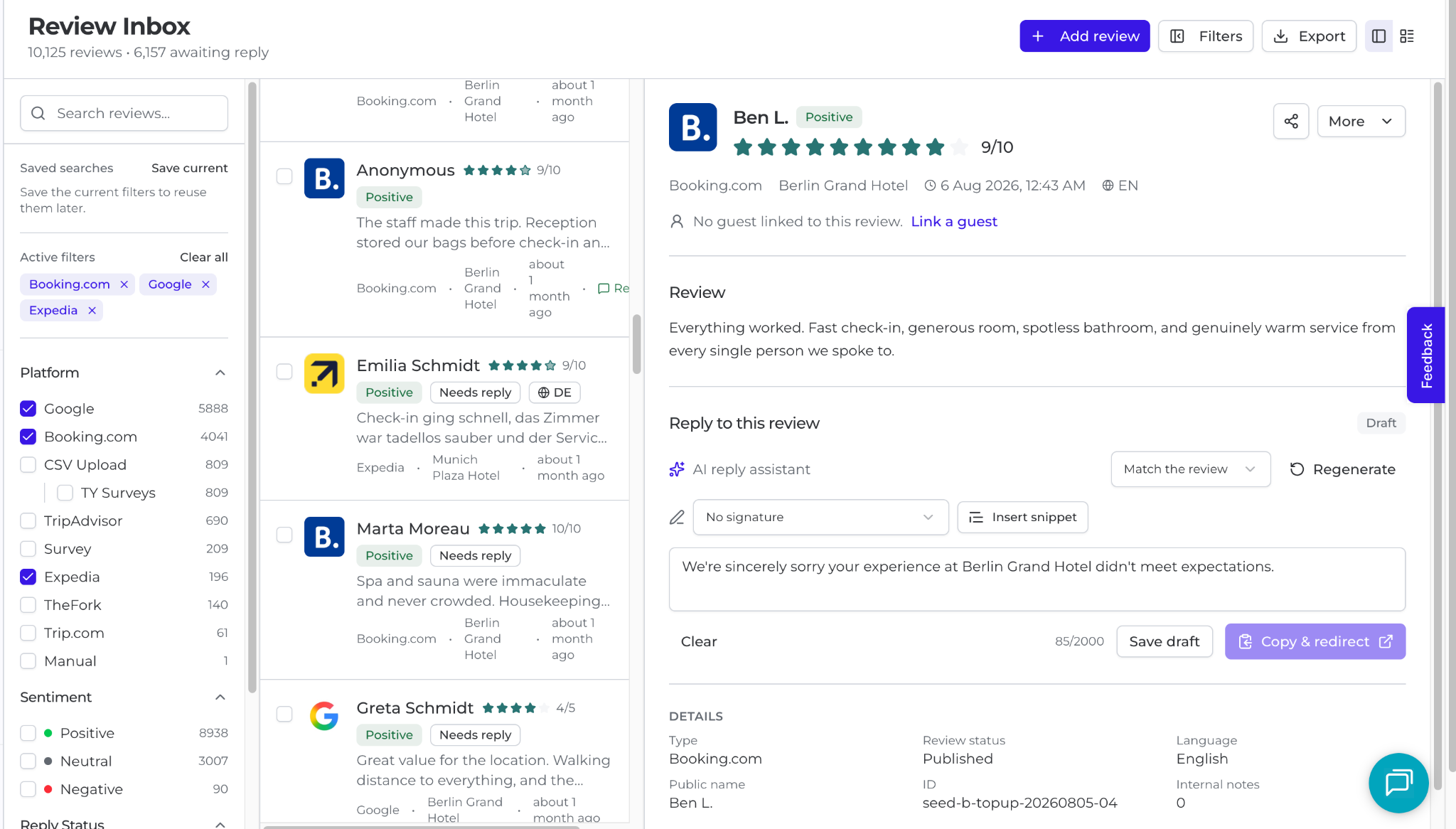
In der Praxis läuft alles in einem durchgängigen Workflow zusammen: Bewertungen und Umfrageergebnisse landen in einem zentralen Posteingang und lassen sich nach Portal, Haus, Datum oder Stimmung filtern. Der AI Reply Assistant erstellt Antworten in der Markenstimme des Hotels, die das Team prüft, anpasst und direkt über angebundene Portale oder per Copy & Paste veröffentlicht. Umfragen werden automatisch auf Basis der Aufenthalte der Gäste ausgelöst.
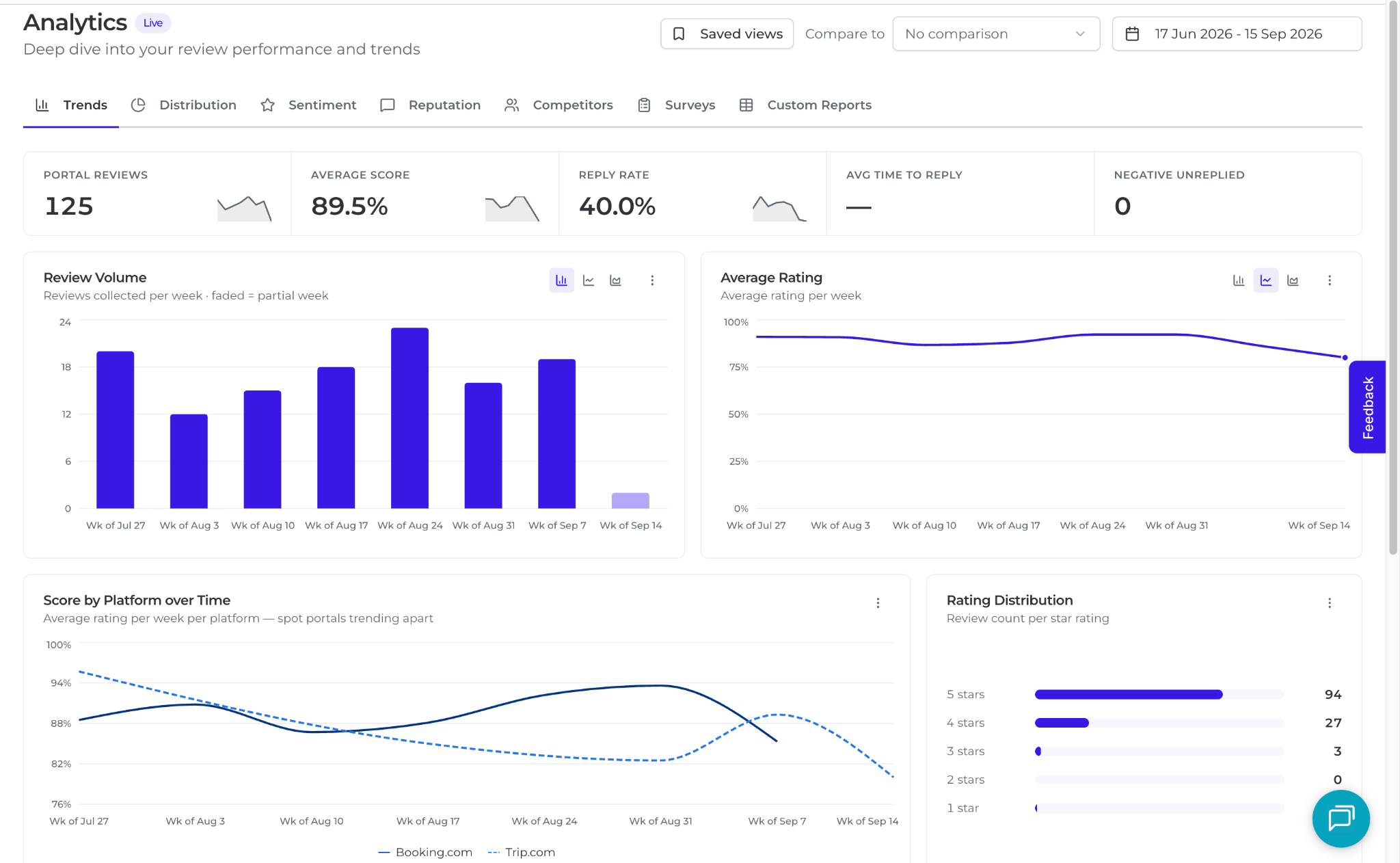
Das Reporting passt sich an die jeweilige Portfolioebene an – von der Zentrale über Regionen bis zum einzelnen Haus. Trends, Portal- und Stimmungsanalysen, Wettbewerbsvergleiche und Umfrage-Performance sind in einer Ansicht gebündelt. Zentrale Kennzahlen wie Bewertungsanzahl, Durchschnittswert, Antwortquote, Antwortzeit und unbeantwortete negative Bewertungen sind direkt abrufbar und per Klick vertiefbar. Eigene Pivot-Tabellen und Diagramme lassen sich ergänzen und ebenso wie beliebige Ansichten als PDF-Report für Stakeholder bereitstellen.
Im Hintergrund analysiert AI Insights die Freitexte aus Bewertungen und Umfragekommentaren, identifiziert Stärken und Verbesserungspotenziale, während die Key Driver Analysis zeigt, welche Themen die Gästezufriedenheit tatsächlich beeinflussen.
Erste Ergebnisse mit Customer Alliance zeigen, dass sich Zufriedenheitswerte und Sichtbarkeit von Bewertungen gemeinsam entwickeln.
Preston Palace verzeichnete nach der Priorisierung einer Renovierung anhand von Gästefeedback-Daten einen Anstieg der Sauberkeits-Zufriedenheit um 14 %; My Arbor steigerte seine Google-Bewertungen um 55 %; und Gorki Apartments erreichte in Berlin mit einem Bewertungsanstieg von 12 % innerhalb von sechs Monaten Platz 1 auf TripAdvisor. Auf Portfolio-Ebene steuert Dorint Hotels & Resorts das Gästefeedback für fast 60 Hotels über Customer Alliance und gibt der Zentrale damit einen einzigen, einheitlichen Überblick statt 60 getrennter Ansichten.
Wer diese sechs Kriterien – Abdeckung, Multichannel-Erfassung, Antwortautomatisierung, Reporting über mehrere Häuser, Integrationen und diagnostische Intelligenz – systematisch prüft, erkennt früh, welche Plattform auch im Portfolio-Maßstab überzeugt, bevor eine ungeeignete Lösung Zeit und Budget kostet.
Die Customer-Alliance-Plattform wurde speziell für Hotelgruppen und -ketten entwickelt: mit zentralen Einblicken auf Gruppenebene und der Möglichkeit, direkt vor Ort zu handeln.
Bereit, Ihre eigene Checkliste zu testen? Vereinbaren Sie eine Demo und sehen Sie, wie Customer Alliance zu Ihrem Portfolio passt.
Guest Feedback Intelligence bedeutet, Gästefeedback über verschiedene OTAs, Sprachen und Zeiträume hinweg zentral zusammenzuführen und in strukturiertes, gemeinsam nutzbares Wissen zu verwandeln. Statt einzelne Kommentare isoliert zu betrachten, werden Rückmeldungen systematisch erfasst, analysiert und priorisiert. So können Teams schneller reagieren, wiederkehrende Muster erkennen und Maßnahmen auf Basis dessen ableiten, was Gäste tatsächlich erleben. Gästefeedback wird damit von einzelnen Kommentaren zu einer kontinuierlichen Quelle für Transparenz, Reputation und operative Verbesserung.
Ja. Customer Alliance vereint Bewertungs- und Portalabdeckung, Multichannel-Umfragen, KI-generierte Antworten in der Markenstimme, hausübergreifendes Reporting und Berechtigungen, über 100 Integrationen sowie AI Insights in einer Plattform – und ist auf die Anforderungen von Hotelgruppen ausgerichtet.
Bewertungsmanagement für Hotelketten muss über Monitoring und Beantwortung hinausgehen: Es braucht hausübergreifende Berechtigungen, portfolioweites Reporting und eine einheitliche Markenstimme an jedem Standort. Customer Alliance wurde für genau diese Anforderungen entwickelt – Dorint Hotels & Resorts steuert damit beispielsweise fast 60 Hotels über einen Account.
Bewertungswerte und -volumen beeinflussen die Sichtbarkeit auf OTAs und in der Suche und können damit sowohl indirekte als auch direkte Buchungen beeinflussen. Eine gepflegte Reputation schafft zudem Vertrauen im Buchungsmoment. Customer-Alliance-Kunden wie Gorki Apartments und My Arbor berichten von höheren Bewertungswerten und besseren Buchungsergebnissen, nachdem sie Gästefeedback systematisch in konkrete Maßnahmen überführt haben.
Die neue Customer Alliance Plattform bringt Guest Feedback Intelligence in Hotels. Sie ist eine AI-first Plattform, die Bewertungen, Umfragen und direktes Feedback an einem Ort zusammenführt und Teams dabei unterstützt, Gästefeedback zu erfassen, zu verstehen und darauf zu reagieren, um das Gästeerlebnis, die Reputation und den Umsatz zu verbessern. Erfolgreiche Hotels verfügen bereits über leistungsstarke Systeme, die den Betrieb effizient steuern. Gästefeedback schafft die Verbindung zu dem, was wirklich zählt: den Erfahrungen Ihrer Gäste. Es macht sichtbar, was begeistert, wo Optimierungspotenzial besteht und welche Erlebnisse Gäste dazu bewegen, immer wiederzukommen.
💡 Möchten Sie sehen, wie die neue Plattform Ihr Hotel unterstützen kann? Buchen Sie eine Demo. Unser Team führt Sie durch die Plattform, beantwortet Ihre Fragen und zeigt Ihnen, wie sie Ihre Gästefeedback-Strategie unterstützen kann.
Die Customer Alliance Plattform ist eine AI-first Guest-Feedback-Intelligence-Plattform für Hotels und unterstützt bereits mehr als 5.000 Unternehmen aus der Hotellerie weltweit dabei, Gästefeedback zu erfassen, zu verstehen, zu teilen und aktiv zur Verbesserung nutzen. Sie führt Bewertungen, Umfragen und direktes Feedback an einem Ort zusammen. Dabei verbindet sie Review Management über die wichtigsten Portale mit individuellen CSAT- und NPS-Umfragen, AI Insights und tiefgehenden Analysen für ein ganzheitliches Verständnis der Gästeerfahrung. Bis heute hat die Plattform über 3 Millionen Gästeumfragen verarbeitet und mehr als 90 Millionen Bewertungen erfasst. Dank über 100+ Integrationen mit PMS-, CRM- und Revenue-Systemen stellt sie die gewonnenen Erkenntnisse genau den Teams bereit, die sie benötigen.
KI verändert, wie Hotels konkurrieren und Entscheidungen treffen und macht strukturiertes Gästefeedback wertvoller denn je. Es kann nicht länger verstreut in Bewertungsportalen, Tabellen und isolierten Reports liegen oder Kommentar für Kommentar manuell gelesen werden.
Deshalb haben wir die Plattform auf einem AI-first Fundament neu entwickelt und jede Kernfunktion weiter verbessert – von der Erfassung und Beantwortung von Bewertungen bis hin zu Umfragen, immer auf Grundlage dessen, was unsere Kunden benötigen. Sie macht Gästefeedback jetzt einfacher strukturierbar, verständlich und über alle Teams und Tools eines Hotels hinweg umsetzbar – und schafft so die Grundlage für die nächsten Entwicklungen.
„Gästefeedback ist nichts Neues; Hotels haben es schon immer erhalten. Die eigentliche Frage ist, wie KI dieses Feedback in Erkenntnisse, Prioritäten, Maßnahmen und messbare Verbesserungen umwandeln kann. Genau das meinen wir mit Guest Feedback Intelligence: nicht nur Bewertungen und Umfragen sammeln, sondern die Daten so aufbereiten, dass Hotels wissen, worauf sie sich konzentrieren und was sie als Nächstes tun sollten.“ Steffen Schmickler, CEO von Customer Alliance
Die Plattform folgt einem zusammenhängenden Zyklus: erfassen, verstehen, teilen und handeln. So kann ein Hotel vom reinen Sammeln von Feedback dazu übergehen, durch gewonnene Erkenntnisse zu handeln. Im Zentrum dieses Zyklus stehen zwei Perspektiven: eine bewertende Perspektive, die beurteilt, ob der Betrieb bei den Gästen positiv wahrgenommen wird, und eine diagnostische Perspektive, die priorisiert, was als Nächstes zu verbessern ist.
Die bewertende Perspektive beantwortet die Frage „Hat es funktioniert?“ Wenn ein Haus sein Frühstücksbuffet verändert, lässt sich nur dadurch herausfinden, ob die Veränderung bei den Gästen wirklich angekommen ist, indem man ihre Zufriedenheit Quartal für Quartal im Verhältnis zum Datum der Änderung verfolgt. Genau so hat Preston Palace die Wirkung der Erneuerung seines Restaurants bestätigt und die Frühstückszufriedenheit auf rund 9,0 von 10 gehoben. So weist ein GM gegenüber der Eigentümerschaft nach, dass sich eine Investition gelohnt hat, oder erfährt in aller Stille, dass dies nicht der Fall war.
Die diagnostische Perspektive beantwortet die Frage „Was sollten wir zuerst verbessern?“ Kein Hotel kann alles beheben, deshalb liegt der Wert in der Priorisierung. Die Key Driver Analysis zeigt, dass die Freundlichkeit des Personals bereits ausgezeichnet bewertet wird und nur wenig Potenzial bietet, die Gesamtnote weiter zu steigern. Gleichzeitig kann sie aufdecken, dass die Ruhe im Zimmer zwar nur mittelmäßig bewertet wird, aber einer der stärksten Treiber der Gästezufriedenheit ist.. So wird die nächste Investition dorthin gelenkt, wo sie sich wirklich auszahlt.
Die neue Customer Alliance Plattform vereint alle zentralen Funktionen an einem Ort: eine Review Inbox, einen Umfrage-Builder mit Kampagnenverteilung, AI Insights mit Key Driver Analysis, eine konsolidierte Analyseansicht, Reports, Website-Widgets und einen eigenen Integrationsbereich.Die Kernfunktionen des Reputationsmanagements – Bewertungen und Umfragen erfassen sowie Feedback beantworten – wurden gemeinsam mit Hoteliers weiterentwickelt. So vereint die Plattform jede Phase des Feedback-Zyklus in einem zentralen Arbeitsbereich. Im Folgenden führen wir durch die einzelnen Bereiche der Plattform – entlang des vollständigen Feedback-Zyklus von der Erfassung bis zur Umsetzung.
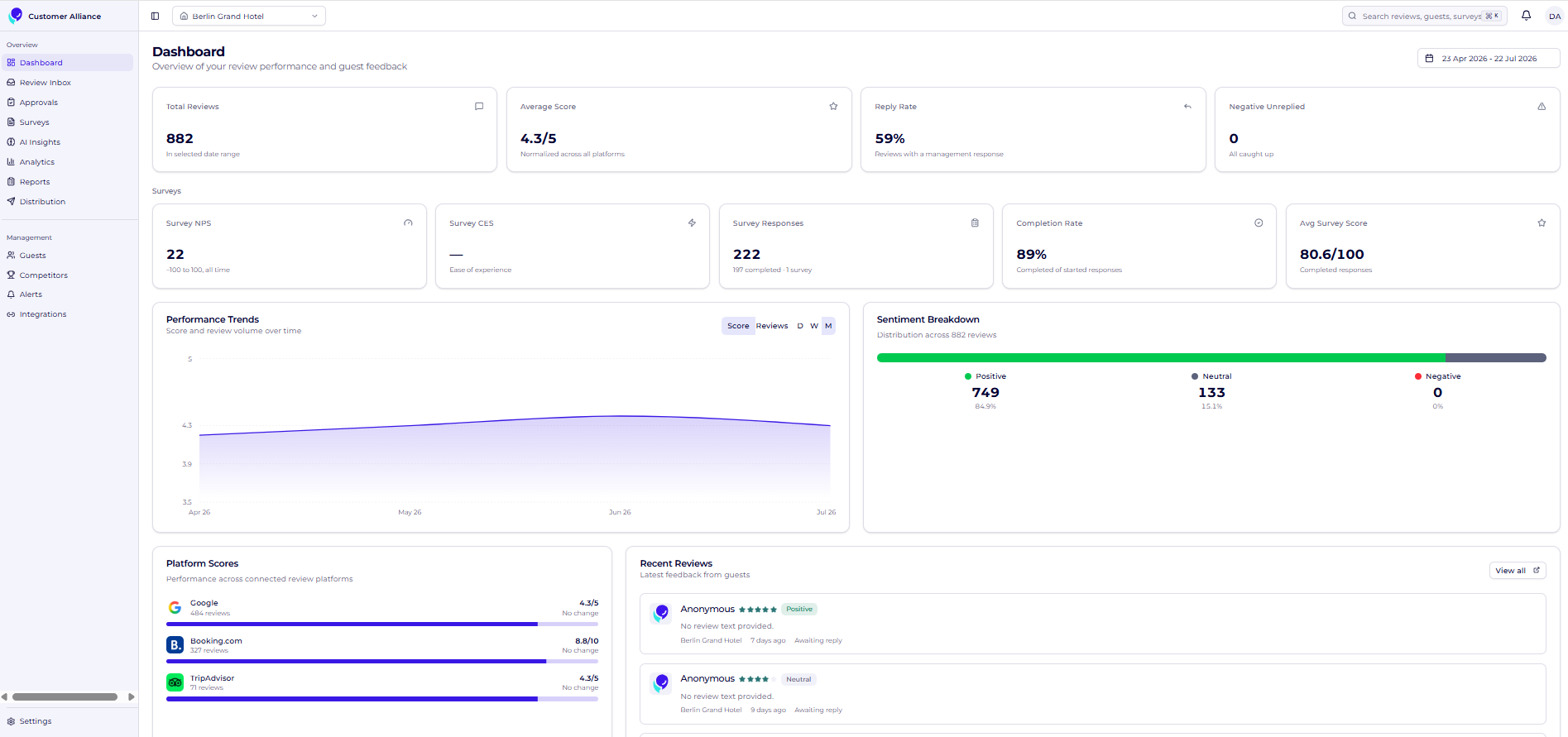
Das Dashboard bietet einen zentralen Überblick über die Gästezufriedenheit – auf Ebene einzelner Immobilien oder über das gesamte Portfolio hinweg. Mit dem globalen Datumsfilter oben rechts lassen sich Zeiträume wie die letzten 7, 30 oder 90 Tage sowie individuelle Zeiträume auswählen und alle Kennzahlen der Seite automatisch aktualisieren.
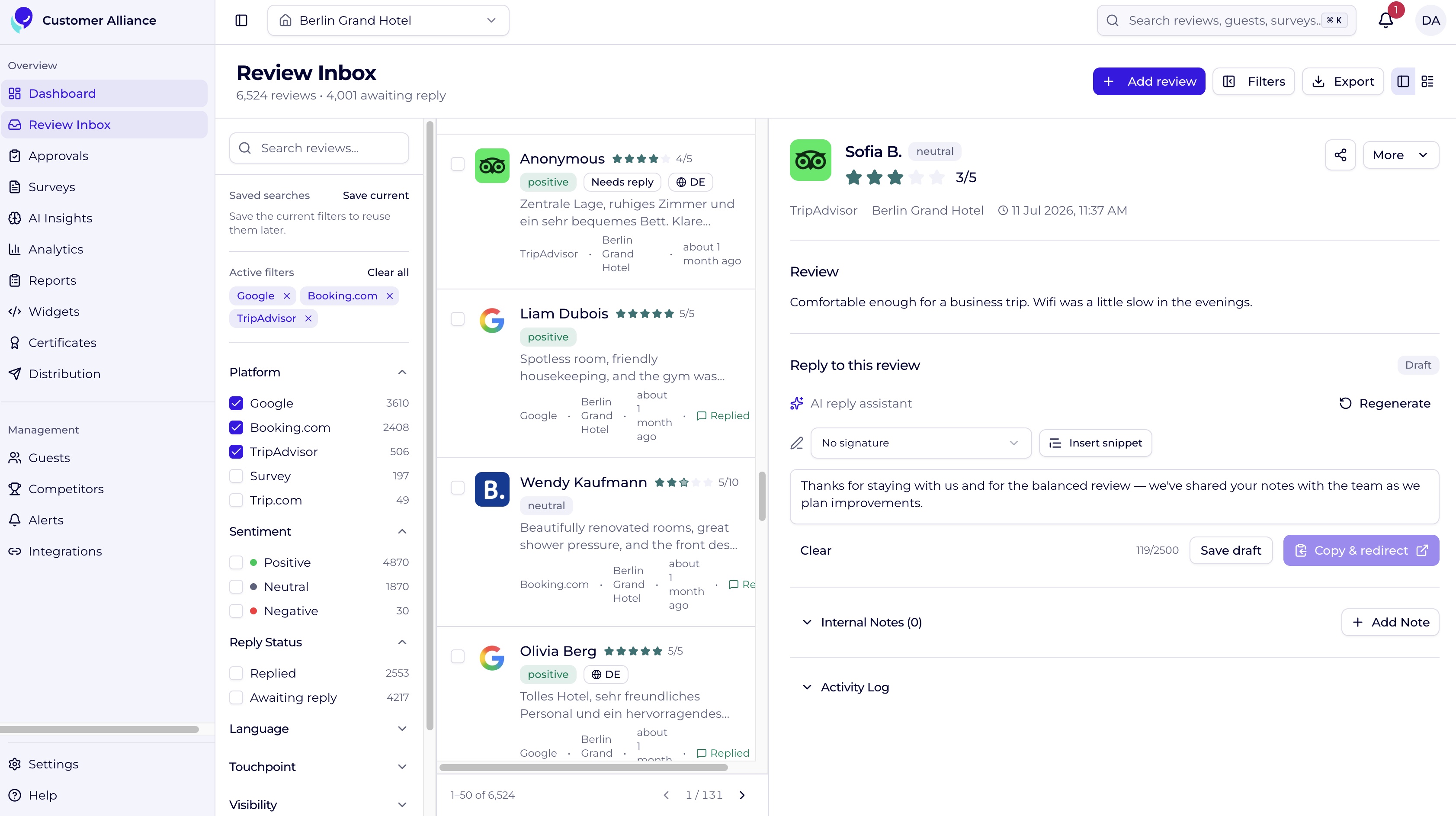
Die Review Inbox vereint Bewertungen aus Drittanbieter-Portalen und abgeschlossene Gästeumfragen in einem zentralen Live-Feed. Mit flexiblen Filtern nach Portal, Zeitraum, Bewertung, Sentiment und Antwortstatus finden Teams schnell die relevantesten Rückmeldungen und können gezielt handeln.
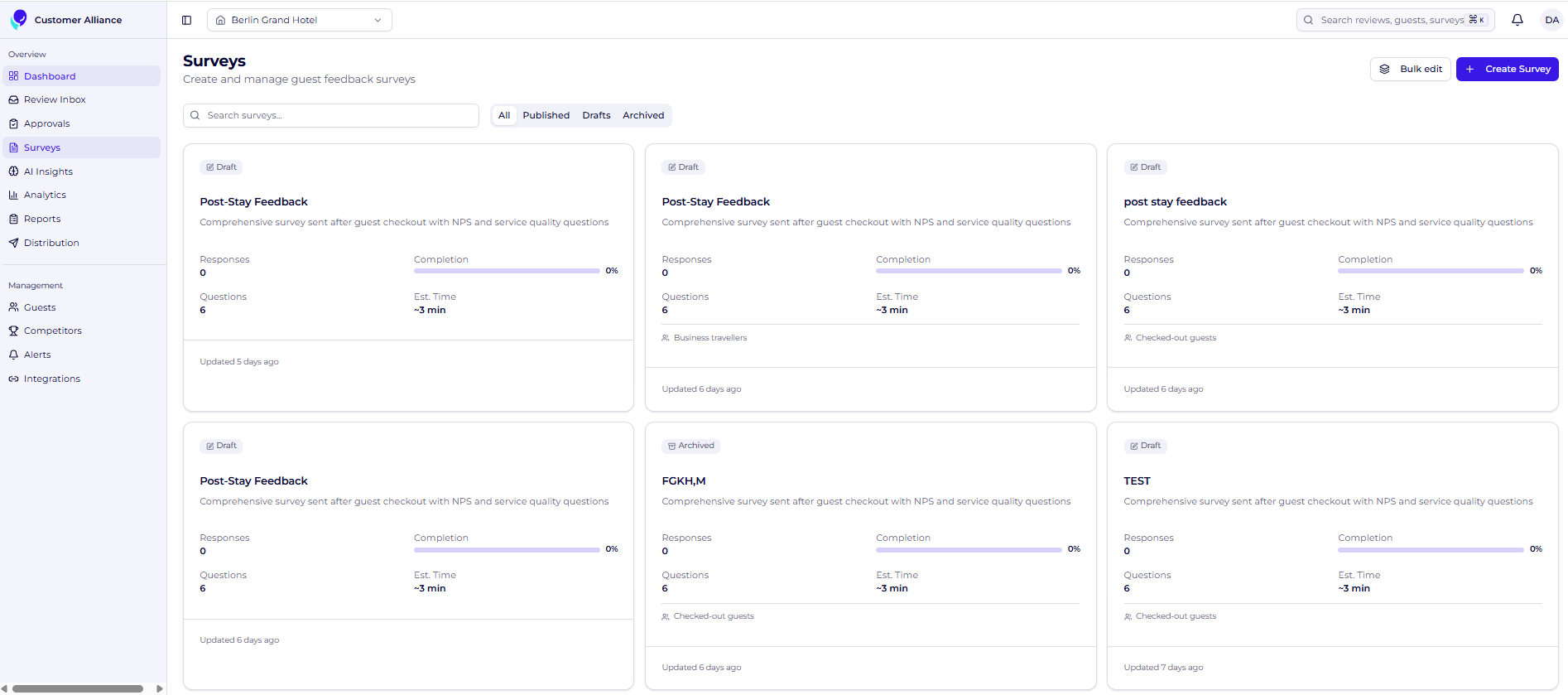
Der neu gestaltete Drag-and-drop-Umfrage-Builder ermöglicht es Ihnen, Gäste genau zu den Momenten zu befragen, die ihren Aufenthalt prägen, und Umfragen gezielt an definierte Zielgruppen zu senden. Verteilen Sie diese automatisiert per E-Mail oder über einen statischen Link – etwa in QR-Codes, auf digitaler Beschilderung oder auf Ihrer WLAN-Login-Seite.
Die Distribution ermöglicht es Ihnen, Kampagnen zu erstellen, zu versenden und zu überwachen, damit Umfragen genau zum richtigen Zeitpunkt die passenden Gäste erreichen. Dank der Daten aus Ihrer PMS-Integration können Sie Zielgruppen präzise segmentieren und Gäste entlang der gesamten Guest Journey ansprechen – vor der Ankunft, während des Aufenthalts oder nach dem Check-out.
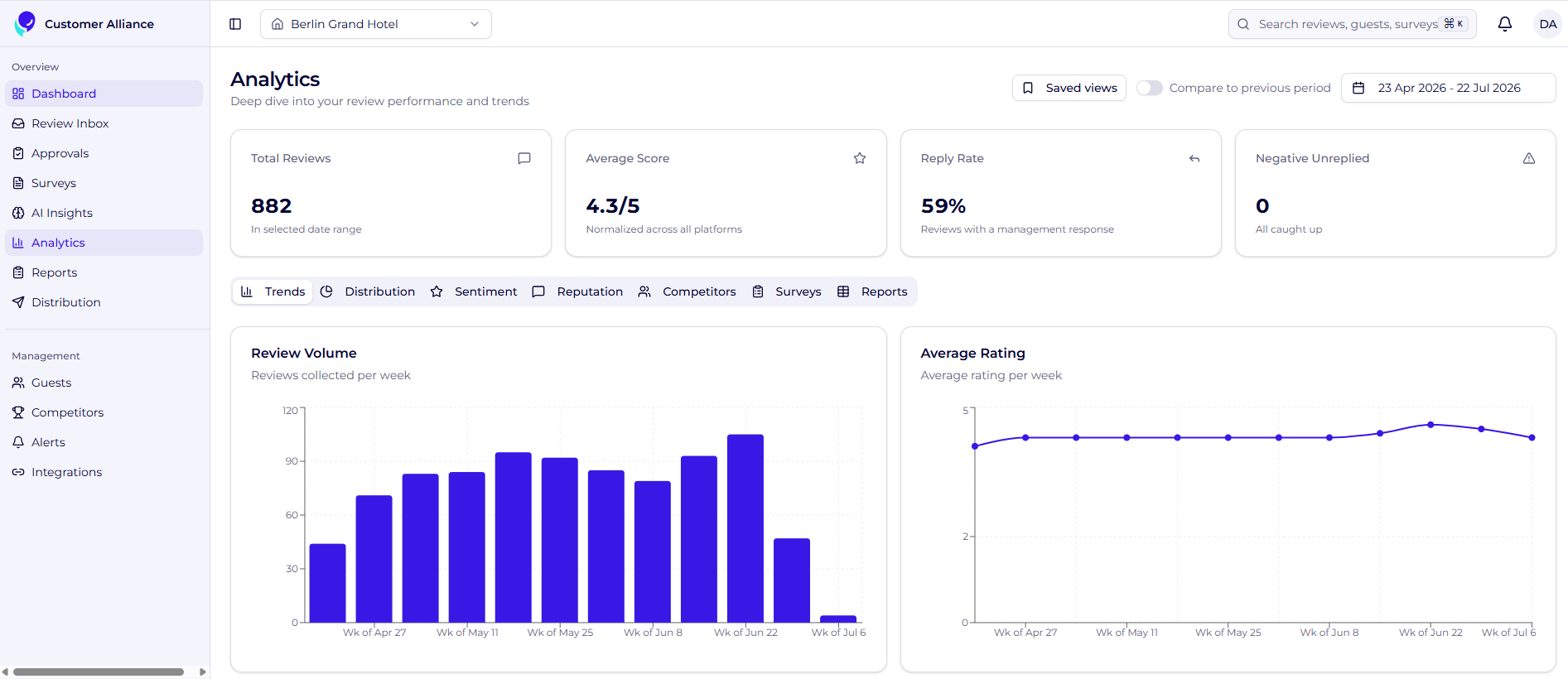
Im Analytics-Bereich der neuen Customer Alliance Plattform können Hoteliers gezielt in einzelne Datenpunkte eintauchen. Die oberen Kacheln spiegeln die wichtigsten Kennzahlen des Home-Dashboards wider, während ein globaler Datumsfilter vier spezialisierte Sub-Dashboards gleichzeitig aktualisiert
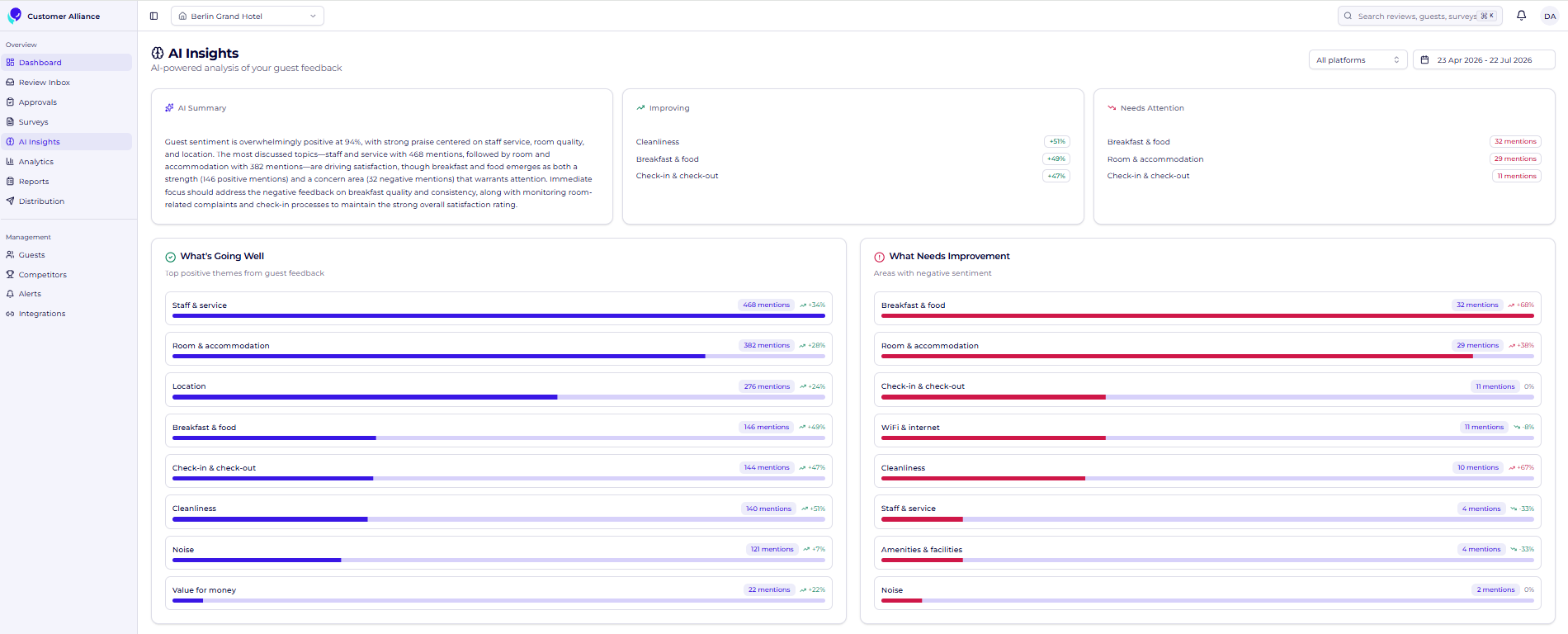
AI Insights analysiert alle Ihre Freitext-Bewertungen und Umfragekommentare und fasst tausende Gästeäußerungen zu klaren, umsetzbaren Themen zusammen. So müssen Sie Feedback nicht länger Bewertung für Bewertung manuell lesen.
Key Driver Analysis identifiziert die genauen Treiber, die Ihre Gesamtzufriedenheit am stärksten verändern, und misst nicht nur, worüber Gäste sprechen, sondern wie stark jedes Thema ihren Zufriedenheits-Score beeinflusst. Wenn das Frühstück zum Beispiel ein zentraler negativer Treiber ist, zeigt die Analyse, welche Maßnahmen den größten Einfluss auf die Bewertung haben – etwa eine bessere Temperatur der Speisen oder eine höhere Servicegeschwindigkeit. So fokussieren Sie Investitionen auf die Bereiche mit dem größten Einfluss.

Reports exportieren saubere, professionelle PDFs für Führungskräfte, Stakeholder und Teammitglieder ohne Plattformzugang. Nutzen Sie integrierte Vorlagen, die vor der Erstellung als Vorschau verfügbar sind, oder erstellen Sie individuelle Reports, indem Sie genau die benötigten Module und Diagramme auswählen die Sie benötigen. Der Reiter „Schedule“ automatisiert die regelmäßige Zustellung an Stakeholder-Postfächer, während „History“ während „History“ transparent festhält, welche Reports wann an welche Empfänger versendet wurden.
Website-Widgets sind Floating-JavaScript-Elemente, die Live-Bewertungsnoten und Gästefeedback direkt auf Ihrer Website anzeigen, um Ihre Gästezufriedenheit für andere sichtbar zu machen. Wählen Sie ein einfaches Bewertungs-Badge oder ein Review-Karussell und übergeben Sie den generierten Code Ihrem Webmaster, oder nutzen Sie die API für ein vollständig individuelles, an Ihre Marke angepasstes Widget.
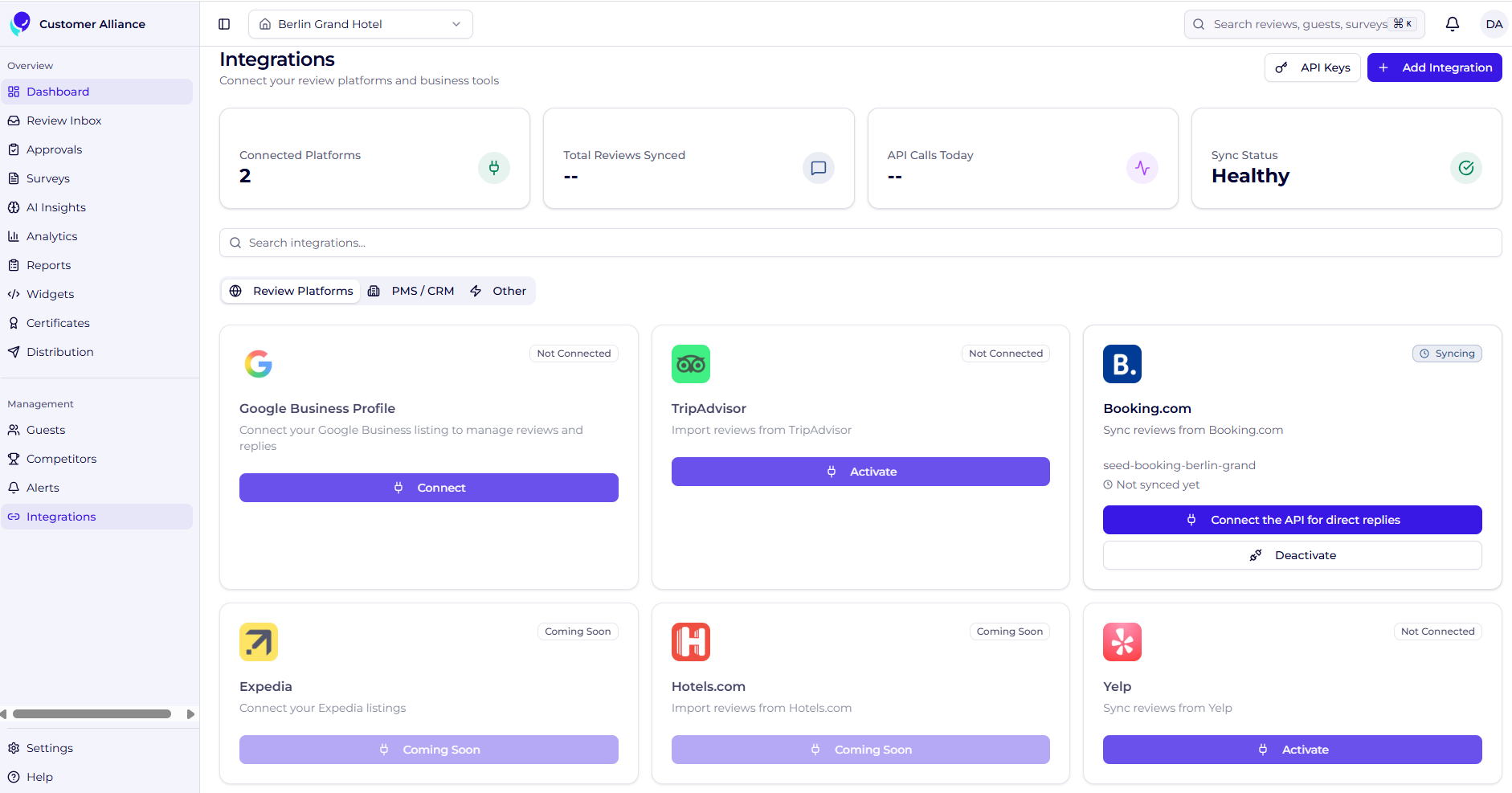
Der Integrationsbereich ist die zentrale Stelle zum Verbinden Ihres digitalen Ökosystems, sodass Gästefeedback in die Tools fließt, die Ihr Team bereits nutzt.
Die Customer Alliance Plattform wurde für Hotels entwickelt und orientiert sich an der Art und Weise, wie Hoteliers tatsächlich arbeiten. Sie bietet den Verantwortlichen für das Gästeerlebnis – darunter General Manager, Cluster- und Regionalmanager sowie Revenue-Teams – eine gemeinsame Sicht auf das Gästefeedback. Jede Rolle erhält dabei die für sie relevante Perspektive, anstatt mit getrennten Reports zu arbeiten.
Die Plattform ist für einzelne Hotels ebenso geeignet wie für komplexe Portfolios mit Hunderten von Immobilien. Unabhängige Hotels, Hotelgruppen, Ketten und Hotelmanagementgesellschaften nutzen Customer Alliance, um einheitliche Standards zu etablieren und Entscheidungen auf Grundlage echter Gästeerlebnisse zu treffen. Dorint Hotels & Resorts nutzt die Customer Alliance Plattform beispielsweise, um Gästefeedback über nahezu 60 Hotels hinweg zentral zu verwalten.
Für General Manager bedeutet das weniger reaktive Maßnahmen und den Nachweis, dass betriebliche Veränderungen bei Gästen Wirkung zeigen. Für Cluster- und Regionalmanager bedeutet es portfolioweites Benchmarking und konsistentes Reporting über Immobilien hinweg. Für Revenue- und Commercial-Teams bedeutet es einen klaren Blick auf das Gästeerlebnis, die Reputation, Sichtbarkeit und Buchungsvertrauen prägen.
Ihre Systeme halten den Hotelbetrieb am Laufen und zeigen Ihnen, was passiert ist. Die neue Customer Alliance Plattform zeigt Ihnen, wie diese Erlebnisse bei Ihren Gästen angekommen sind, worauf Sie sich als Nächstes konzentrieren sollten und ob Ihre letzten Maßnahmen Wirkung gezeigt haben.
Das ist der Schritt vom Verwalten von Bewertungen hin zu Guest Feedback Intelligence. Hotels, die jetzt in diese Ebene investieren, fügen nicht einfach ein weiteres Feedback-Tool hinzu – sie schaffen eine Grundlage, die den gesamten Technologie-Stack wertvoller macht.
Bereit, die neue Customer Alliance zu erleben? Buchen Sie eine Demo und entdecken Sie, wie die Plattform Ihrem Team hilft, besseres Feedback zu sammeln, zu verstehen, was Gäste wirklich schätzen, und nachzuweisen, wo der größte Handlungsbedarf liegt.
Guest Feedback Intelligence ist die Praxis, alles zusammenzuführen, was Gäste sagen, über Bewertungsportale, Umfragen, Sprachen und Zeit hinweg, und daraus ein strukturiertes, geteiltes und umsetzbares Verständnis über das gesamte Hotel hinweg zu schaffen. Aufgebaut auf vier Säulen (erfassen, verstehen, teilen und handeln), lässt sie ein Hotel erkennen, was Gäste durchgängig erleben, welche Themen am wichtigsten sind und ob jüngste Veränderungen gewirkt haben, statt Feedback Kommentar für Kommentar zu lesen.
Andere Review-Management-Tools sagen Ihnen, was Gäste gesagt haben, und helfen beim Antworten. Customer Alliance sagt Ihnen, welches Thema Sie zuerst angehen sollten, ob Ihre letzte betriebliche Veränderung die Zufriedenheit beeinflusst und wie das Gästeerlebnis, Reputation und Buchungen prägt. Diese Entscheidungsebene wird schnell unverzichtbar, weil ihr Fehlen bedeutet, wieder auf Vermutungen statt auf fundierte Erkenntnisse zurückzugreifen.
Nicht ganz, es ist der nächste Schritt. Reputationsmanagement konzentriert sich darauf, Bewertungen zu überwachen und zu beantworten, um das Online-Image eines Hotels zu schützen. Guest Feedback Intelligence umfasst all das und erweitert es um das Verständnis von Feedback im großen Maßstab, die teamübergreifende Weitergabe von Erkenntnissen und das gezielte Handeln darauf. Gleichzeitig stärkt sie die Reputationssignale, die KI-Assistenten und Suchmaschinen heute nutzen, um Hotels zu empfehlen.
Sie können Umfragen aus einer leeren Vorlage oder einem Template erstellen und dabei NPS, CSAT, CES, Sterne- und Emoji-Bewertungen, Textfelder sowie Single- oder Multiple-Choice-Fragen nutzen. Bedingte Folgefragen ermöglichen gezielte Rückfragen auf Basis der Antworten eines Gastes. Eine unbegrenzte Anzahl von Umfragen sind in den Tarifen verfügbar, die diese enthalten.
Ja. Die AI-first Plattform ist ab sofort für Hotels und Hotelgruppen weltweit verfügbar. Bestehende Feedback-Abläufe wie Reputationsmanagement, die Erhebung von Bewertungen, das Beantworten von Feedback und Umfragen bleiben zentrale Bestandteile der Plattform
Ja. Der eigene Integrationsbereich verbindet die Customer Alliance Plattform mit der bestehenden Systemlandschaft: Teams können Bewertungsportale anbinden, PMS- und CRM-Systeme integrieren, Benachrichtigungen über Slack und Microsoft Teams erhalten sowie API-Schlüssel und Webhooks verwalten. So stehen Feedback-Daten überall dort zur Verfügung, wo Teams Entscheidungen treffen und arbeiten

Heute bin ich auf einen interessanten Artikel auf hottelling.net gestoßen. Bisher wurden die Hotels auf dem Buchungsportal HRS anhand des Preises aufgelistet. Doch nun wird dieses System umgestellt. Zukünftig sollen Hotels gemäß ihrer Gästebewertung aufgelistet werden. Hierbei spiele vor allem die Anzahl der Bewertungen, die für ein Hotel abgegeben wurden, eine große Rolle.
Meiner Meinung nach, wirkt dies dem Trend der Manipulation von Bewertungen nicht gerade entgegen, wie auch in dem Artikel beschrieben:
„Rund ein Viertel der Befragten legten dar, dass (negative) Bewertungen offenbar von Konkurrenzbetrieben verfasst worden seien. Ein weiteres Viertel gab zu, selbst Bewertungen manipuliert zu haben. 43 Prozent der Hotels berichten von Erfahrungen von Erpressungen von Gästen, die mit einer negativen Bewertung drohten, wenn sie kein Upgrade oder ähnliches erhielten.“
Den ganzen Artikel lesen sie hier
Die Bedeutung von Online-Bewertungen hat nun auch Facebook dazu veranlasst, ein eigenes Bewertungssystem à la Qype zu integrieren. Lokalitäten können zukünftig anhand einer Sternebewertung weiter empfohlen werden. Mehr dazu gibt es hier
Mit dem flexibleren Fragebogen ist es nun möglich, die einzelnen Kriterien in eine individuelle Reihenfolge zu bringen. Ferner können Sie die Namen der Kriterien entsprechend anpassen. Wir bieten dazu mehrere vorausgewählte Möglichkeiten.
Außerdem haben wir noch weitere Aktualisierungen für Sie:

Brillante Geschäftsstrategie oder zweifelhafte Praxis? In diesem Artikel lüften wir den Vorhang über das Review-Gating.
Wir werden erkunden, was es ist, welche Auswirkungen es auf Ihr Unternehmen hat und warum es sich um eine Strategie handelt, die Sie am besten vermeiden sollten (und welche Strategien Sie stattdessen anwenden sollten). Außerdem untersuchen wir die Richtlinien der beliebtesten Bewertungsplattformen, um zu sehen, ob Review-Gating Ihr Inserat wirklich aus dem Internet verbannt.
Lassen Sie uns gemeinsam durch die nuancierte Welt der Online-Bewertungen navigieren und lernen, wie Sie auf der anderen Seite unversehrt und ethisch einwandfrei daraus hervorgehen können.
Stellen Sie sich dieses Szenario vor: Sie hatten kürzlich mit einem Unternehmen zu tun, entweder um ein Produkt zu kaufen oder eine Dienstleistung in Anspruch zu nehmen. Um Feedback zu erhalten, schickt Ihnen das Unternehmen eine Umfrage mit der Frage: "Haben Sie eine positive Erfahrung gemacht?"
Wenn Sie mit „Ja“ antworten, werden Sie zu einer öffentlichen Bewertungsseite weitergeleitet, auf der Sie Ihre positiven Erfahrungen teilen können. Wenn Sie jedoch mit "Nein" antworten, werden Sie zu einem privaten Feedback-Formular gelenkt, das jegliche öffentliche Kritik effektiv zum Schweigen bringt.
Diese Taktik wird als Review-Gating bezeichnet. Sie ähnelt einem selektiven Türsteher in einem exklusiven Club, der nur die gut gekleideten Gäste hineinlässt und den Rest zu einem schmuddeligen Seiteneingang leitet.
Das Ergebnis? Eine scheinbar tadellose Online-Reputation voller positiver Bewertungen, während negatives Feedback leise hinter den Kulissen gehandhabt wird.
Auch wenn dies auf den ersten Blick eine kluge Strategie zu sein scheint, ist die Aufrechterhaltung einer perfekten Online-Reputation nicht so einfach oder vorteilhaft, wie es scheinen mag.
Wenn Unternehmen Spielchen mit ihren Online-Bewertungen spielen, verlieren am Ende alle. Werfen wir einen Blick darauf, was Review-Gating wirklich bedeutet und wie es die Integrität des Kundenfeedbacks untergräbt.
Online-Bewertungen sind wie Freunde, die sich gegenseitig erzählen, was sie wirklich über ein Produkt oder eine Dienstleistung denken. Sie helfen Kunden herauszufinden, ob etwas ihr Geld wert ist, indem sie reale Erfahrungen teilen.
Aber Review-Gating untergräbt dies. Es lässt die Dinge zu gut aussehen, indem es nur die glücklichen Kunden zeigt und die unglücklichen versteckt. Dies verhindert, dass Kunden fundierte Entscheidungen treffen, und kann dazu führen, dass sie sich enttäuscht fühlen, wenn ihr Besuch oder Kauf nicht den Erwartungen entspricht.
Darüber hinaus sind Bewertungen nicht nur für Kunden, sondern auch für Unternehmen. Gute Bewertungen sagen Ihnen, was Sie richtig machen, während schlechte Bewertungen darauf hinweisen, was verbessert werden muss. Indem Sie schlechte Bewertungen verstecken, lassen Sie sich konstruktives Feedback entgehen, das dabei hilft, besser zu werden.
Indem nur die guten Dinge gezeigt werden, trickst Review-Gating Kunden aus und hindert Unternehmen daran, ihre Fehler zu sehen. Es verwandelt einen Zwei-Wege-Chat in ein einseitiges Gespräch. Im Laufe der Zeit schadet dies sowohl dem Kunden, der keine kluge Entscheidung treffen kann, als auch Ihrem Unternehmen, indem er die Chance verliert, zu lernen und zu wachsen.
Ein guter Ruf, der durch jahrelange harte Arbeit und guten Service erworben wurde, kann das beste Merkmal eines Unternehmens sein. Aber dieses Vertrauen ist leicht zu verlieren und schwer zurückzugewinnen, besonders durch eine zweifelhafte Strategie wie Review-Gating.
Kunden wollen, dass Unternehmen ehrlich und real sind. Wenn sie also herausfinden, dass Sie absichtlich schlechtes Feedback verheimlichen, fragen sie sich, was Sie sonst noch verheimlichen.
Das Problem hört hier nicht auf. In der heutigen vernetzten Welt verbreiten sich Nachrichten schnell. Wütende Kunden können ihre Beschwerden in sozialen Medien, Blogs oder an anderen Orten teilen, an denen sie jeder sehen kann. Dies kann schnell ändern, wie Menschen Ihre Marke sehen. Anstelle von großartigem Service- oder Qualitätsprodukten könnten sie Ihre Marke mit Unehrlichkeit in Verbindung bringen.
Der Verlust des Vertrauens kann zudem den Verlust von Kunden bedeuten. Sie könnten nicht nur aufhören, bei Ihnen zu kaufen, sondern sie könnten auch anderen sagen, dass sie Ihre Marke meiden sollen.
Zunächst scheint das Review-Gating zwar eine clevere Möglichkeit zu sein, Ihre Online-Präsenz sauber zu halten, ist aber tatsächlich sehr riskant. Der Reputationsschaden ist viel schlimmer als der vorübergehende Vorteil, negative Bewertungen zu verbergen.
Vergessen wir ein wenig die moralische Seite des Review-Gating und schauen wir uns die praktischen Probleme an. Bewertungsplattformen werden immer intelligenter und strenger. Sie arbeiten hart daran, diese Art von Tricks zu erkennen und zu stoppen.
Ein Verstoß gegen diese Regeln kann zu schweren Strafen führen. Ihr Unternehmen könnte in große Schwierigkeiten geraten, so könnten alle Ihre Bewertungen gelöscht oder sogar Ihr Unternehmensprofil gesperrt werden.
Stellen Sie sich vor: An einem Tag genießen Sie viele 5-Sterne-Bewertungen und am nächsten Tag ist Ihr Konto eingefroren, alle Bewertungen sind weg und Sie müssen bei Null anfangen. Das ist ein schneller Abstieg von der Spitze.
Denken Sie daran, es geht nicht nur darum, Regeln zu befolgen. Es geht darum, transparent zu sein. Bewertungsplattformen sind nicht nur Orte für gute oder schlechte Kommentare; sie sind vertrauenswürdige Informationsquellen für Kunden auf der ganzen Welt. Um ihr Vertrauen zu wahren, müssen wir fair spielen.
Also, was genau sagen Bewertungsplattformen zum Review-Gating? Werfen wir einen Blick auf die Richtlinien einiger der beliebtesten Plattformen.
Der Suchmaschinenriese listet Review-Gating innerhalb seiner Richtlinie „Verbotene und eingeschränkte Inhalte“ auf. Sie fällt unter die Kategorie der irreführenden Inhalte und besagt:
„Beiträge zu Google Maps sollten ein echtes Erlebnis an einem Ort oder in einem Unternehmen widerspiegeln. Fake-Engagement ist nicht erlaubt und wird entfernt.
Dazu gehört... "negative Bewertungen zu unterbinden oder zu verbieten oder selektiv positive Bewertungen von Kunden einzuholen."
Der Verhaltenskodex des deutschen Reisebuchungsportals besagt eindeutig, dass „die Verwendung von Systemen, die die Veröffentlichung von Bewertungen in Abhängigkeit von der Zufriedenheit steuern, nicht zulässig ist“.
In den Bewertungsrichtlinien von TripAdvisor heißt es ausdrücklich, dass das Review-Gating gegen ihre Richtlinien verstößt:
"Review-Gating. Wir verbieten die Praxis, selektiv positive Inhalte zu erbitten und/oder moderate oder negative Inhalte abzulehnen. Wenn eine Umfrage oder eine externe Website Benutzer letztendlich dazu anweist, eine Bewertung auf Tripadvisor abzugeben, müssen die Benutzeroberfläche und die Erfahrung für die Abgabe positiver und negativer Bewertungen identisch sein. Einen Gast zum Beispiel auf eine Bewertungsseite zu leiten, wenn er auf eine positive Erfahrung hinweist, ihn aber auf eine andere Seite (z. B. einen internen Kundensupportkanal) zu leiten, wenn er auf eine negative Erfahrung hinweist, verstößt gegen unsere Bewertungsrichtlinien.“
Andere beliebte Buchungsmaschinen wie Expedia und Booking.com erwähnen ihre Haltung zum Review-Gating in ihren Richtlinien nicht ausdrücklich. Sie erwarten jedoch im Allgemeinen, dass Unternehmen transparent und fair sind, wenn es um Bewertungen geht.
Review-Gating mag vom Tisch sein, aber das bedeutet nicht, dass Sie Ihre Online-Reputation dem Zufall überlassen müssen. Hier sind einige ethischere und effektivere Strategien, um die Auswirkungen negativer Bewertungen zu verringern.
Anstatt zu versuchen, negative Bewertungen zu verbergen, warum diese nicht mit positiven in den Schatten stellen? Eine schlechte Bewertung verliert viel von ihrem Einfluss, wenn sie von einem Meer großartiger Rückmeldungen umgeben ist.
Denken Sie darüber nach, wie Bewertungen auf TripAdvisor präsentiert werden. Für jedes Inserat werden die fünf neuesten Bewertungen auf der ersten Seite angezeigt. Dies gibt Ihnen eine großartige Gelegenheit, das Positive gegenüber dem Negativen zu betonen.
Alles, was Sie brauchen, sind fünf neue großartige Bewertungen, und die negative Bewertung wird auf die zweite Seite verschoben. Sie ist weiterhin leicht zu finden, wenn ein Interessent danach sucht, steht aber nicht mehr im Vordergrund, wenn jemand nach Ihrem Unternehmen sucht.
Sie sind sich nicht sicher, wie Sie schnell neue Bewertungen erhalten? Wir haben 8 Methoden, die Sie heute implementieren können, um den Ball ins Rollen zu bringen.
Die Art und Weise, wie Sie auf eine schlechte Bewertung reagieren, kann viel über Ihr Unternehmen aussagen und darüber, wie sehr Sie sich um Ihre Kunden kümmern.
Wenn Sie sorgfältig auf eine schlechte Bewertung antworten, sehen potenzielle Kunden ein Unternehmen, das aufpasst und sich darum kümmert, Kunden glücklich zu machen. So wissen sie, dass sich Ihr Unternehmen schnell und professionell darum kümmert, wenn sie ein Problem haben.
Auf der anderen Seite könnte es potenzielle Kunden beunruhigen, wenn Sie nicht auf schlechtes Feedback reagieren. Es könnte so aussehen, als ob Sie sich nicht darum kümmern, was Kunden denken, und nicht daran interessiert sind, Probleme zu beheben.
Kurz gesagt, eine gut ausgearbeitete Antwort hat die Macht, die Auswirkungen einer negativen Bewertung auf Ihr Unternehmen umzukehren. Wenn Sie Probleme mit der Beantwortung von Bewertungen haben, verwenden Sie Bewertungsantwortvorlagen oder sogar KI-Tools. Diese Tools helfen Ihnen nicht nur, durchdachte Antworten zu erstellen, sondern können Ihnen auch erheblich Zeit sparen und die Einheitlichkeit Ihrer Antworten gewährleisten.
Review-Gating mag wie eine verführerische Abkürzung zu einer großartigen Online-Reputation erscheinen, aber die Risiken und potenziellen Folgen überwiegen bei weitem alle kurzfristigen Gewinne. Letztendlich verrät diese Strategie nicht nur das Vertrauen Ihrer Kunden, sondern verschwendet auch wertvolle Verbesserungsmöglichkeiten.
Der wahre Weg zu einer starken Online-Reputation liegt nicht in der Manipulation von Feedback, sondern im ehrlichen und respektvollen Umgang damit. Regen Sie neue Bewertungen an, reagieren Sie vorsichtig auf Kritik und streben Sie immer nach Transparenz.
Die Welt der Online-Bewertungen kann eine Herausforderung sein, aber denken Sie daran: Unternehmen, die Authentizität, Transparenz und Kundenzufriedenheit schätzen, stehen immer an der Spitze. Zeigen Sie Ihr Engagement für diese Werte in Ihren Bewertungspraktiken und Sie werden feststellen, dass Vertrauen nicht nur verdient wird - es wird in Form von treuen Kunden und einem florierenden Geschäft zurückgegeben.
![Verwaltung von Online-Bewertungen: eine schrittweise Anleitung [+ kostenlose Vorlage]](https://cdn.prod.website-files.com/698057eb8576bde9c55da93c/6a06bb52f89317f2c1385deb_69b9034abd6f633a1eaad0c1_customer-alliance-managing-online-reviews-main-banner-1145x433%25402x.png)
Die Verwaltung von Bewertungen kann Ihre Online-Präsenz erhöhen, Sie von der Konkurrenz abheben und mehr Kunden anziehen. Aber wenn Sie mit einer langen To-Do-Liste konfrontiert sind, kann die Verwaltung von Bewertungen auf der Strecke bleiben.
In den letzten 15 Jahren haben wir Tausenden von Unternehmen geholfen, Bewertungen und Feedback besser zu verwalten. Ganz gleich, ob Sie von der Menge der Bewertungen auf verschiedenen Portalen überwältigt sind, nicht wissen, wie Sie darauf reagieren sollen, oder nicht wissen, wie Sie das Bewertungsfeedback implementieren sollen – wir sind für Sie da.
In dieser Schritt-für-Schritt-Anleitung finden Sie unsere besten Tipps, wie Sie Bewertungen effektiv verwalten können. Damit Sie sofort loslegen können, haben wir außerdem eine einfach zu verwendende Vorlage zum kostenlosen Download erstellt.
💡 Sie sind nur wegen der Vorlage hier? Springen Sie nach unten zum Video-Walkthrough und zum Download-Formular.
Es gibt Hunderte von Bewertungsportalen, die sich an unterschiedliche Branchen und Regionen richten. Um das Bewertungsmanagement zu vereinfachen, ist es wichtig, sich auf die für Ihr Unternehmen wichtigsten Portale zu konzentrieren.
Google ist eine Bewertungsplattform, von der jedes Unternehmen profitieren kann. Als weltweit bekannteste Suchmaschine haben die Google-Bewertungen einen erheblichen Einfluss darauf, wie potenzielle Kunden Ihr Unternehmen wahrnehmen.
Um herauszufinden, auf welche anderen Portale Sie sich konzentrieren sollten, sehen Sie nach, woher die meisten Ihrer Bewertungen kommen. Recherchieren Sie Bewertungsportale, die für Ihre Branche, aber auch für Ihre Zielgruppe spezifisch sind. TripAdvisor zum Beispiel ist für die meisten Gastgewerbebetriebe sehr wertvoll. Wenn jedoch die meisten Ihrer Gäste aus Deutschland kommen, ist eine regionale Bewertungsseite wie HolidayCheck möglicherweise relevanter.
Nachdem Sie Ihre wichtigsten Bewertungsportale bestimmt haben, vervollständigen Sie dort Ihre Unternehmensprofile oder melden Sie sie an. Diese Profile ermöglichen es Ihnen, Ihre Bewertungen aktiv zu überwachen und darauf zu reagieren. Dies hilft auch bei der Suchmaschinenoptimierung (SEO), da Suchmaschinen diese verifizierten Profile nutzen, um die Glaubwürdigkeit Ihres Unternehmens zu bestätigen.
Wenn Sie Online-Bewertungen manuell verwalten, haben Sie wenig Kontrolle darüber, mit welchen Portalen Ihre Kunden interagieren. Mit unserer Verteilungsfunktion können Sie jedoch den Prozentsatz der Bewertungsanfragen bestimmen, die an jedes Portal gehen.
Wenn also TripAdvisor und Google für Ihr Unternehmen am wichtigsten sind, können Sie Ihre Online-Präsenz dort proaktiv aufbauen. Sie können die Verteilung Ihrer Bewertungen sogar nach Sprache anpassen, um Ihre Präsenz in bestimmten Ländern auszubauen. Sehen Sie in der interaktiven Demo, wie die Verteilung funktioniert.
Auf jede Bewertung sofort zu reagieren, kann störend sein, da es Ihre Konzentration von anderen Aufgaben ablenkt. Das mag in Ordnung sein, wenn Sie nur ein paar Bewertungen pro Woche erhalten, aber sobald Sie die Anzahl der Bewertungen erhöhen, wird dies bald zu Ineffizienz führen.
Indem Sie bestimmte Zeiten am Tag oder in der Woche für die Verwaltung von Überprüfungen vorsehen, haben Sie die Möglichkeit, jeder Überprüfung die Aufmerksamkeit zu widmen, die sie verdient.
Um einen Zeitplan für die Überprüfung der Bewertungen festzulegen, sollten Sie sich Gedanken machen:
Sobald Sie sich für einen Zeitplan entschieden haben, legen Sie einen wiederkehrenden Block in Ihrem Kalender fest. Es kann schwierig sein, neue Gewohnheiten beizubehalten, aber wenn Sie sich bewusst Zeit für diese Aufgabe nehmen, werden Sie auf dem richtigen Weg bleiben.
Sich die Logins für jedes Bewertungsportal zu merken und zwischen den einzelnen Registerkarten hin und her zu wechseln, ist mühsam und zeitaufwändig. Aus diesem Grund haben wir unseren Review Stream entwickelt. Diese zeitsparende Funktion durchsucht automatisch die von Ihnen gewünschten Bewertungsportale und fasst alle Ihre Bewertungen an einem Ort zusammen.
Verschaffen Sie sich einen Überblick über Ihre Bewertungsergebnisse, filtern und suchen Sie nach den Informationen, die Sie benötigen, und antworten Sie sogar direkt von Ihrem Dashboard aus auf Bewertungen. Sehen Sie unseren Review Stream in Aktion in der interaktiven Demo
Um die beste Reaktion zu erhalten, wenn Sie um Bewertungen bitten, müssen Sie dies über einen Kanal tun, mit dem Ihre Kunden am besten vertraut sind. Das kann per SMS, E-Mail, QR-Code oder über soziale Medien sein. Für die meisten Unternehmen ist die E-Mail ein guter Ausgangspunkt. Sie ist bequem, ermöglicht eine einfache Personalisierung und wird von einer breiten Bevölkerungsgruppe genutzt.
Die Art und Weise, wie Sie Ihre Anfrage formulieren, macht einen großen Unterschied. Die Menschen haben viel zu tun, und wenn sie sich die Zeit nehmen, eine Bewertung abzugeben, tun sie Ihnen damit letztlich einen Gefallen. Eine generische, fade Bewertungsanfrage wird nur allzu leicht ignoriert.
Um einen effektiven Überprüfungsantrag zu verfassen, sollten Sie diese Schlüsselelemente berücksichtigen:
Sobald Sie Ihre Anfrage verfasst haben, speichern Sie sie als Vorlage (mit Platz für die Personalisierung), damit Sie nicht jedes Mal eine neue Nachricht verfassen müssen. Dann müssen Sie nur noch die Felder für die Personalisierung ersetzen, z. B. den Namen des Gastes oder Details zu seinem Erlebnis.
💡 Pro-Tipp: In Ihrem kostenlosen Download haben wir eine Vorlage für die Anforderung von Bewertungen bereitgestellt, die Sie an Ihr Unternehmen anpassen können. Holen Sie sich die Vorlage für das Bewertungsmanagement hier.
Nicht nur die Art und Weise, wie Sie fragen, sondern auch der Zeitpunkt, wann Sie fragen, entscheidet darüber, wie viele Bewertungen Sie erhalten werden. Um den richtigen Zeitpunkt zu bestimmen, müssen Sie Ihre Customer Journey verstehen: den Prozess, den ein Kunde durchläuft, wenn er mit Ihrem Unternehmen interagiert, von der ersten Entdeckung bis zum Kauf und darüber hinaus.
Überlegen Sie, an welchen Berührungspunkten Ihre Kunden am stärksten mit Ihnen in Kontakt treten. Bei vielen Unternehmen ist dies kurz nach einer erfolgreichen Dienstleistung oder einem Kauf der Fall. Zu diesem Zeitpunkt ist die Erfahrung des Kunden noch frisch in seinem Gedächtnis, und er ist eher bereit, eine detaillierte Bewertung abzugeben. Dies ist auch der Zeitpunkt, an dem sie sich wahrscheinlich positiv über Ihr Unternehmen äußern.
Das Versenden von Bewertungsanfragen zum richtigen Zeitpunkt für jeden Kunden erfordert einen systematischen Ansatz. Nehmen wir an, Sie sind General Manager in einem Hotel und beschließen, einen Tag nach dem Auschecken Ihrer Gäste per E-Mail um eine Bewertung zu bitten. So könnten Sie es einrichten:
🛑 Vergessen Sie nicht, dass es in den meisten Regionen gesetzlich vorgeschrieben ist, die ausdrückliche Zustimmung Ihrer Gäste einzuholen, bevor Sie ihnen E-Mails schicken.
Sie können diese Zustimmung auf verschiedene Weise einholen, z. B. über ein Kontrollkästchen auf Ihrem Buchungsformular oder ein Anmeldeformular auf Ihrer Website.
Um rechtliche Konsequenzen, einschließlich hoher Geldstrafen, zu vermeiden, sollten Sie sich vergewissern, dass Sie die erforderlichen Genehmigungen haben, bevor Sie eine E-Mail-Kampagne starten.
Selbst mit einer Vorlage ist es schwierig, Bewertungen manuell anzufordern, so dass Sie unweigerlich einige Rückmeldungen verpassen werden. Mit Customer Alliance können Sie den idealen Zeitpunkt für den Versand Ihrer Bewertungsanfragen festlegen, die dann im Hintergrund ausgeführt werden, ohne dass Sie manuell eingreifen müssen. Das bedeutet mehr Bewertungen für Ihr Unternehmen und eine Aufgabe weniger auf Ihrer To-Do-Liste.
Fallstudie: Vor dem Einsatz von Customer Alliance überließ Medicover Romania die Erstellung von Bewertungen dem Zufall. Doch seit der Automatisierung der Bewertungserfassung hat das Unternehmen über 46.000 Patientenbewertungen gesammelt. Sie haben nicht nur die Anzahl ihrer jährlichen Google-Bewertungen vervierfacht, sondern auch ihre Bewertungen um fast 20 Punkte erhöht. Lesen Sie die vollständige Fallstudie hier.
Die Beantwortung Ihrer Bewertungen ist ein äußerst effektiver (aber oft übersehener) Aspekt des Bewertungsmanagements.
In unserer Studie gaben 88 % der Befragten an, dass sie die Reaktion eines Unternehmens auf Bewertungen als leicht bis äußerst wichtig einstufen. Und warum? Sie zeigt Ihren Kunden, dass Sie ihr Feedback zu schätzen wissen, und gibt potenziellen Kunden einen Einblick in Ihren Service.
Trotzdem antworten die meisten Unternehmen nur selten, wenn überhaupt. Dies liegt in der Regel an Zeitmangel oder daran, dass sie nicht wissen, wie sie antworten sollen. Eine qualitativ hochwertige Antwort auf eine Bewertung zeichnet sich durch mehrere wichtige Merkmale aus.
💡 Pro-Tipp: Die Beantwortung von Bewertungen kann auch Ihre Suchmaschinenoptimierung verbessern, da sie dazu beiträgt, Vertrauen in Ihre Marke aufzubauen, was Google bei der Bestimmung Ihrer Platzierung in den Suchergebnissen berücksichtigt. Sie können in Ihre Antworten auch unternehmensspezifische Schlüsselwörter einfügen, was mit der zunehmenden Verbreitung der KI-gestützten Suche nur von Vorteil sein wird.
Die Beantwortung von Rezensionen mag einfach erscheinen, aber es ist oft schwierig zu wissen, was man sagen soll. Wenn man bei Null anfängt, kann man sich überfordert fühlen, und es ist leicht, seine Antwort in Frage zu stellen. Unser Review Stream bietet eine Reihe von Optionen, die das Beantworten von Rezensionen schnell und einfach machen.
Sie können eine unbegrenzte Anzahl von Vorlagen für alle Arten von Bewertungen erstellen und diese für Ihre Kunden und Ihr Unternehmen personalisieren. Wählen Sie einfach die entsprechende Vorlage aus der Dropdown-Liste aus und passen Sie Ihre Antwort an.
Wenn Sie noch mehr Zeit sparen möchten, generiert unser AI Reply Assistant personalisierte, einzigartige Antworten mit nur einem Klick. Sehen Sie den AI Reply Assistant in Aktion in der interaktiven Demo.
Die Verwaltung von Bewertungen trägt nicht nur dazu bei, Ihre Online-Präsenz zu erhöhen, sondern bietet Ihnen auch eine Fundgrube für Feedback, das Ihnen hilft, Ihren Service zu verbessern.
Start by dividing your reviews into categories like customer service, price and location. Grouping your reviews like this makes it easier to spot which topics are most important to your customers.
Beginnen Sie damit, Ihre Bewertungen in Kategorien wie Kundenservice, Preis und Standort zu unterteilen. Wenn Sie Ihre Bewertungen auf diese Weise gruppieren, können Sie leichter erkennen, welche Themen für Ihre Kunden am wichtigsten sind.
Zählen Sie die Häufigkeit des Lobes oder der Beschwerde in jeder Kategorie. So können Sie die Bedeutung der einzelnen Themen oder Trends quantifizieren. Sie können auch ein Tool wie ChatGPT verwenden, um herauszufinden, welche Themen am dringendsten Ihre Aufmerksamkeit erfordern. Durch die Analyse des Inhalts Ihrer Bewertungen können Sie einen klaren Plan zur Verbesserung Ihres Unternehmens auf der Grundlage der Wichtigkeit erstellen.
Nehmen wir an, Sie stellen nach Ihrer Analyse fest, dass der Begriff „langsam“ in Bezug auf die Servicezeiten häufig auftaucht. Mit diesem Wissen können Sie Initiativen priorisieren, um den Service zu beschleunigen, z. B. eine Mitarbeiterschulung, den Einsatz zusätzlicher Servicemitarbeiter zu Spitzenzeiten oder die Bewertung Ihrer aktuellen Prozesse, um Engpässe zu beseitigen.
Unsere Plattform verfügt über integrierte Tools, mit denen Sie Ihre Daten ohne die mühsame manuelle Analyse untersuchen können. Die Textanalyse ermittelt sofort, welche Themen in den Bewertungen am häufigsten vorkommen und wie positiv oder negativ sie von Ihren Kunden wahrgenommen werden.
Wir arbeiten außerdem an einer neuen KI-Funktion, die Ihnen sagen wird, welche Themen die größten Auswirkungen auf Ihr Unternehmen haben werden (und auf welche Sie später zurückkommen können).
Jetzt kennen Sie die Schritte, die Sie unternehmen müssen, um Ihre Strategie für das Review-Management in Gang zu bringen. Aber den Überblick zu behalten, kann eine Herausforderung sein. In dieser kostenlosen Vorlage haben wir für Sie einen Platz geschaffen, an dem Sie Ihre Bewertungen protokollieren, kategorisieren und beantworten können.
Um noch mehr Zeit zu sparen, finden Sie mehr als 30 Vorlagen für die Beantwortung von Überprüfungsanfragen sowie eine Vorlage für die Gestaltung Ihrer E-Mail mit der Bitte um Überprüfung. Schauen Sie sich das kurze Video unten an, um zu sehen, wie Sie es verwenden, und holen Sie sich Ihre Vorlage hier.
Holen Sie sich Ihre kostenlose Vorlage für das Review Management
Die Verwaltung von Bewertungen ist für jedes Unternehmen, das online gefunden werden und mehr Kunden anziehen möchte, von großem Wert. Für viele ist das manuelle Sammeln, Beantworten und Analysieren von Bewertungen jedoch nicht machbar.
Ob es an der schieren Menge der Bewertungen liegt oder an fehlendem Personal oder Zeit, die Verwaltung von Bewertungen kann schnell überwältigend wirken. Durch den Einsatz einer Bewertungs- und Feedback-Management-Software wie Customer Alliance entfällt ein Großteil der manuellen Arbeit, wodurch Sie Zeit sparen und die Effizienz steigern können.
Wenn Sie wissen möchten, wie wir Ihnen helfen können, vereinbaren Sie einen Termin für ein 15-minütiges Einführungsgespräch mit einem unserer Experten.
Niemand möchte Kritik an seinem Unternehmen hören. Aber lassen Sie sich nicht dazu verleiten, schlechte Bewertungen zu entfernen oder Taktiken wie das „Review Gating“ anzuwenden. Ein paar negative Bewertungen verleihen Ihrem Unternehmen Authentizität und lassen Sie für potenzielle Kunden vertrauenswürdiger erscheinen. Eine Antwort auf die Bewertung (Tipps dazu finden Sie hier) ist ebenfalls eine gute Möglichkeit, Ihren Kundenservice zu präsentieren und kann die Auswirkungen negativer Bewertungen abschwächen.
Erkundigen Sie sich bei der jeweiligen Bewertungsplattform nach den Richtlinien für die Entfernung gefälschter Bewertungen, da jede Plattform ihre eigenen Verfahren hat. Sie können die Auswirkungen der gefälschten Bewertung jedoch auch mit einer gut formulierten Antwort abschwächen (die deutlich macht, dass Sie keine Aufzeichnungen über den Kauf/die Buchung des Kunden haben). Sie können auch eine Kampagne zum Sammeln von Bewertungen starten, um die gefälschten Bewertungen mit echtem, positivem Feedback zu übertönen.
Erfahren Sie, wie KI-Erkenntnisse, automatisierte Workflows und einheitliche Dashboards die manuelle Arbeit reduzieren und die Zufriedenheit in Ihrem Hotel steigern können.
Holen Sie sich eine personalisierte Demo


