La gestión del Revenue Management como elemento de diferenciación competitiva entre alojamientos
18/07/2017
15/05/2026
Tomasz Pieszko
El aumento del número de portales de reserva de producto turístico y la gran competitividad entre los mismos ha hecho que en los últimos años los valores y parámetros diferenciales se limiten a calidad y posicionamiento. Fenómenos como el Big Data se aplican a la toma de decisiones para la optimización de resultados a la vez que provocan una cuantificación de la realidad que posibilita un ajuste cada vez mejor de la oferta. Al mismo tiempo, ofrecen parámetros acerca del viajero para poder medir lo que ocurre a su alrededor y poder ajustar los niveles de personalización y de calidad. El Revenue Management, a través de una aplicación de inteligencia de mercado en precios y disponibilidad, ayuda a una gestión más eficiente de los recursos. Dando un paso más allá, la tecnología ha seguido su curso para hacer más eficiente la gestión del denominado “Revenue” o ingresos del negocio. Con
El aumento del número de portales de reserva de producto turístico y la gran competitividad entre los mismos ha hecho que en los últimos años los valores y parámetros diferenciales se limiten a calidad y posicionamiento. Fenómenos como el Big Data se aplican a la toma de decisiones para la optimización de resultados a la vez que provocan una cuantificación de la realidad que posibilita un ajuste cada vez mejor de la oferta. Al mismo tiempo, ofrecen parámetros acerca del viajero para poder medir lo que ocurre a su alrededor y poder ajustar los niveles de personalización y de calidad.
El Revenue Management, a través de una aplicación de inteligencia de mercado en precios y disponibilidad, ayuda a una gestión más eficiente de los recursos. Dando un paso más allá, la tecnología ha seguido su curso para hacer más eficiente la gestión del denominado “Revenue” o ingresos del negocio. Con la creación de los RMS (Revenue Management System), se ha facilitado la labor en la gestión de “inventarios volátiles” de producto a los que se necesita dar salida en escenarios cada vez más tecnológicos. La apuesta actual debe centrarse en la línea de invertir esfuerzos en el enfoque adecuado para la gestión del Revenue Management, respaldado por la tecnología adecuada que será esencial para que los hoteles optimicen tanto sus ingresos como su rentabilidad.
La situación de un mercado más transparente hacia el viajero
El consumidor de hoy realiza una compra más inteligente, lo cual añade presión sobre la figura del hotelero que debe hacer predicciones más precisas en relación a la solicitud de reserva para una fecha concreta o para aprovechar una promoción puntual. Con el auge de las OTA ́s, los metabuscadores y otros canales de distribución online, el precio y el valor de la percepción que un hotelero muestra al viajero a través de diversos puntos de contacto digitales y plataformas se magnifica. Los hoteles necesitan asegurarse de que su posicionamiento en el mercado y la estrategia en sí están alineados con la percepción del público. Con este propósito, los responsables de Revenue Management y los equipos de comercialización tienen que trabajar mano a mano con departamentos como el de marketing o el financiero.
Funcionalidades para interpretar una realidad más tecnológica
Para estar al día en la gestión del Revenue Management debemos contar con una tecnología que nos ayude a realizar una gestión eficiente de las tareas de comercialización del hotel. Por lo tanto, desde BEONPRICE planteamos una serie de factores básicos que la tecnología ofrece y que los RMS ponen a disposición del hotelero para mejorar la rentabilidad en la distribución del hotel:
Datos históricos y ritmo de reserva. Los datos históricos de un hotel se almacenan tradicionalmente en el PMS, construyendo un marco que nos ayuda a interpretar la realidad en base a información del pasado. Con este tipo de datos, un Revenue Manager puede recrear curvas de reserva a pasado para tener una idea de que ocurrirá en el futuro. Una vez disponemos de esta información, es posible determinar patrones de reservapara segmentar y proponer un precio más preciso y acorde a la demanda. A partir de esta metodología, podemos analizar sobre eventos puntuales analizados sobre el pasado cuál será el comportamiento del viajero y adaptar de esta forma la demanda.
Datos de precios de la competencia. Un RMS puede facilitar la tarea de canalizar la información sobre la competencia. Disponer de información en tiempo real sobre el precio, la oferta, las condiciones de la oferta, política de cancelación, etcétera, nos remitirá una imagen más clara de la oferta general del mercado para una fecha determinada. Esta percepción puede utilizarse para anticiparnos a la competencia, pese a que parece arriesgado, ya que es importante aprovechar esta información sin que nos condicione en todo momento. No decantarnos por unas políticas de precios a la baja y contar con una propuesta de valor única y propia será el camino más adecuado ante una competencia tan feroz en precios “last minute”.
Eventos y factores macroeconómicos. La información histórica de la reserva permite establecer una línea base para fechas destacadas como pueden ser fiestas locales o eventos en mercados emisores a nuestro destino. Un rastreo rápido de medios de comunicación locales o de la administración del lugar de origen puede ayudarnos a adaptar nuestra oferta a factores que se escapan de nuestro control y condicionan la demanda. Factores macroeconómicos como el desarrollo económico del país, los cambios de transporte en toda la ciudad o variaciones como el precio de los carburantes generan fluctuaciones en los precios que nos permiten disponer de herramientas para personalizar al máximo nuestra oferta sobre las circunstancias del mercado.
Datos relacionados con el transporte aéreo. La conexión entre el transporte aéreo y la demanda hotelera es clara. A mayor número de vuelos programados para aterrizar en un mercado, más viajeros en busca de un lugar para alojarse. Imagina saber con una semana de antelación que el aeropuerto de tu ciudad tendrá una llegada masiva de viajeros. Se supone que si conecta con su público objetivo las posibilidades aumentan de cara a recibir reservas. Pese a que algunas circunstancias puntuales pueden alegrarnos el día, es importante adaptarnos a cualquier posible situación y conectar con ofertas de vuelos más hotel. Ni que decir queda que existen RMS preparados para ofrecernos la información sobre este tipo de producto.
Información sobre la reputación online del alojamiento. Los hoteleros, cada día que pasa, son más conscientes de la reputación online y del peso de los comentarios en los procesos de toma de decisiones del viajero. Si este parámetro lo ligamos al precio y la percepción de estos desde el punto de vista del cliente, seguro que nos lo tomamos mucho más en serio. Los RMS actuales permiten utilizar el parámetro de la percepción del viajero para determinar qué posición ocupa un determinado alojamiento en el mercado. A mayor calidad percibida por el viajero, mayor capacidad para forzar con el precio por la parte del Revenue Management.
Inclusión de factores meteorológicos. Ser conscientes de la meteorología es una fórmula interesante para los hoteles ya que pueden predecir mejor los cambios en la demanda. Monitorizar el clima local en los mercados emisores puede proporcionar información adicional conectada con la reserva de nuestro establecimiento. Para los hoteles y destinos turísticos, el mercado está condicionado por el clima. Esto puede proporcionarles una visión significativa. Pronósticos precisos sobre la demanda pueden condicionar nuestros resultados e incluso suponer la diferencia entre beneficios y pérdidas.
Sistemas de Business Intelligence. La tecnología actual permite la aplicación de módulos de análisis avanzado que favorecen el conocimiento del mercado y, lo que es más importante, la toma de decisiones. Tener en cuenta parámetros como las ventas según mercado, segmentación, canales, agencias, tarifas y su evolución permiten la cooperación y el analysis-reporting entre el resto de áreas del hotel y facilita tener una visión completa de cuál es la relación que se establece entre nuestro alojamiento y el mercado.
Con el cálculo del RevPAR Neto en el horizonte y el cálculo de los costes de adquisición por canal como “sueño” de cada hotelero, el Revenue Management dibuja un futuro prometedor en la gestión de los ingresos. Los departamentos de Revenue escalan posiciones dentro del organigrama de todo alojamiento “transversalizando” su trabajo junto a departamentos de ventas, marketing y contabilidad. Las estrategias de Revenue Management toman un mayor peso en la toma de decisiones, son más proactivas y conectan la rentabilidad directamente con márgenes ajustados. La necesidad de rentabilizar, sobre todo en temporadas de “vacas flacas”, se acentúa. Invertir en tecnología y en optimización de recursos es la puerta que se abre con los RMS. Innovación aplicada a vista de resultados, reactivación de la demanda a partir de factores más sensibles a la reserva y equilibro sobre rentabilidad entre departamentos hacen de los RMS cómo BEONPRICE un valor a la alza que hace ganar más dinero a los alojamientos jugando las reglas que marca el mercado y apoyados por el poder del dato.Para más información acerca de Revenue Management, échele un vistazo a nuestro artículo "El concepto de Hotel Revenue Management" y ¡adquiera otra perspectiva!Y si además de su Revenue Management, le preocupa su Reputación Online, ¡solicite una DEMO GRATUITA con nosotros! rellenando el siguiente formulario:
A medida que crece un portfolio hotelero, también se vuelve más compleja la elección del software adecuado para gestionar el feedback de los huéspedes.
Cuando intervienen varios establecimientos, regiones, equipos, portales de reseñas, encuestas y sistemas, la cuestión ya no es simplemente si una plataforma puede recopilar feedback y responder a él. También debe ofrecer a los equipos una visión coherente de todo el portfolio, sin perder la capacidad de entender qué está ocurriendo en cada establecimiento.
Entonces, ¿qué deberían tener realmente en cuenta los grupos hoteleros al comparar diferentes plataformas?
En este artículo analizamos seis criterios clave para evaluar un software de gestión del feedback de los huéspedes, desde la cobertura de portales de reseñas y las integraciones hasta el reporting multiestablecimiento y la capacidad de identificar qué factores influyen realmente en la satisfacción de los huéspedes.
Puntos clave
Un portfolio con 50 establecimientos y 7 portales de opiniones implica gestionar muchos canales de feedback distintos; ningún equipo regional puede leer ese volumen opinión por opinión.
La queja que los huéspedes mencionan con más frecuencia y la que realmente está lastrando la puntuación casi nunca coinciden; solo un análisis de factores clave con ranking indica cuál abordar primero.
Dorint Hotels & Resorts gestiona el feedback de huéspedes de cerca de 60 hoteles a través de una única cuenta de Customer Alliance, con visibilidad ajustable por establecimiento, región o marca.
Customer Alliance reúne la cobertura de más de 20 portales, encuestas CSAT/NPS/CES, respuestas generadas con IA en el tono de marca, y Key Driver Analysis en una sola plataforma, utilizada por más de 5.000 empresas del sector hotelero, entre ellas Marriott, Radisson, BWH y Dorint.
¿Por qué necesitan los grupos hoteleros una gestión del feedback de huéspedes multipropiedad?
Para un grupo hotelero, gestionar el feedback de huéspedes en varios establecimientos no consiste sólo en llevar el control de un volumen creciente de opiniones. Se trata de construir una visión coherente de la experiencia del huésped en todo el portfolio. Sin un enfoque centralizado, el feedback queda fragmentado entre establecimientos, portales, encuestas y equipos, lo que dificulta comparar el rendimiento o detectar patrones comunes entre ubicaciones. Una gestión del feedback multipropiedad da a la central y a los equipos regionales visibilidad sobre qué hoteles están funcionando bien, dónde están surgiendo problemas recurrentes y cómo varían las expectativas de los huéspedes dentro del grupo. Al mismo tiempo, los equipos de cada establecimiento siguen gestionando su propio feedback y actuando a nivel local. Esta combinación de supervisión central y visión a nivel de establecimiento ayuda a los grupos hoteleros a mantener estándares consistentes y a aprovechar mejor el feedback de huéspedes en toda la organización.
Dorint Hotels & Resorts es un ejemplo concreto de esto en la práctica: el grupo gestiona el feedback de huéspedes de cerca de 60 hoteles en Customer Alliance, lo que da a la central visibilidad sobre todo el portfolio mientras cada establecimiento sigue gestionando sus propias respuestas a huéspedes y el seguimiento local. Descubra cómo gestiona Dorint su programa de feedback a nivel de grupo.
¿Qué criterios debe utilizar un grupo hotelero para comparar software de gestión del feedback de huéspedes?
Revise estos seis criterios en orden. Cada uno representa una capacidad que un portfolio necesita específicamente, y Customer Alliance se ha construido en torno a cada uno de ellos.
Criterio 1: cobertura de opiniones y portales
Confirme que el software recoge opiniones de todos los portales relevantes para su portfolio, incluidos los específicos de cada región, como HolidayCheck, donde una parte significativa de los huéspedes realmente deja opiniones, y no solo Google y Expedia, por ejemplo.
Criterio 2: captura de feedback multicanal más allá de las opiniones
El feedback de huéspedes no se limita a las opiniones públicas: compruebe que el software también gestiona encuestas CSAT, NPS y CES en los momentos clave del recorrido del huésped, y no solo una solicitud de opinión por correo electrónico.
Criterio 3: automatización de respuestas y coherencia del tono de marca
Pida una demo en directo de las respuestas generadas con IA y compruebe si mantienen un tono de marca coherente entre distintos establecimientos e idiomas, en lugar de una plantilla genérica.
Criterio 4: reportes y análisis multipropiedad
Los reportes deben segmentarse por nivel: la central ve todo el portfolio, un gerente regional ve su cluster, y un director de hotel ve sólo su propio establecimiento, permitiendo en todo momento bajar de la media del portfolio hasta el establecimiento concreto. Pregunte hasta qué nivel de detalle llega realmente ese acceso, y cuántos pasos hacen falta para pasar de una cifra del portfolio a un establecimiento específico; una vista plana e igual para todos no le dirá qué establecimiento necesita ayuda.
Criterio 5: integraciones con PMS, CRM y sistemas de revenue
Compruebe que el software se conecta con su PMS y CRM actuales para automatizar la sincronización de datos de huéspedes y activar encuestas en función de los eventos de la estancia, en lugar de requerir cargas manuales de listas. Customer Alliance ofrece más de 100 integraciones con sistemas de PMS, CRM y revenue, conectables mediante OAuth o intercambio de claves API.
Criterio 6: inteligencia diagnóstica y evaluativa, no solo gestión
Pregunte si el software puede clasificar los temas de feedback según su influencia real en la puntuación de satisfacción, y confirmar si un cambio operativo concreto, una renovación, un nuevo proveedor de desayunos, un cambio de personal, realmente movió esa cifra. Aquí es donde Key Driver Analysis y AI Insights de Customer Alliance llegan más lejos: un software que solo recopila y organiza feedback se limita a gestionarlo; Customer Alliance clasifica qué corregir primero y demuestra si funcionó, lo que la convierte en una plataforma de guest feedback intelligence y no en una simple herramienta de gestión de opiniones.
¿Cómo cumple Customer Alliance los seis criterios?
En la práctica, todo esto funciona como un único flujo de trabajo. Las opiniones y encuestas completadas llegan a una sola bandeja de entrada, filtrable por portal, establecimiento, fecha o sentimiento; el AI Reply Assistant redacta una respuesta en el tono de marca del hotel, que el equipo edita y envía, publicándola directamente en los portales conectados o copiándola para el resto. Las encuestas se activan automáticamente a partir de los eventos de estancia del PMS.
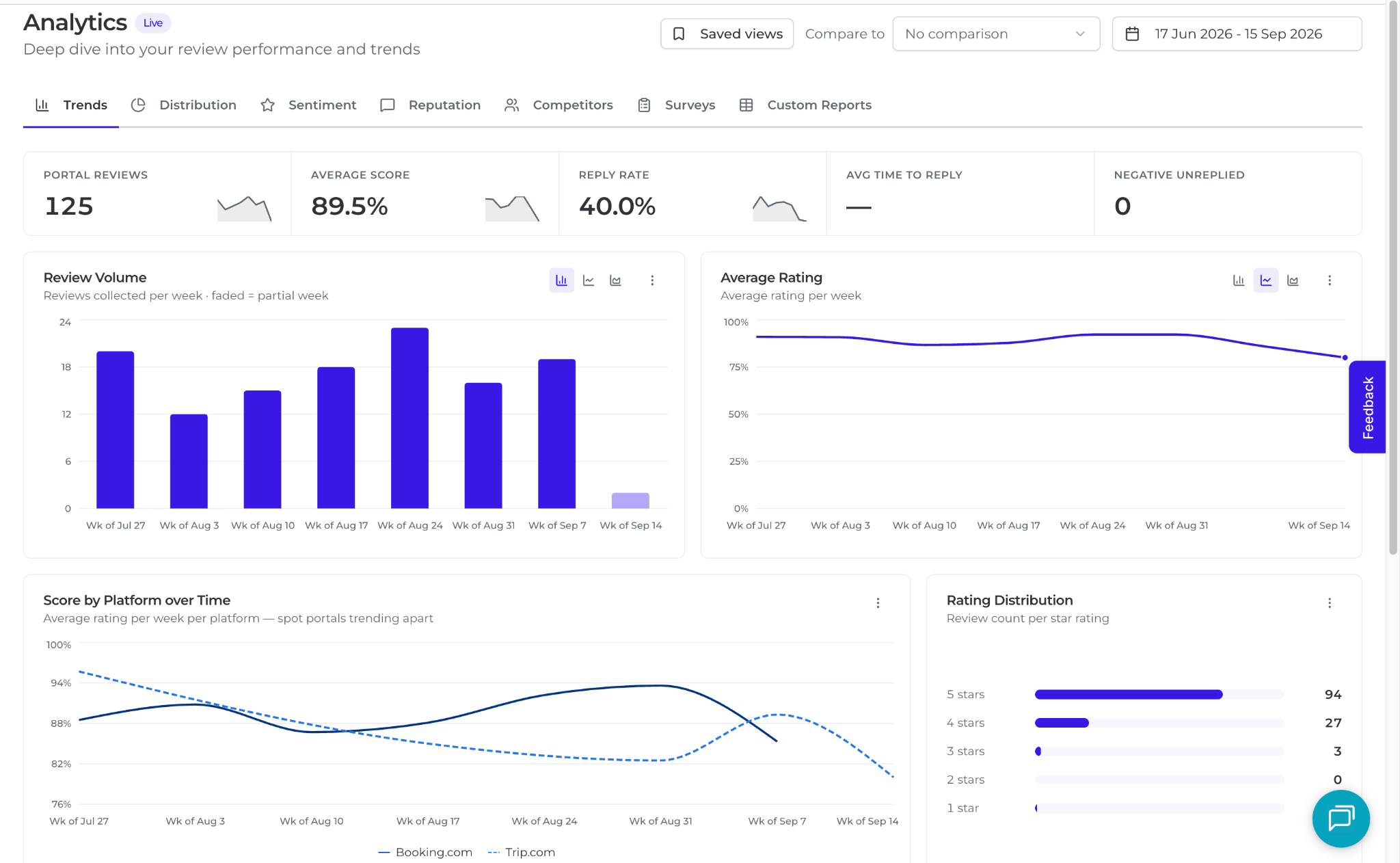
Los reportes se agregan al nivel del portfolio que se esté consultando, central, región o un único establecimiento, sin añadir un submenú nuevo cada vez que se incorpora una métrica. Tendencias, desglose por portal, sentimiento, benchmarking frente a la competencia y rendimiento de encuestas conviven en la misma pantalla, con indicadores principales siempre visibles: total de opiniones, puntuación media, tasa de respuesta, tiempo medio de respuesta y opiniones negativas sin responder, en las que se puede hacer clic directamente. Como no todos los grupos hoteleros siguen las mismas métricas, también se puede crear una tabla dinámica o un gráfico personalizado a partir de los datos subyacentes y guardarlo junto a los paneles integrados, o programar cualquier vista como informe en PDF para los stakeholders que no acceden a la plataforma.
Por debajo de todo esto, AI Insights lee cada comentario de texto libre en opiniones y encuestas para destacar qué está funcionando bien y qué necesita mejorar, y Key Driver Analysis clasifica cuáles de esos temas mueven realmente la puntuación.
Criterio
Qué ofrece Customer Alliance
Cobertura de reseñas y portales
Google, Expedia, HolidayCheck y más de 16 portales adicionales en una sola bandeja de entrada
Feedback multicanal
Encuestas CSAT, NPS y personalizadas a lo largo de todo el recorrido del huésped, con más de 3 millones de encuestas procesadas
Automatización de respuestas y tono de marca
El AI Reply Assistant genera respuestas alineadas con la marca en segundos, editables antes de enviarlas
Informes y permisos multipropiedad
Paneles consolidados y acceso basado en roles, por propiedad, región o marca
Integraciones de sistema
Más de 100 integraciones con sistemas PMS, CRM y de revenue
Inteligencia diagnóstica y evaluativa
AI Insights y Key Driver Analysis clasifican qué corregir primero y confirman si funcionó
¿Qué resultados obtienen los hoteles al cerrar el ciclo del feedback?
Los primeros resultados con Customer Alliance muestran que las puntuaciones de satisfacción y la visibilidad de las opiniones avanzan juntas.
Preston Palace registró un aumento del 14 % en la satisfacción con la limpieza tras usar los datos de feedback de huéspedes para priorizar una renovación; My Arbor incrementó sus opiniones en Google un 55 %; y Gorki Apartments alcanzó el puesto número 1 en TripAdvisor en Berlín, con una mejora del 12 % en su puntuación de opiniones en seis meses. A nivel de portfolio, Dorint Hotels & Resorts gestiona el feedback de huéspedes de cerca de 60 hoteles en Customer Alliance, dando a la central una visión única y coherente en lugar de 60 vistas separadas.
Elija un software que le ofrezca feedback intelligence, no solo gestión de opiniones
Revisar los seis criterios, cobertura, captura multicanal, automatización de respuestas, reportes multipropiedad, integraciones e inteligencia diagnóstica, permite ver qué plataformas realmente funcionan a escala de portfolio antes de que una implementación fallida cueste tiempo y presupuesto.
Para grupos y cadenas hoteleras en particular, la plataforma Customer Alliance está construida exactamente en torno a esta shortlist: visión a nivel de grupo con capacidad de acción a nivel local.
Guest Feedback Intelligence es el enfoque que consiste en reunir todo lo que dicen los huéspedes, en distintas OTA, idiomas y periodos de tiempo, y convertirlo en conocimiento estructurado, compartido y accionable en toda la operación. Reúne el feedback de distintos portales en una sola vista, lo organiza a gran escala y permite a los equipos responder, identificar patrones, priorizar acciones y tomar decisiones basadas en lo que los huéspedes experimentan de forma constante. Es una manera de tratar el feedback de huéspedes no como comentarios aislados, sino como una fuente continua de visibilidad, reputación e insight que orienta cómo opera y mejora el hotel.
¿Cumple Customer Alliance los seis criterios para grandes grupos hoteleros?
Sí. Customer Alliance reúne cobertura de opiniones y portales, encuestas multicanal, respuestas generadas con IA en el tono de marca, reportes y permisos multipropiedad, más de 100 integraciones y AI Insights en una sola plataforma, y la utilizan grupos hoteleros.
¿Qué necesita la gestión de opiniones para cadenas hoteleras más allá del monitoreo estándar?
Para las cadenas hoteleras, la gestión de opiniones debe añadir permisos multipropiedad, reportes a nivel de portfolio y un tono de marca coherente en cada establecimiento, además de monitorear y responder a las opiniones. Customer Alliance está construida en torno a estos requisitos, con Dorint Hotels & Resorts como ejemplo, que gestiona casi 60 hoteles en una sola cuenta.
¿Una mejor gestión del feedback de huéspedes aumenta realmente las reservas?
La puntuación y el volumen de opiniones influyen en el posicionamiento y la visibilidad en las OTA y en los buscadores, lo que afecta tanto a las reservas indirectas como a las directas. Más allá de la visibilidad, una reputación más sólida y bien gestionada aumenta la confianza del viajero en el momento de reservar, razón por la que clientes de Customer Alliance como Gorki Apartments y My Arbor han visto mejoras tanto en la puntuación de sus opiniones como en resultados relacionados con las reservas, tras cerrar el ciclo entre el feedback y la acción.
La nueva plataforma Customer Alliance lleva la Guest Feedback Intelligence a los hoteles. Es una plataforma AI-first que reúne reseñas, encuestas y feedback directo en un solo lugar y ayuda a los equipos a recopilar el feedback de los huéspedes, a comprenderlo y a actuar en consecuencia para mejorar la experiencia del huésped, la reputación y los ingresos. Los grandes hoteles ya se apoyan en excelentes sistemas que mantienen la operación en marcha. El feedback de los huéspedes es lo que conecta todo eso con las personas a las que va dirigido: tus huéspedes. Te muestra qué funciona, qué mejorar a continuación y qué les hace volver. 💡 ¿Te gustaría descubrir cómo la nueva plataforma puede ayudar a tu hotel?Reserva una demo. Nuestro equipo te mostrará la plataforma, responderá a tus preguntas y te enseñará cómo puede apoyar tu estrategia de gestión del feedback de los huéspedes.
Los datos clave
La nueva plataforma Customer Alliance es AI-first, diseñada para la gestión de la reputación y la Guest Feedback Intelligence en el sector hotelero. Está disponible desde ya para hoteles y grupos de todo el mundo.
La Guest Feedback Intelligence reúne cada voz de los huéspedes (reseñas, encuestas y feedback directo) en una vista estructurada, compartida y accionable. Así es como un hotel pasa de leer los comentarios uno a uno a comprender lo que los huéspedes viven de forma recurrente, para luego actuar.
La plataforma sigue un único ciclo continuo: recopilar, comprender, compartir y actuar. El feedback pasa de la recopilación al análisis y a la decisión sin salir de la herramienta.
Confían en Customer Alliance más de 5.000 empresas del sector hotelero
Los primeros resultados son medibles. Preston Palace registró un aumento del 14 % en la satisfacción sobre la limpieza, My Arbor un incremento del 55 % en sus reseñas de Google y Gorki Apartments alcanzó el primer puesto en TripAdvisor en Berlín, con una mejora del 12 % en su puntuación de reseñas en seis meses.
¿Qué es la plataforma Customer Alliance?
La plataforma Customer Alliance es una plataforma de Guest Feedback Intelligence AI-first para hoteles, desarrollada por Customer Alliance y utilizada por más de 5.000 hoteles en todo el mundo. Reúne en un solo lugar reseñas, encuestas y feedback directo y ayuda a los hoteles a recopilar el feedback de los huéspedes, a comprenderlo, a compartirlo y a actuar en consecuencia. Combina la gestión de reseñas en los principales portales con encuestas CSAT y NPS personalizadas, AI Insights y analíticas. Hasta la fecha ha procesado más de 3 millones de encuestas de huéspedes y recopilado más de 90 millones de reseñas, y hace llegar los insights a los equipos que los necesitan a través de más de 100 integraciones con sistemas PMS, CRM y de revenue management.
Con la plataforma Customer Alliance, un hotel puede:
Reunir en un solo lugar las reseñas de todos los portales y sus propias encuestas
Responder a las reseñas en Booking.com, Expedia, HolidayCheck y otros 16 portales, con respuestas generadas por la AI en la Brand Voice del propio hotel
Medir CSAT, NPS y los momentos clave del recorrido del huésped con encuestas personalizadas
Detectar, con AI Insights y Key Driver Analysis, qué temas influyen más en la satisfacción
Demostrar si una reforma o un cambio operativo movió la puntuación
Compartir los insights con los equipos de GM, revenue, operaciones, calidad y regionales a través de más de 100 integraciones con sistemas PMS, CRM y de revenue management
¿Por qué hemos reconstruido la plataforma ahora?
La AI ha cambiado la forma en que los hoteles compiten y toman decisiones, y eso hace que el feedback estructurado de los huéspedes sea más valioso que nunca. Ya no puede quedarse disperso en portales de reseñas, hojas de cálculo e informes aislados, leyendo un comentario cada vez.
Por eso hemos reconstruido la plataforma sobre una base AI-first y hemos mejorado cada funcionalidad principal, desde la recopilación de reseñas y las respuestas hasta las encuestas, a partir de lo que nos han pedido nuestros clientes. Ahora hace que el feedback de los huéspedes sea fácil de estructurar, comprender y utilizar entre los equipos y las herramientas de un hotel, y está lista para acompañar todo lo que construyan a continuación.
«El feedback de los huéspedes no es nada nuevo; los hoteles siempre lo han tenido. La verdadera pregunta es cómo la AI puede convertir ese feedback en insights, prioridades, acciones y mejoras medibles. Eso es lo que entendemos por Guest Feedback Intelligence: no solo recopilar reseñas y encuestas, sino darles sentido para que los hoteles sepan dónde centrarse y qué hacer a continuación.»
Steffen Schmickler, CEO de Customer Alliance
¿Qué pueden hacer los hoteles con la nueva plataforma?
La plataforma sigue un único ciclo continuo: recopilar, comprender, compartir y actuar. Así, un hotel puede pasar de limitarse a recopilar feedback a también actuar sobre él. En el centro de ese ciclo hay dos perspectivas: una perspectiva evaluativa, que juzga si la operación llega de verdad a los huéspedes, y una perspectiva de diagnóstico, que prioriza qué mejorar a continuación.
La perspectiva evaluativa responde a la pregunta «¿funcionó?». Cuando un establecimiento cambia el bufé de desayuno, la única manera de saber si el cambio llegó realmente a los huéspedes es seguir su satisfacción trimestre a trimestre en relación con la fecha del cambio. Así fue exactamente como Preston Palace confirmó el impacto de la renovación de su restaurante, contribuyendo a elevar la satisfacción sobre el desayuno hasta cerca de 9,0 sobre 10. Así es como un GM demuestra a la propiedad que una inversión dio sus frutos, o descubre en silencio que no fue así.
La perspectiva de diagnóstico responde a la pregunta «¿qué deberíamos mejorar primero?». Ningún hotel puede arreglarlo todo, así que el valor está en la priorización. Key Driver Analysis puede mostrar que la amabilidad del personal ya es excelente, con poco margen para mover la puntuación, mientras que el silencio en las habitaciones es solo mediocre pero es uno de los factores más fuertes de la satisfacción, redirigiendo así la próxima inversión hacia donde realmente rinde.
¿Qué incluye la nueva plataforma Customer Alliance?
La nueva plataforma Customer Alliance incluye un Review Inbox, un creador de encuestas con distribución de campañas, AI Insights con Key Driver Analysis, una vista analítica consolidada, informes, widgets para el sitio web y un área dedicada a las integraciones. Los fundamentos de la gestión de la reputación (recopilación de reseñas, respuestas y encuestas) se han refinado con las aportaciones de los hoteleros y, juntos, reúnen cada fase del ciclo de feedback en un mismo espacio de trabajo. A continuación, un recorrido por cada área, en el orden en que el feedback la atraviesa.
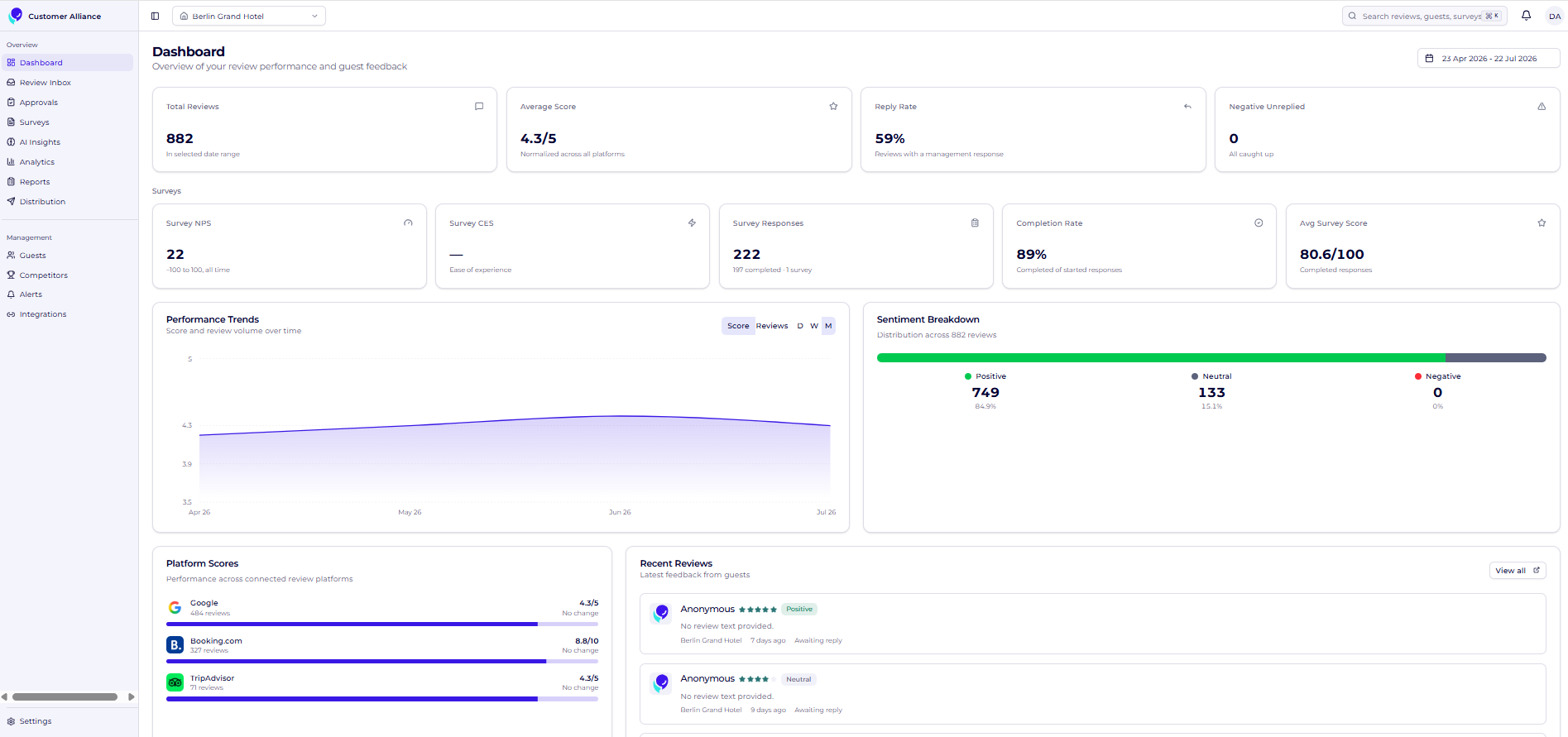
Dashboard: la satisfacción del huésped de un vistazo
El dashboard ofrece una panorámica inmediata y de alto nivel de la satisfacción del huésped, ya sea de un solo establecimiento o de toda su cartera. Un filtro de fechas global en la esquina superior derecha (últimos 7, 30 o 90 días, o un intervalo personalizado) actualiza todas las métricas de la página a la vez.
Cuatro indicadores de rendimiento principales: reseñas totales, puntuación media, reseñas respondidas y reseñas negativas sin resolver, estas últimas marcadas como acción crítica para que la recuperación del servicio tenga prioridad.
Tendencias de rendimiento y desglose del sentimiento: ve cuándo bajaron o subieron las puntuaciones, con una lectura impulsada por la AI sobre si la percepción de los huéspedes está cambiando.
Puntuaciones por portal y feed de reseñas en directo: compara Google, Booking.com y TripAdvisor de un vistazo y abre el flujo completo haciendo clic en cualquier reseña reciente.
Alertas en tiempo real: el icono de campana le avisa cuando una reseña cruza un umbral de puntuación o cuando un compañero es mencionado en una reseña.
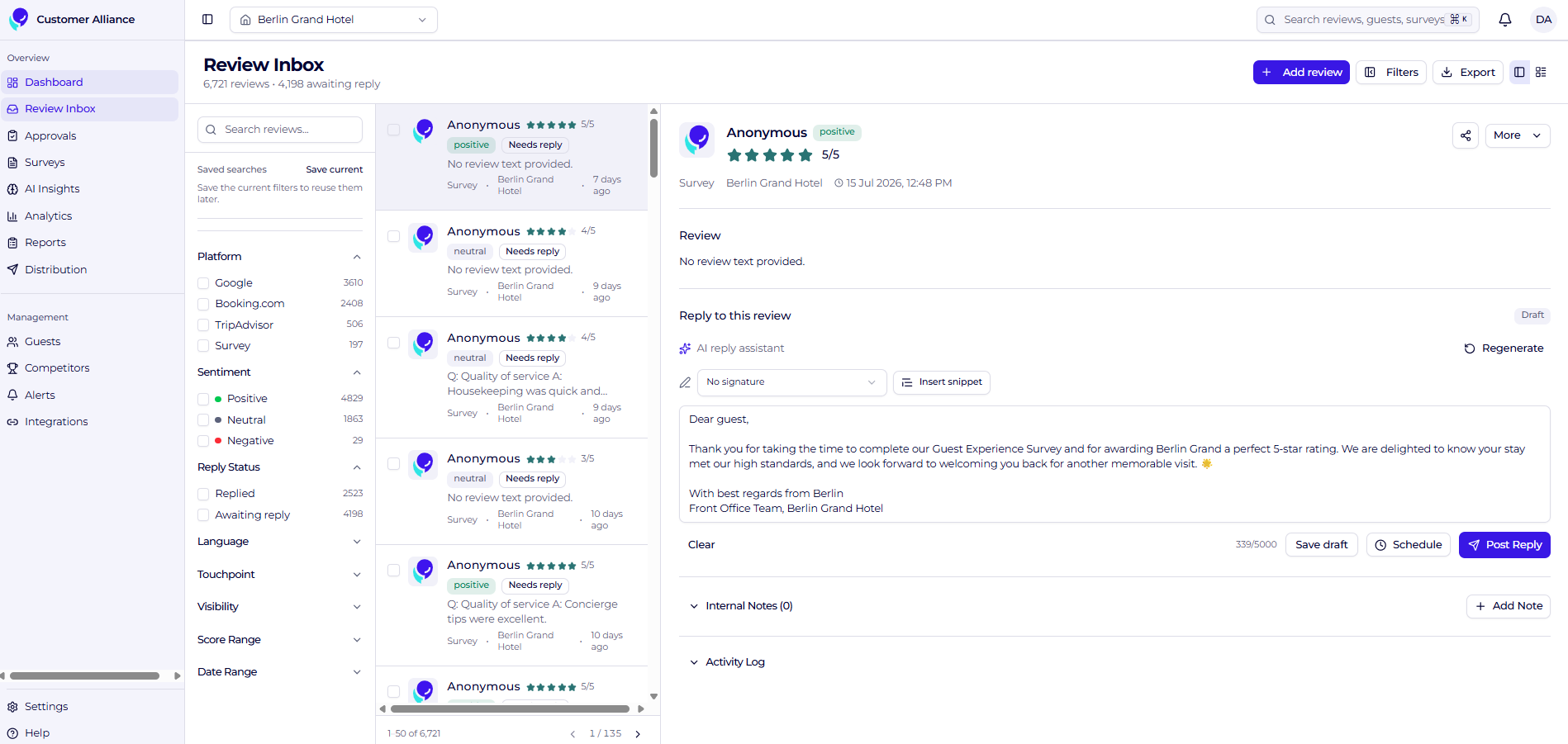
Review Inbox: recopilar y responder al feedback en un solo lugar
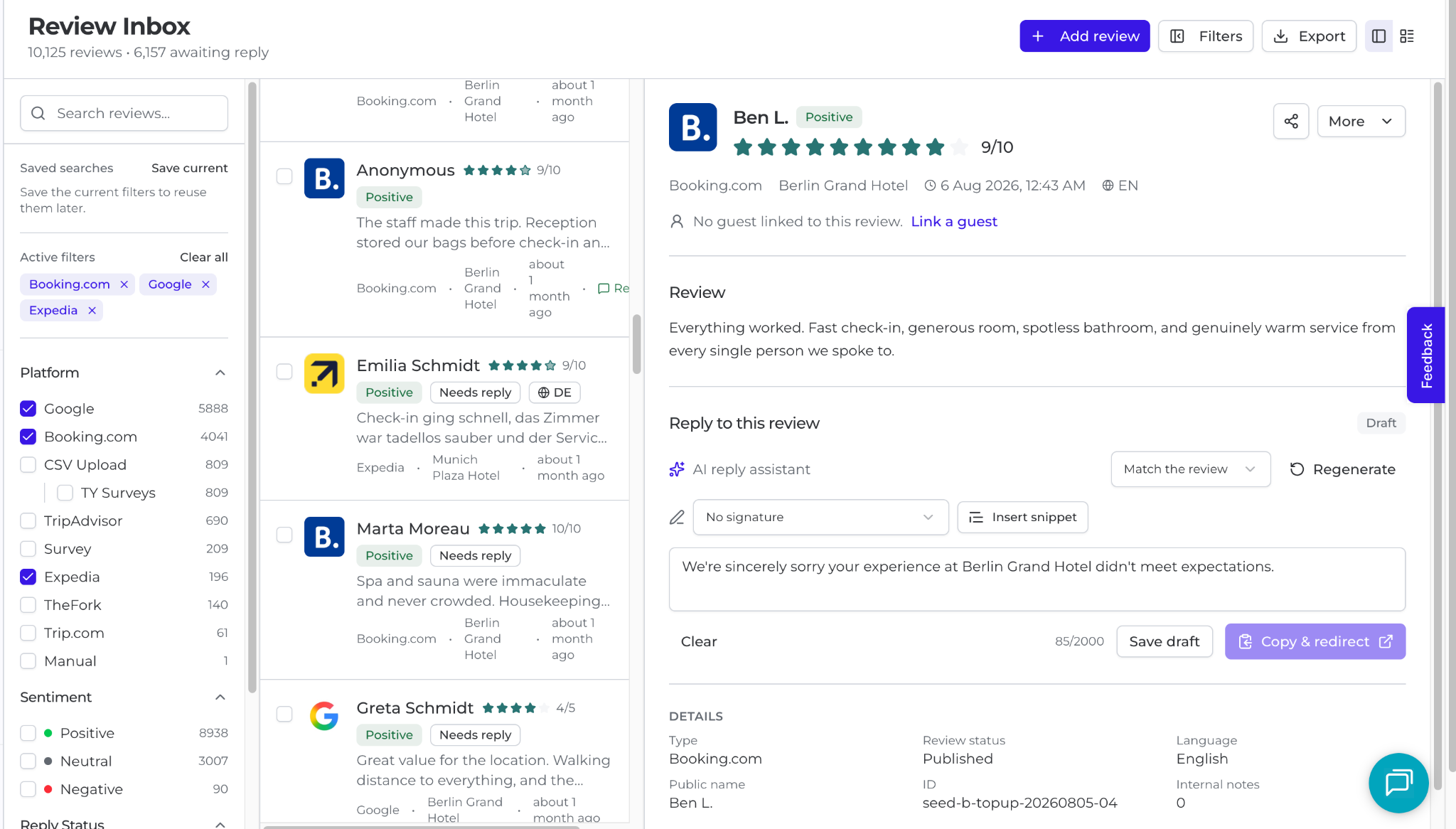
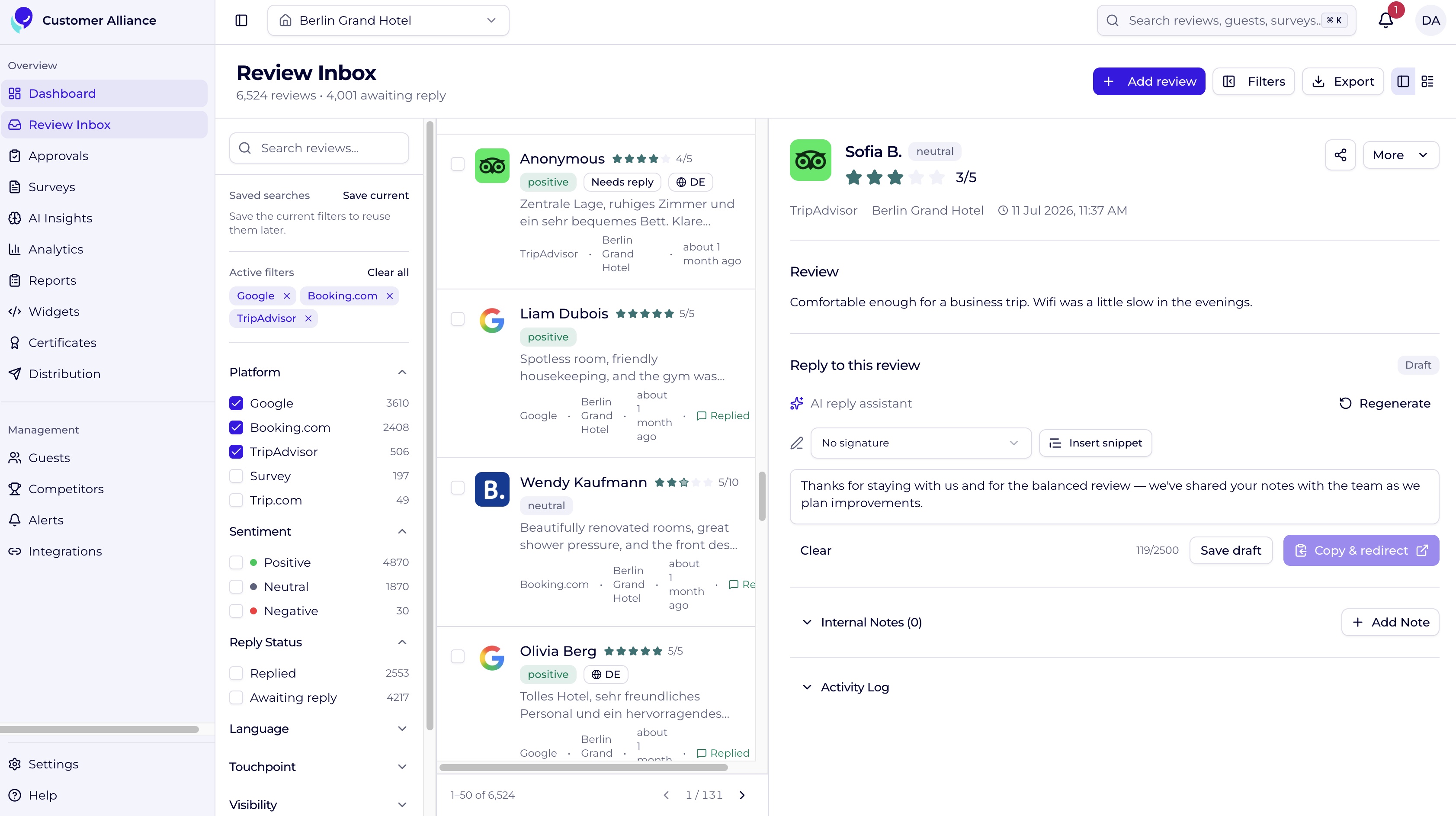
El Review Inbox es un feed en directo que reúne las reseñas de portales de terceros junto con las encuestas de huéspedes completadas. Una barra de filtros permite aislar el feedback por portal, fecha, puntuación, sentimiento o estado de respuesta, para que te centres en lo que importa en este momento.
Cada ficha de reseña muestra el nombre del huésped, la puntuación media, un indicador de sentimiento y el estado de respuesta; al desplegarla, aparecen el texto completo y las puntuaciones de las subpreguntas.
Responde manualmente o genera un borrador en tu Brand Voice definida y edítalo antes de enviarlo.
En los portales conectados directamente, publica con un clic; en los portales externos, tu respuesta se copia en el portapapeles y se redirige para pegarla y enviarla.
Programa respuestas para más tarde, menciona a compañeros para escalar los casos e importa feedback offline o en papel subiendo un archivo CSV que fluye directamente a sus analíticas.
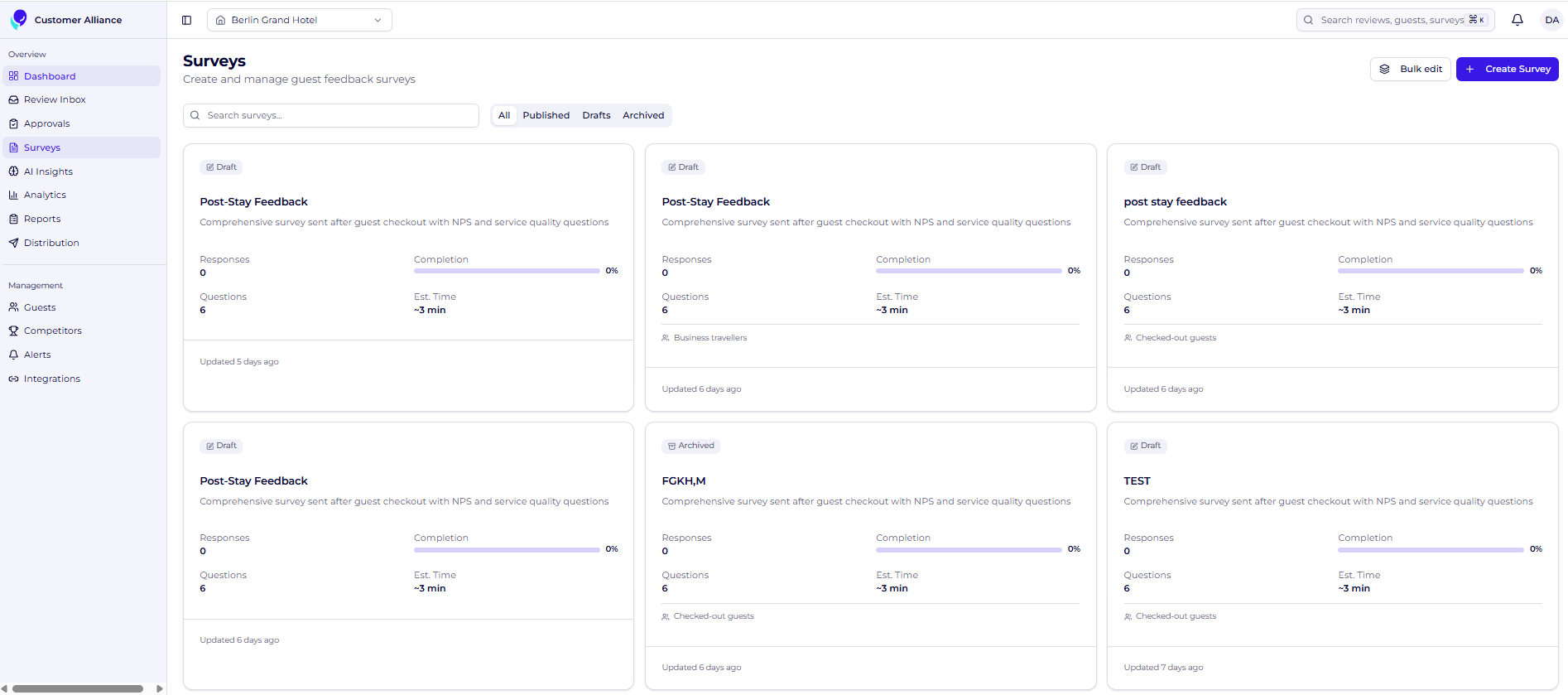
Encuestas: feedback específico más allá de las reseñas públicas
El creador de encuestas rediseñado, de arrastrar y soltar, te permite preguntar a los huéspedes por los momentos que marcan su estancia y enviar encuestas a audiencias específicas. Distribuirlas por correo electrónico automatizado o mediante un enlace estático en códigos QR, en señalización digital o en tu página de acceso al Wi-Fi.
Empieza desde una encuesta en blanco o desde una plantilla del sector lista para usar.
Elige entre NPS, CSAT, CES, valoración de 1 a 5 estrellas, valoración con emojis, texto corto y largo, y preguntas de selección única o múltiple.
Añade subpreguntas condicionales, por ejemplo un seguimiento automático cuando un huésped da una puntuación de detractor, para ganar profundidad sin recargar la encuesta.
Previsualiza en escritorio y móvil, guarda los borradores automáticamente y publica para que las encuestas se activen cuando se cumplan sus disparadores. Las encuestas ilimitadas están disponibles en los planes que las incluyen.
Distribución: enviar las solicitudes de feedback a los huéspedes adecuados en el momento adecuado
En Distribución crea, envía y supervisa las campañas que ponen tus encuestas frente a los huéspedes en el momento oportuno. Con los datos de tu integración con el PMS, puedes segmentar tu audiencia y llegar a los huéspedes antes de su llegada, durante su estancia o después del check-out.
Consulta el rendimiento a nivel de cuenta: tasas de apertura y de clic en la parte superior del dashboard, con estadísticas en tiempo real de cada campaña activa debajo.
Crea una campaña en unos pocos pasos: ponle nombre, elija envío automatizado (activado por eventos del sistema) o manual, vincula la encuesta y su disparador (por ejemplo, dos días después del check-out), redacta el asunto y el cuerpo y aplica tu branding.
Despliega en varios canales y deja que las campañas automatizadas funcionen en segundo plano una vez activas.
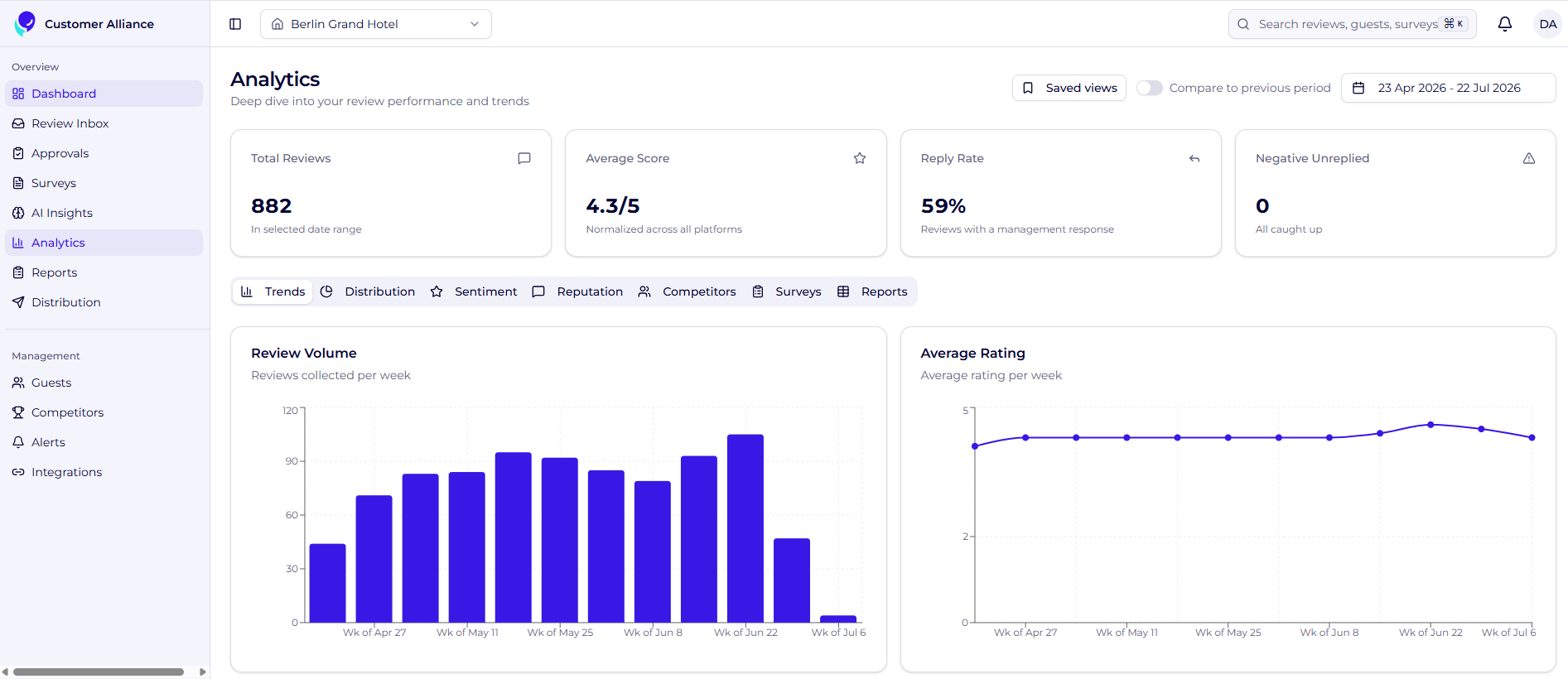
Analytics: comprender tu feedback en profundidad
En la nueva plataforma Customer Alliance, el área Analytics permite a los hoteleros profundizar en puntos de datos concretos. Los indicadores superiores reflejan su dashboard de inicio y un filtro de fechas global actualiza cuatro subpaneles especializados a la vez.
Trends: volumen de reseñas, puntuación media y rendimiento por establecimiento a lo largo del tiempo.
Distribution: volumen y puntuación por portal, rendimiento directo de las encuestas y una matriz multiestablecimiento por canal.
Sentiment: recuento de reseñas positivas, neutras y negativas, además de un mapeo del sentimiento establecimiento por establecimiento.
Panorámica de la competencia: un chequeo resumido frente a los competidores configurados, con un módulo Competitors específico para un benchmarking más a fondo.
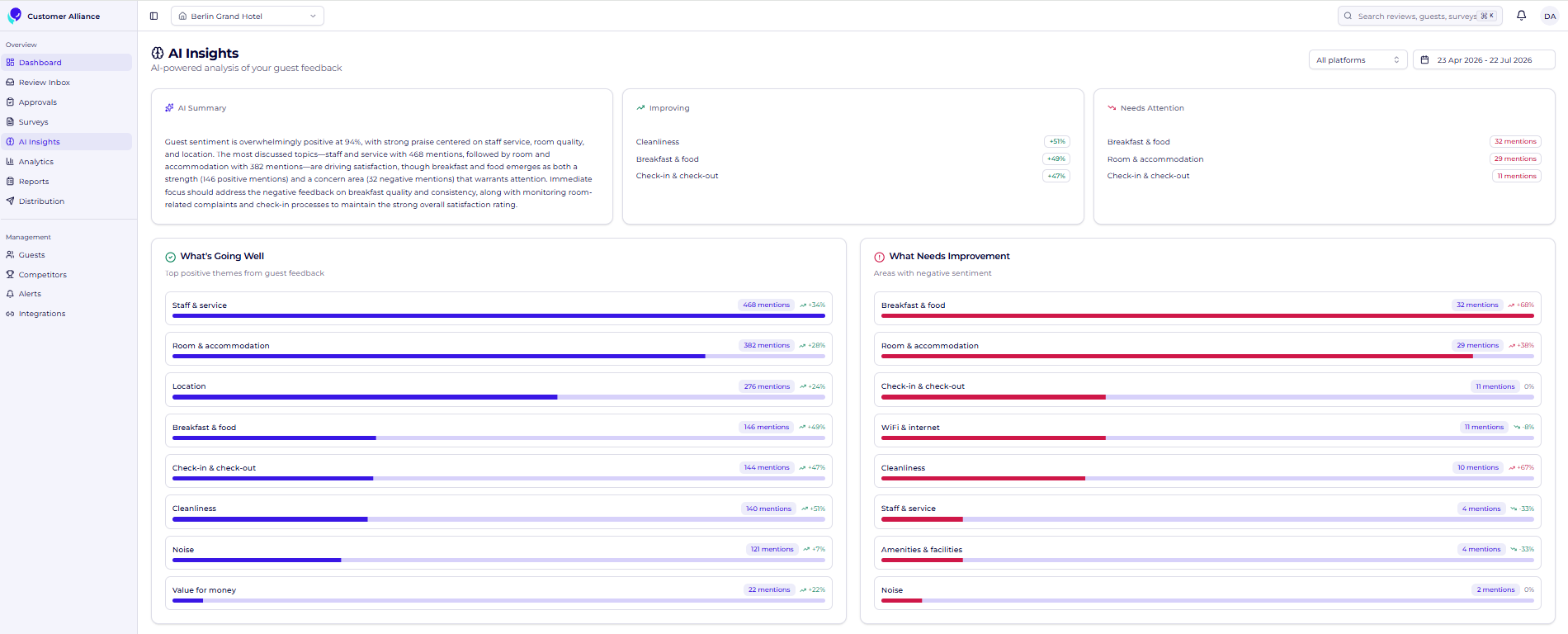
AI Insights y Key Driver Analysis: saber dónde actuar
AI Insights recorre todas tus reseñas y comentarios de encuesta en texto libre y sintetiza miles de palabras de los huéspedes en temas claros y accionables, para que dejes de leer el feedback una reseña cada vez.
Una sección de resumen con Performance Momentum indica qué áreas operativas están mejorando y cuáles retrocediendo frente al periodo anterior.
«Qué va bien» y «Qué hay que mejorar» agrupan el sentimiento por categoría; haz clic en una categoría para ver las citas exactas y los subtemas que la impulsan.
La AI genera recomendaciones a medida para tu establecimiento, con un sistema de pulgar arriba y pulgar abajo que entrena el modelo para tu propiedad concreta.
Key Driver Analysis identifica las palancas exactas que más mueven la satisfacción global, midiendo no sólo de qué hablan los huéspedes, sino cuánto influye cada tema en su puntuación final. Si el desayuno es un factor negativo principal, puede señalar si la temperatura de los platos o la rapidez del servicio aportará el mayor aumento de puntuación una vez resuelto, para que inviertas donde importa.
Informes: compartir el rendimiento con la dirección y los equipos
Informes exporta PDF limpios y profesionales para la dirección, los stakeholders y los equipos. Utiliza las plantillas integradas (con vista previa antes de generar) o crea un informe personalizado seleccionando exactamente los módulos y gráficos que necesitas. La pestaña «Schedule» automatiza el envío recurrente a los buzones de los stakeholders y la pestaña «History» mantiene un registro de qué se envió y a quién.
Widgets para el sitio web: mostrar el feedback de los huéspedes en tu web
Los widgets para el sitio web son elementos JavaScript flotantes que muestran en directo las puntuaciones de las reseñas y el feedback de los huéspedes en tu web, como prueba social. Elige una simple insignia de valoración o un carrusel de reseñas y entrega el código generado a tu webmaster, o utiliza la API para un widget totalmente personalizado y adaptado a tu marca.
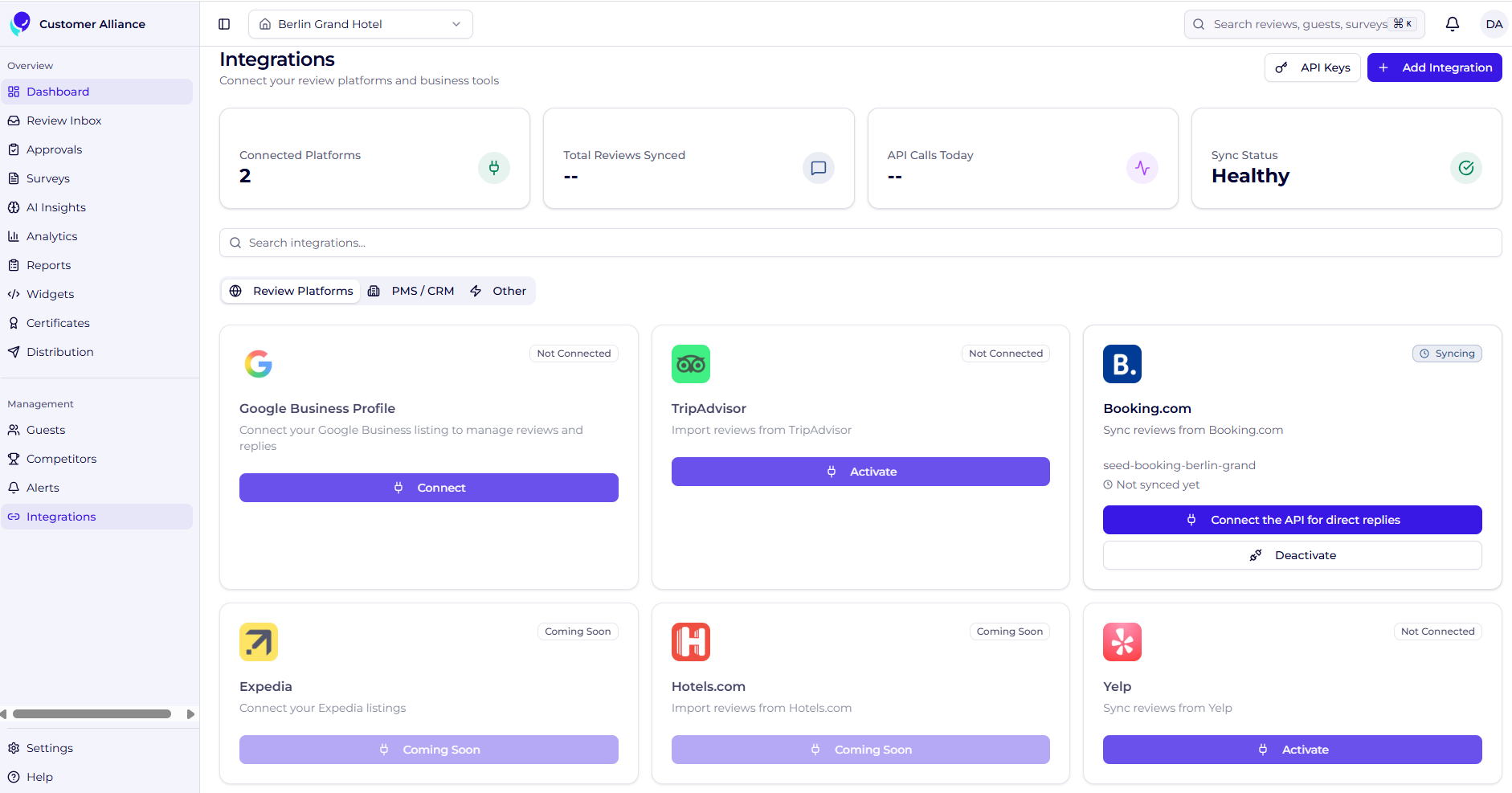
Integraciones: conecta su stack tecnológico hotelero
El área de Integraciones es el punto central para conectar su ecosistema digital, de modo que el feedback de los huéspedes fluya hacia las herramientas que tu equipo ya utiliza.
Portales de reseñas: gestiona las conexiones API directas o solicita una conexión para los canales sin enlace nativo.
Sistemas centrales: conecta tu PMS y su CRM para automatizar la sincronización de datos de los huéspedes y activar campañas de encuesta según los eventos de la estancia.
Canales de colaboración: envía las alertas en tiempo real a Slack o Microsoft Teams.
Claves API y webhooks: genera tokens seguros para importar los datos en bruto a plataformas de analítica y aplicaciones a medida. Las nuevas integraciones se conectan mediante OAuth o intercambio de clave API y se activan de inmediato.
¿Para quién es la plataforma Customer Alliance?
La plataforma Customer Alliance está diseñada para hoteles y entrenada en la realidad del trabajo diario de los hoteleros. Ofrece a las personas responsables de la experiencia del huésped (directores de hotel, cluster y regional managers, y equipos de revenue) una vista compartida del feedback, que cada uno lee a través de la perspectiva relevante para su función, en lugar de trabajar con informes separados.
Funciona igual tanto si gestionas un establecimiento como si gestionas cientos. Hoteles independientes, grupos y cadenas hoteleras y empresas de gestión hotelera utilizan Customer Alliance para mantener estándares coherentes y fundamentar sus decisiones en lo que los huéspedes viven realmente. Dorint Hotels & Resorts, por ejemplo, gestiona el feedback de los huéspedes en casi 60 hoteles con la plataforma Customer Alliance.
Para los directores de hotel, eso significa menos apagar fuegos y la prueba de que los cambios operativos llegaron a los huéspedes. Para los cluster y regional managers, significa benchmarking a nivel de cartera y reporting coherente entre establecimientos. Para los equipos de revenue y comerciales, significa una lectura más clara de las señales de experiencia que moldean la reputación, la visibilidad y la confianza al reservar.
Saber qué mejorar y demostrar que funcionó
Sus sistemas mantienen el hotel en marcha y le muestran qué ha ocurrido. La nueva plataforma Customer Alliance está construida para mostrarte cómo lo ha percibido el huésped, en qué centrarse a continuación y si el último cambio funcionó. Es el paso de gestionar reseñas a la Guest Feedback Intelligence. Los hoteles que invierten ahora en esta capa no sólo añaden una herramienta de feedback; construyen la capa que hace más valioso todo lo demás en su stack.
¿Listo para conocer la nueva Customer Alliance? Reserve una demo y descubra cómo la plataforma ayuda a tu equipo a recopilar mejor feedback, a comprender lo que valoran los huéspedes y a demostrar dónde centrar los esfuerzos.
Preguntas frecuentes
¿Qué es la Guest Feedback Intelligence?
La Guest Feedback Intelligence es la práctica de reunir todo lo que dicen los huéspedes, a través de portales de reseñas, encuestas, idiomas y tiempo, y convertirlo en una comprensión estructurada, compartida y accionable en todo el hotel. Construida sobre cuatro pilares (recopilar, comprender, compartir y actuar), permite a un hotel ver qué viven los huéspedes de forma recurrente, qué temas importan más y si los cambios recientes funcionaron, en lugar de leer el feedback un comentario cada vez.
¿En qué se diferencia Customer Alliance de otras herramientas de gestión de reseñas?
Otras herramientas de gestión de reseñas dicen qué dijeron los huéspedes y ayudan a responder. Customer Alliance indica qué tema abordar primero, si el último cambio operativo movió la puntuación y cómo la experiencia del huésped está moldeando la reputación y las reservas. Es esa capa de decisión la que hace que la herramienta sea difícil de abandonar sin volver a trabajar por conjeturas.
¿Es la Guest Feedback Intelligence lo mismo que la gestión de la reputación?
No exactamente, es el siguiente paso. La gestión de la reputación se centra en monitorizar las reseñas y responderlas para proteger la imagen online de un hotel. La Guest Feedback Intelligence engloba eso y le añade la comprensión del feedback a gran escala, su puesta en común entre los equipos y la acción que se deriva, lo que también refuerza las señales de reputación que hoy los asistentes de AI y los motores de búsqueda utilizan para recomendar hoteles.
¿Qué tipos de encuestas puedo crear?
Puedes crear encuestas desde una página en blanco o desde una plantilla, utilizando NPS, CSAT, CES, valoraciones con estrellas y emojis, campos de texto y preguntas de selección única o múltiple. Las subpreguntas condicionales permiten activar seguimientos específicos según la respuesta de un huésped. Las encuestas ilimitadas están disponibles en los planes que las incluyen.
¿Está disponible ya la nueva plataforma Customer Alliance?
Sí. La plataforma AI-first está disponible desde ya para hoteles y grupos de todo el mundo, y los flujos de feedback existentes (gestión de la reputación, recopilación de reseñas, respuestas y encuestas) siguen siendo su núcleo.
¿Se integra la plataforma con los sistemas existentes de un hotel?
Sí. Un área de Integraciones específica permite a los equipos conectar los portales de reseñas, integrar un PMS y un CRM, enviar alertas a Slack y Microsoft Teams y acceder a claves API y webhooks, de modo que los datos de feedback se muevan allí donde trabajen.
Los clientes esperan una experiencia excelente tanto en la tienda física como en línea. Incluso si tu empresa no tiene una tienda física, la experiencia del consumidor sigue siendo un factor determinante. La voz del consumidor es lo que tus compradores dicen sobre su experiencia con tu marca. Utiliza los comentarios de los consumidores para destacar tu tienda frente a la competencia.
Sigue leyendo para ver cómo puedes aprovechar el poder de la retroalimentación para mejorar tu tienda de comercio electrónico.
¿Por qué es importante la Voz del Consumidor para el comercio electrónico?
La voz del cliente, también llamada voz del consumidor, es ahora la forma principal de entender a tu cliente. Sé proactivo al solicitar comentarios. Deja que los consumidores te digan lo que quieren y necesitan para evitar las suposiciones sobre sus deseos. Para un repaso, consulta La Guía de la Voz del Cliente: Importancia, herramientas VoC y ejemplos.
El 89% de los consumidores de todo el mundo se esfuerza por leer reseñas antes de comprar un producto (1).
Esta estadística por sí sola revela lo influyente que es la voz del consumidor para otros consumidores potenciales. Lo que otros tienen que decir sobre tus productos a menudo aporta más valor y confianza a tu marca que lo que tú mismo puedas decir sobre tu propia tienda.
Investiga lo que se dice sobre tu empresa. Si es bueno, úsalo para promocionar. Si no, usa los comentarios para mejorar. Veamos cómo puedes recopilar esta retroalimentación.
Métodos para recopilar comentarios de los clientes
Las oportunidades para recopilar comentarios son muchas. Considera estas formas de capturar los datos de la voz de tu consumidor.
Cuestionarios
Envía un cuestionario para solicitar comentarios sobre las diferentes etapas del recorrido del cliente.
¿Les pareció intuitivo tu sitio web?
¿Fue fácil el proceso de pago?
¿Quedaron satisfechos con el producto/servicio?
¿Te recomendarían a un amigo? (Sí, esta es una Net Promoter Score pregunta.)
El hecho de que tu tienda opere en línea no resta importancia a las entrevistas. Las entrevistas ofrecen una excelente manera de obtener datos brutos y sin filtrar de la voz del consumidor y generarán confianza con aquellos a quienes entrevistes.
Realiza la entrevista por teléfono o incluso por correo electrónico, según la conveniencia de tu cliente. Asegúrate de preguntarles si puedes grabar la entrevista e incluso usarlas en tu sitio web para citas de clientes.
Reseñas en línea
Nuestra sugerencia: No te quedes esperando pasivamente a que los clientes dejen reseñas. ¿Por qué?
Tus clientes están mucho más dispuestos a dejar reseñas de lo que crees:
El 76% de los consumidores dejará una reseña si se les pide (2).
Así que no seas tímido. ¿Por qué no automatizar una invitación para dejar una reseña después de cada compra? Hay muchos proveedores que ofrecen esta solución.
Si dispones de los medios, utiliza el chat en vivo para hablar con los clientes cuando estén en tu sitio. Les encantará la comodidad de una respuesta rápida y encontrarán que su compra se facilita, ya que podrán obtener rápidamente una respuesta a su pregunta.
Además, para reducir el abandono del carrito, considera incluir un chat en vivo en tu página de pago o en tu página de precios.
Cómo usar los comentarios para promocionar tu tienda
Demuestra que te importa tomándote las reseñas en serio. Muchos clientes descubren que las marcas no responden en absoluto a sus reseñas, ¿y sabes qué? Cuando no respondes a las reseñas, corres el riesgo de aumentar la rotación de clientes en un 15%. (3)
Convierte los comentarios negativos a tu favor
Responde bien a los comentarios negativos. Y sí, los consumidores buscan cómo responde una empresa a los comentarios negativos. Si terminas recopilando muchas reseñas (¡como deberías!), seguramente tendrás algunas negativas. ¿Pero sabes qué? Eso ayuda a generar confianza. El 30% de los consumidores no creerá que tus reseñas son reales si no tienes ninguna negativa (4).
Además, al responder rápida y apropiadamente, podrías convencer a un consumidor de que edite su calificación o reseña de tu tienda y terminar con otra reseña positiva.
Los comentarios negativos de los clientes son también siempre una oportunidad para aprender de la voz del consumidor. Quizás disfruten de tu producto en general, pero mencionen un pequeño punto débil en una reseña o cuestionario. Soluciónalo para aumentar las ventas y la satisfacción del cliente.
Optimiza, optimiza, optimiza
Ah, y otra cosa que hemos oído que es útil: Optimiza las descripciones de los productos basándote en los comentarios. Así, es más probable que las expectativas de tus consumidores coincidan con tu producto o servicio. ¡Y entonces estarán contentos, y probablemente serán leales!
Mejora tu tienda basándote en lo que les gusta y disgusta a los clientes. Esto va más allá de las ofertas de tu empresa, sino que también incluye la experiencia del cliente:
¿Pudieron encontrar toda la información que necesitaban?
Si no, ¿la ayuda estaba a mano?
¿Cómo fue su experiencia con el proceso de pago?
¿La descripción del producto reflejaba con precisión el producto?
Evoluciona, ya sea positivo, neutral o negativo. Analiza los resultados y toma decisiones prácticas.
Usa los comentarios para fomentar las compras
Dado que la industria del comercio electrónico es online, depende en gran medida de las reseñas de los consumidores y las tiendas de comercio electrónico necesitan bastantes reseñas por producto para generar ingresos. Mira:
Las reseñas de 50 o más por producto pueden significar un aumento del 4,6% en las tasas de conversión (4).
Aumenta la tasa de conversión de tu tienda de comercio electrónico utilizando los datos de la voz del consumidor directamente en tu sitio web. Muchas empresas fomentan las compras mostrando las reseñas de los consumidores.
Por ejemplo, aquí en Customer Alliance, ofrecemos un widget que los clientes pueden integrar en su sitio web para mostrar los comentarios de los clientes que reciben.
Por último, es importante distribuir los comentarios de los consumidores entre varios portales de reseñas para construir tu presencia online. Asegúrate de tener reseñas en todas las plataformas de reseñas relevantes. Al hacerlo, atraerás a nuevos consumidores a tu sitio web.
En conclusión, invertir en una solución de voz del consumidor es un excelente paso para construir la visibilidad online de tu sitio de comercio electrónico y promover la confianza del cliente.
Fuentes:
Informe de Trustpilot: El papel fundamental de las reseñas en la confianza en Internet
Centro de aprendizaje: 51 estadísticas de reseñas de clientes para que reconsideres su uso
Chatmeter: Google confirma que responder a las reseñas mejora tu SEO local
Infografía de Vendasta: 50 estadísticas importantes que debes saber sobre las reseñas online
We’re so excited to announce the launch of in-app and in-web surveys! Also known as microsurveys, they offer a short, targeted and timely way to collect customer feedback right inside your website or app.
With lots of use cases and instant, actionable data, we can’t wait to see how microsurveys will get you even better results. But first, let’s dive in and learn more about this powerful feedback tool. Here we go!
In-Web And In-App Surveys vs “Traditional” Surveys
Traditional surveys are multi-question or multi-page and are often sent to the customer via email. These types of surveys still hold tremendous value, providing deep insights that are key to any Voice of the Customer program.
But there are some instances where bigger isn’t necessarily better. Microsurveys are the perfect complement to traditional surveys, targeting the here and now of specific customer scenarios.
What Makes In-Web And In-App Surveys Different?
Microsurveys ask just one core question (with an optional conditional question), making them quick and easy to complete. By reducing the number of steps the customer needs to take, microsurveys reduce friction.
As they appear right on the screen, they also eliminate the need to leave the website or app to give feedback. This results in a higher response rate and even more valuable data for your business.
Microsurveys allow you to ask the right questions at the right time with customisable triggers. Your microsurvey could appear on a certain page, like a booking confirmation. Or it could pop up when a customer clicks a specific button, for example after hitting ‘Send’ on a message. This helps capture feedback when the topic is still fresh in the customer’s mind (which will again make them more likely to respond!)
How To Use In-Web And In-App Surveys
In-web and in-app surveys can be used for many different question types depending on your business goals. This includes:
Numerical ratings (for metrics like NPS, CSAT and CES)
Star ratings (e.g. to share opinions on the quality of an article)
Free text fields (e.g. to provide suggestions about a product)
Multiple choice (e.g. to give a reason for cancellation)
Let’s take a look at a few ways microsurveys can be used in practice.
Improve A Process
In a bid to increase revenue, a hotel is looking to optimise its booking process. To do this, they collect opinions using one simple question that appears when a user has completed a booking.
This Customer Effort Score (CES) question offers a simple way to learn how easy the user found the booking process. Depending on the score given, the in-web survey could also include a follow-up, free text question, like:
Awesome! Anything else we can do to improve?
Thank you! How can we make the booking process easier?
Understand Customer Churn
A car dealership wants to know why some customers cancel their maintenance plan so they can improve their offer. To do this, they ask a single, multiple-choice question to users of their app when they have completed a cancellation.
The car dealership can then analyse the responses for trends to steer the direction of their service. For example, if most respondents answered ‘It was too expensive’, the dealership may consider lowering the monthly cost or introducing an additional service into the plan.
Measure Customer Loyalty
A company wants to identify their most loyal customers and convert them into brand ambassadors. A single Net Promoter Score (NPS) question gives them the ideal solution.
Again, the company could ask a follow-up question that changes depending on the score given. Run continuously, this microsurvey will also allow them to track changes in overall customer loyalty.
Sounds Great! How Do I Get Started With In-Web And In-App Surveys?
Simply schedule a call with your Customer Success Manager who will answer your questions and help you get set up! Alternatively, if you are not yet working with Customer Alliance but would like to find out more, you can schedule a free, no-obligation demo with us by clicking the button below.
“We know that people want to hear other people’s experiences to help them make decisions.”
That’s what Google say about the development of Search Generative Experience (SGE). Soon, being found online won’t just be about optimised websites and targeting keywords. It will be about your entire digital footprint, including how other people talk about your brand.
In this article, we’ll explore how this evolution is set to shift the way businesses approach online visibility and give you a clear strategy going forward.
Understanding and adapting to these changes is crucial for anyone looking to stay ahead in the digital marketplace. So let’s demystify SGE–your roadmap to mastering the future of online search starts here.
How SGE will change the way people search
To understand why external content will be so powerful for online visibility, first, we need to get familiar with the goal of SGE.
According to Google:
“With the new generative AI functions, search becomes even more efficient. Thanks to these advances, you can understand a topic more quickly, gain new perspectives and insights, and complete your tasks more easily.”
What does this mean in practice? Imagine a traveller, let’s call her Sarah, planning a trip to Paris. She’s not just looking for any accommodation; she wants to stay in a quintessentially Parisian boutique hotel. It has to be pet-friendly because her dog Roscoe goes wherever she goes. Sarah also cares about sustainable practices and wants to make the most of Paris’s café scene.
Traditionally, Sarah might search “pet-friendly boutique hotels near Eiffel Tower”. She would likely click on a few different pages, weigh up the amenities, read vague descriptions, and cross-reference locations. Then once she’d narrowed down her best options, she might check for sustainability credentials and search the areas for local cafés.
SGE aims to condense Sarah’s quest into a single, intuitive search query: “Eco-friendly pet-friendly hotel in Paris near cafes”.
The websites that Google’s AI thinks are the most relevant for that query will show up at the top of the page, above organic rankings (and sometimes even above paid ads).
So how can you feed Google the information it needs to ensure your business shows up where it matters most?
Look beyond your website
As we pointed out at the start of this article, Google is interested in hearing what other people think of your brand, not just how you present yourselves.
That’s not to say that you needn’t bother optimizing your website for search—far from it—but it means that external content is just as important. This includes:
Your customer reviews
Your social media profiles (and what you post there)
Mentions of your brand on other websites and social media
Together, these create a complete picture of your brand authority that tells Google how to include you in the search results. Their goal is to provide the most relevant content for their users, so the more information they have about you, the more accurately their algorithms can figure out where to place you.
Customer reviews: the next big thing for SGE ranking
Of the types of external content we mentioned above, we think reviews will become one of the most important factors for ranking when SGE rolls around. Why? Not only do reviews provide insights from people who’ve actually used your products or services, they also tell Google more about what you do well and how certain demographics might experience your business.
To prepare for SGE, we recommend three things:
Get more reviews
Encourage more detailed reviews
Reply to your reviews
1. How to get more reviews
Most businesses take a hands-off approach to reviews. They expect some, though not all, happy customers to share their feedback and leave their review volume up to chance.
If you want to reap the benefits of reviews for SGE, you need to take a more proactive approach. There are many ways you can encourage customers to leave reviews. The key is to make it as quick, convenient and easy as possible.
Here are a few ideas to get you started:
Generate a direct Google review link through your Google My Business listing. This will prevent a poor user experience where a customer has to navigate through multiple screens to share their feedback.
Add the link to your email signature for a subtle review reminder that is seen many times a day.
Add the link to your website in high-traffic areas like your homepage to prompt return visitors.
Create a template review request email to run strategic review campaigns. Great copy, personalisation and a direct link can help increase your review volume.
Design “Leave us a review” cards and a QR code with your review link. Distribute the cards with transactions or strategically place them around your business.
Add a review invitation to the end of your surveys. Since respondents have already shown a willingness to provide feedback, they’re more likely to take this extra step.
Pro tip 💡 use review management software to automate review collection. Platforms like Customer Alliance offer the most efficient way to consistently increase your reviews. Our software sends automatic invitations that allow your customers to leave public reviews in a matter of seconds, with no manual work on your end.
2. How to encourage more detailed reviews
Many reviews are surface-level, and don’t go into detail about their experience. This is fine if you just want to build up your review score on portals like Google or Yelp. However, to give search algorithms more information about your business your reviews need to include relevant keywords.
Simple prompts can help you get richer reviews that offer more information for potential customers and Google alike. For example, rather than simply asking guests you leave a review, you could ask them if there was anything they particularly enjoyed about their experience or the nature of their visit.
You can also think about this strategically. Say you’re a general manager of a hotel, and one of your unique selling points is your proximity to a popular tourist attraction. In this case, you might encourage guests to mention how they found the location convenient for their sightseeing plans.
Questions like, “Did our proximity to [Tourist Attraction] enhance your stay?” or “How did you find the convenience of getting to [Tourist Attraction] from our hotel?” can guide guests to provide reviews that highlight this key aspect of your hotel.
Remember, it’s important to make these prompts as natural and unobtrusive as possible. The aim is to encourage guests to share their genuine experiences in a way that also feeds directly into SGE’s demand for specificity and personalisation
3. How to reply to reviews
The quality of your responses can be just as influential as the reviews themselves in shaping public perception and improving your SGE rankings. Responding to all types of reviews, not just the positive ones, shows a well-rounded and authentic approach to customer service. It provides additional content for SGE algorithms to scan, improving your search relevance and demonstrating active engagement with your customer base.
A good review response should be personalised, addressing the customer by name if possible, and reflect genuine appreciation for their feedback. Whether the review is positive or negative, acknowledge the customer’s experience.
For positive reviews, express gratitude and reiterate any specific points they praised, subtly incorporating relevant keywords. For example, if a review mentions the high-quality breakfast at your hotel, you could suggest the guest might enjoy the restaurant’s signature three-course tasting menu during their next stay.
In the case of negative reviews, respond with empathy and a commitment to improve. Apologise for any issues they faced, and if appropriate, offer a way to rectify the situation. This not only demonstrates good customer service but also reassures potential customers reading the reviews.
Pro tip 💡 use AI to keep up with your review responses. As you collect more reviews, you may find that it’s hard to respond to each one manually. Customer Alliance’s AI Reply Assistant will drastically reduce the time spent replying while generating consistently high-quality, personalised responses.
Get SGE-ready with a solid review management strategy
With SGE on the horizon, your customer reviews are set to become more crucial than ever. They’re not just snapshots of customer sentiment. They’re the blueprint for how you show up online.
The key isn’t just getting more reviews–it’s getting richer, more detailed feedback. Engage with these reviews genuinely–thank your customers, address concerns, and show you’re listening. It’s not just good customer service; it’s smart SEO strategy.
Embrace this shift. Use your reviews to paint a vivid picture of your business for Google’s AI. Do this, and you’re not just adapting to the future of search–you’re owning it.
It’s a Monday morning, and you settle into your chair, cup of coffee in hand, ready to check your latest reviews. A stream of positive feedback flows by, validating your team’s hard work. But then, you spot it—a harsh, critical review that makes your heart sink. As you read closer, though, something’s off. This isn’t a dissatisfied customer; it’s a fake review.
But before the panic sets in, know this: you’re not powerless. By the end of this article, you’ll know how to combat fake reviews and minimise their impact on your business.
1. Check Google’s policy to see if the review qualifies for removal
Before you tackle the suspicious review, let’s review Google’s guidelines. They’ve provided clear rules about which reviews can be removed.
Spam and fake content: any reviews that are repetitive or showcase irrelevant content, and any reviews that aren’t based on a real experience or are from fake accounts, are against Google’s policies.
Off-topic reviews: reviews that don’t pertain to an actual experience, including ones that touch on political ideologies, social causes, or other unrelated issues, can be flagged for removal.
Restricted content: this includes reviews that share personal information, like someone’s address, phone number, or any other private data. It also covers reviews promoting illegal or harmful activities.
Illegal content: any review that promotes illegal activities or includes hateful speech against a group based on race, gender, religion, or other protected categories is against Google’s terms.
Sexually explicit material: any review containing explicit content or language will be removed.
Conflict of interest: reviews written by employees, owners, or competitors, which can be seen as biased or malicious, violate Google’s policies.
After acquainting yourself with Google’s guidelines, revisit the review in question. Does it violate any of the above policies?
If you’re unsure, it’s still worth flagging the review. Google’s support team will then assess its validity. It’s always better to bring a potential issue to their attention than to let a possible fake review tarnish your business’s reputation.
2. Flag the fake review in your Google Business Profile
Fortunately, requesting that Google remove a review is fairly straightforward. Here are step-by-step instructions to guide you through the process.
Finding the review on your profile:
Log in to your Google My Business account.
On the dashboard, select the location of your business (if you have multiple locations).
Click on “Read reviews” from the menu on the left
Browse through the reviews to locate the one you suspect is fake.
Once you’ve identified the fake review:
Directly to the right of the review, you’ll three dots
Click on the dots an then ‘Report review’
Describing the review:
After clicking the flag:
A window will pop up asking why you’re reporting the review
Choose the relevant reason and then ‘Send report’
3. Request denied? Submit a one-time appeal of the fake review
It’s disheartening when a clearly fake review remains on your profile even after you’ve reported it. However, Google provides another way to assert your case – a one-time appeal. Here’s how to navigate this process:
Understanding the criteria for re-evaluation: Before proceeding, it’s essential to know that Google will only re-evaluate reviews based on their guidelines and policies. This means that the content of the review should clearly violate these guidelines for a successful appeal.
Steps to launch your appeal:
Go to the Reviews Management Tool
Confirm your email address
Select your business and then click ‘Check the status of a review I reported previously and appeals options’
At the bottom of the page, select Appeal eligible reviews and then select the review you want to appeal
Click ‘Continue’ and then ‘Submit an appeal’
In the new tab, fill out the form and submit it
You’ll receive an email with the verdict of your appeal
How to make your appeal stand out
Clarity is crucial: while you need to be concise, ensure you’re clear about which guidelines the review violates. For example, instead of just stating it’s fake, specify how it may be from a biased source or contains false information about services/products you don’t offer.
Present your evidence: if you have any supporting evidence, like email correspondence that contradicts the reviewer’s claims or timestamps proving inaccuracies, make sure to include them. This added layer of verification can bolster your appeal.
Professional tone: always maintain a professional demeanor in your appeal. Even if the fake review has emotionally affected you, avoid using charged language. Stick to the facts and be objective.
After submitting an appeal for a review on Google, the response time can vary. Typically, you can expect to hear back from Google within 3 to 5 business days, although this can be longer during peak times or for complex cases. It’s essential to remain patient and periodically check your email, including the spam folder, for any notifications from the Google My Business team.
4. When removal isn’t possible: how to lessen the impact of a fake review
While it’s frustrating when Google won’t take down a fake review, it’s not the end of the world. In fact, how you respond can make a significant difference in how potential customers perceive your business.
Write a reply that showcases your credibility to other customers (while making it clear the review is not to be trusted)
Responding to a review—especially a fake one—requires tact and professionalism. Your response can influence potential clients and show that your business values feedback and integrity.
Tips for crafting a professional response
It’s natural to feel attacked by a fake review, but resist the urge to retaliate. Start by acknowledging the reviewer’s feedback, e.g., “Thank you for taking the time to leave a review.”
Without directly stating the review is fake, highlight any discrepancies. For instance, “We checked our records, and it seems there might have been some confusion. We don’t offer the service you mentioned.”
Show that you’re proactive about finding a resolution. “We value all feedback and want to understand your experience better. Please feel free to contact us directly at [your contact info] so we can address any concerns.”
End on a note that emphasises what you do best. “We pride ourselves on [a unique selling point, e.g., “providing top-notch customer service”], and we hope that all our customers leave feeling satisfied.”
Remember, your response isn’t just for the person who left the review—it’s for all the potential customers reading it. By showcasing your professionalism and dedication to customer satisfaction, even a fake review can become an opportunity to highlight your business’s integrity.
Pro tip 💡 Customer Alliance’s AI Reply Assistant wites high-quality, personalised responses with just one click, making it easy to respond to even the trickiest reviews.
Run a review campaign to drown out the fake review with genuine, positive reviews
A single negative or fake review can disproportionately sway potential customers. However, one of the most effective ways to counteract this is by amplifying the voices of your genuine, satisfied customers.
Launching a review campaign can help spotlight these authentic, positive experiences. Here’s how you can get started:
Identify customers who’ve had a recent positive experience with your business. Then, send personalised requests through your email marketing provider, asking them to share their experience on the relevant review platform. Pro tip: make it easy for them by sharing a direct link to write a review if possible.
It’s natural for some customers to overlook the initial request. Send a gentle reminder after a week or so, reiterating how valuable their feedback is. Ensure it’s not too pushy; the goal is to nudge, not annoy.
Try to respond to each new review you get. Engaging shows how much you value the customer’s feedback and plays a part in drowning out any negativity from the fake review.
Get new reviews on autopilot
Review management software like Customer Alliance enables you to send review invitations to your customers automatically. Since they constantly run in the background, they make sure you always have a steady stream of reviews coming in. This helps you maintain a strong online reputation while counteracting any isolated negative or fake feedback.
Take back control from fake Google reviews
Fake Google reviews can be a challenge, but they’re manageable with the right approach. While it might be tempting to react emotionally to unjust feedback, it’s essential to remain calm and strategic. By staying informed and understanding the tools at your disposal, you can tackle these challenges head-on.
Remember, how you handle adversity often speaks louder than the adversity itself. Engage with reviews professionally, be transparent in your communications, and always prioritize the concerns of genuine customers.
Instead of getting frustrated with fake feedback, use it as an opportunity to showcase your business’s strengths. Your proactive approach to managing reviews, both real and fake, can set you apart from the rest.
FAQs about how to remove fake Google reviews
Q: What’s the first step to take when I suspect a Google review is fake?
A: If you believe a review is fake, the first step is to familiarize yourself with Google’s content and review policies. This helps you determine if the review in question violates any of their guidelines. If it does, you can proceed to report or flag it through your Google Business Profile.
Ensure you document the review (like taking a screenshot) before any actions, as you might need it later for reference or appeals.
Q: I flagged a fake review, but Google didn’t remove it. What now?
A: If you’ve flagged a review and Google didn’t take action, it doesn’t mean the end of the road. You can submit a one-time appeal for a re-evaluation. Navigate to the Google My Business Help Center, choose “Contact Us”, and follow the prompts related to reviews.
When appealing, provide a clear, concise explanation about why you believe the review is fake, and if possible, share any evidence (like correspondence or transaction records) that supports your claim.
Q: Are there other ways to mitigate the impact of a fake review if it can’t be removed?
A: Absolutely! If a fake review can’t be removed, it’s important to respond to it professionally. A well-crafted response can reassure potential customers of your dedication to service.
Mention any discrepancies in the review without being confrontational and offer a way for the reviewer to contact you directly. Additionally, consider running a review campaign to encourage genuine, positive reviews from your satisfied customers, which can overshadow the negative impact of a fake one.
Convierte los comentarios de los huéspedes en resultados prácticos
Descubra cómo la información de inteligencia artificial, los flujos de trabajo automatizados y los paneles unificados pueden reducir el trabajo manual y aumentar la satisfacción en todo su hotel.

.png)

.jpeg)

.png)

.webp)
.webp)